


China High-Speed Rail Baggage Restrictions & Regulations: Size, Weight, Power Banks & Alcohol Allowances

Author's Profile Picture
China High-Speed Rail Luggage Rules

High-speed rail (HSR) has become a favorite way for people in Hong Kong to travel. Beyond connecting Guangdong Province, it also offers direct routes to Shanghai, Beijing, Chongqing, and more than 80 other cities across mainland China, bringing destinations closer than ever.

And just like flying, HSR has luggage restrictions. Before you set off, make sure you’re up to speed on HSR baggage weight limits, storage options, and prohibited items so your trip goes as smoothly as possible!

Get the Best Airfare Deals
BEIJING
SHANGHAI
HONGKONG
SHENZHEN
See all flights

China's High-Speed Rail Network Overview

China High-Speed Rail Luggage Rules

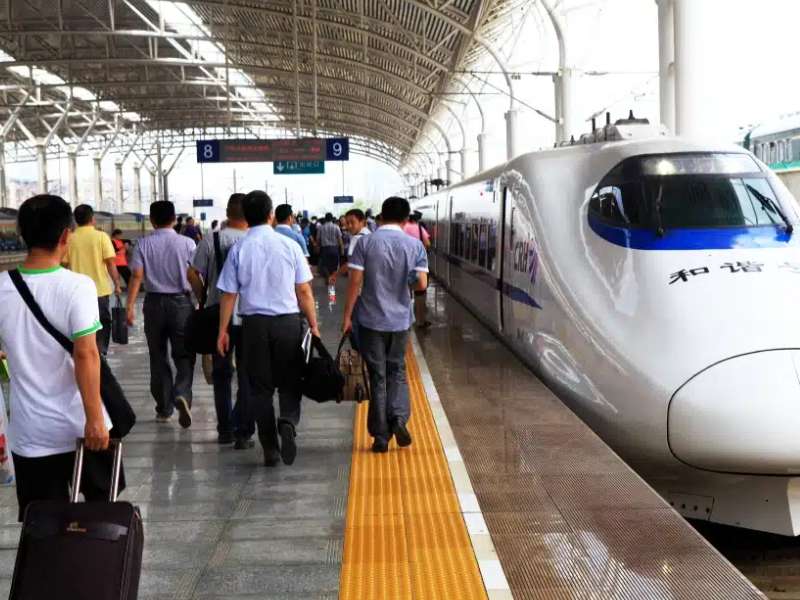
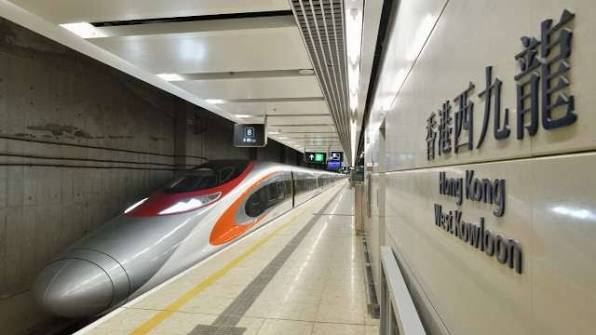
China’s high-speed rail terminus is located at Hong Kong West Kowloon Station—the world’s largest underground railway station.

It has 15 platforms serving both long- and short-distance routes. From West Kowloon, you can reach over 100 stations across Mainland China without changing trains, covering 58 cities including Shenzhen, Guangzhou, Beijing, Shanghai, Chongqing, Hangzhou, Guilin, Kunming, Tianjin, Wuhan, Xiamen, Zhengzhou, and Chaoshan.

There are 70 train pairs each weekday, and more than 110 pairs on weekends and holidays. The ride to Shenzhen takes just 14 minutes, while the fastest services to Beijing take about 7 hours and 30 minutes.

Destination

Types of Trains

Drive time

Daily Train Schedule

Shenzhen (Futian)

High-speed rail (G-prefix)

About 14 minutes

Frequent departures, almost every 10 minutes

Guangzhou

High-speed rail (G-series)

About 47 minutes

Frequent departures, almost every 30 minutes

Xiamen

High-speed rail (G prefix)

About 4 hours

Frequent departures, 4 to 5 departures daily

Chaoshan

High-speed rail (G-series)

About 2 hours 23 minutes

Frequent departures, almost every hour

Hangzhou

High-speed trains (G-series), overnight sleeper EMU trains (D-series)

About 7 hours

1 to 2 departures daily

Shanghai

High-speed rail (G-prefix), overnight sleeper EMU (D-prefix)

About 8 hours

1 to 2 departures daily

Beijing

High-speed trains (G-series), overnight sleeper EMU trains (D-series)

About 8 hours

1 to 2 departures daily

High-Speed Rail Route Map

China High-Speed Rail Luggage Rules

China High-Speed Rail travel time (fastest time)

West Kowloon High-Speed Rail Station to Shenzhen Futian Station

About 14 minutes

West Kowloon Station to Shenzhen North

About 18 minutes

West Kowloon Station to Guangzhou South Station

About 47 minutes

West Kowloon Station to Guangzhou East Station

About 1 hour 42 minutes

West Kowloon Station to Dongguan

About 1 hour 7 minutes

West Kowloon High-Speed Rail Station to Chaoshan Station

About 2 hours 23 minutes

West Kowloon High-Speed Rail Station to Guilin West Station

About 3 hours 20 minutes

West Kowloon Station to Wuhan Station

About 4 hours 30 minutes

West Kowloon Station to Xiamen Station

About 3 hours and 52 minutes

West Kowloon Station to Shanghai Hongqiao Station

About 7 hours 45 minutes

West Kowloon Station to Beijing West

About 8 hours 45 minutes

West Kowloon Station to Tianjin West Station

About 10 hours

🎁 Book Cheapest Flights Worldwide | Search Best Hotels | Get fast & reliable eSIM.

China High-Speed Rail Baggage Regulations: Dimensions, Weight, and Storage Locations

Unlike flying, when you take the High-Speed Rail you’ll need to carry your luggage onto the train yourself, so the railway authority imposes strict limits on luggage size and weight:

Baggage Type

Rules and Restrictions

Baggage Dimensions

The sum of the external dimensions (length + width + height) of each piece of baggage must not exceed 130 centimeters.

Baggage Weight Limit

Adults: 20 kg Children (including children riding free): 10 kg Diplomatic personnel: 35 kg

Mobility aids

Folding wheelchairs and folding strollers, such as those used by seniors, pregnant women, and people with disabilities, may be carried free of charge and do not count toward the baggage allowance above.

※ The combined weight of the equipment and the user must not exceed 200 kilograms, and equipment dimensions are limited to 120 centimeters (length) x 70 centimeters (width).

Luggage storage area

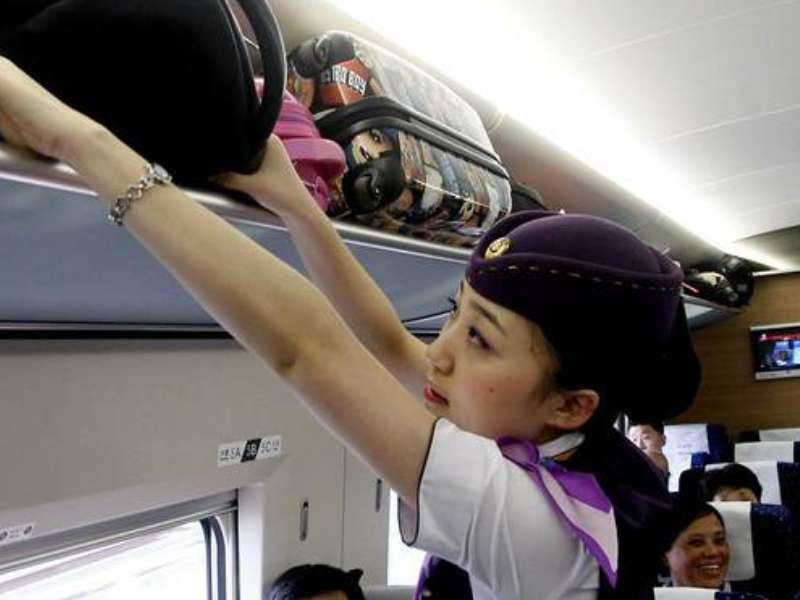
Large luggage: Stow it in the dedicated large-luggage storage area by the door of the train car. Carry-on items: Place them on the overhead rack above your seat.

Prohibited Items, Aerosols, and Duty-free Allowances for Tobacco and Alcohol

HSR limits

It’s not just about luggage size, the everyday items below also come with strict rules at border control; if you're not careful, they could be confiscated on the spot:

1. Aerosol sprays (sunscreen/hydrating mist/hair spray)

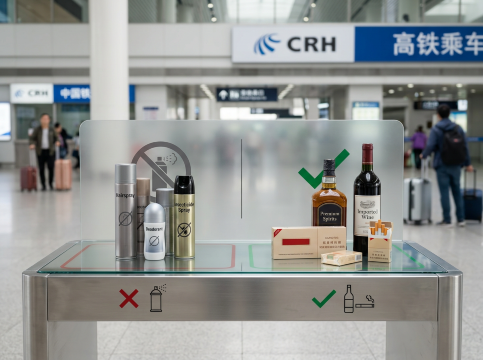
  • Restrictions: Aerosol cans containing flammable ingredients (such as sunscreen spray, hydrating mist, hair spray, deodorant, etc.) must be in individual containers no larger than 100 milliliters, and you may carry only one item per type.
  • Trip.com Tip: We recommend bringing lotion-based sunscreen or skincare products instead to avoid having them confiscated during security screening at West Kowloon Station due to volume limits.

2. Perfume and Nail Polish

  • Restriction: The total amount you carry must not exceed 50 milliliters.

3. Dangerous items and sharp objects (strictly prohibited)

  • Restrictions: To keep everyone safe, any flammable or explosive items, corrosive or radioactive materials, and infectious substances are not permitted. In addition, sharp objects such as nail clippers, scissors, fruit knives, and other pointed tools are considered dangerous items and are strictly prohibited on board.

4. Animals and Pets

  • Restriction: To keep train cars clean and safe, all live animals (including cats, dogs, pet birds, etc.) are not permitted on board the high-speed rail.
  • Exception: Visually impaired passengers may bring guide dogs wearing a guide harness on board, but must present the relevant certification when traveling.

5. Duty-free tobacco and alcohol entry allowances (inbound/outbound comparison chart)

Whether you're heading to Mainland China or returning to Hong Kong, there are duty-free allowances for tobacco and alcohol when you cross the border, so be sure to check the latest rules:

  • Duty-free cigarette allowance:
    • Hong Kong ➔ Mainland China: Hong Kong and Macau residents, as well as frequent cross-border travelers (entering more than once within 15 days), are limited to carrying 200 cigarettes (1 carton) per trip and are not eligible for duty-free allowances; other travelers may bring up to 400 cigarettes (2 cartons) duty-free per trip.
    • Mainland ➔ Hong Kong: On your return to Hong Kong, each traveler may bring in up to 19 duty-free cigarettes.
  • Duty-free alcohol allowance:
    • Hong Kong ➔ Mainland China: Hong Kong and Macao residents may bring in 1 duty-free bottle (750 ml or less, 12% ABV or higher) of alcoholic beverages per trip; frequent cross-border travelers are not eligible for the duty-free allowance.
    • Mainland China ➔ Hong Kong: On your return to Hong Kong, each traveler may bring in up to 1 liter (alcoholic beverages) duty-free.
Check China Notable Hotel Prices
BEIJING
SHANGHAI
HONGKONG
SHENZHEN
See All Hotels

🔥Exclusive Hotels Deal: Up to 10% OFF for New Users

Discover the world with Trip.com! Book the perfect hotel anywhere in the world and get an unbeatable 10% discount if you're a first-time user! Download our app now and start planning your next trip with ease.

Just click this link and download the Trip.com App, after successfully registering as a member, use it when you place an order!
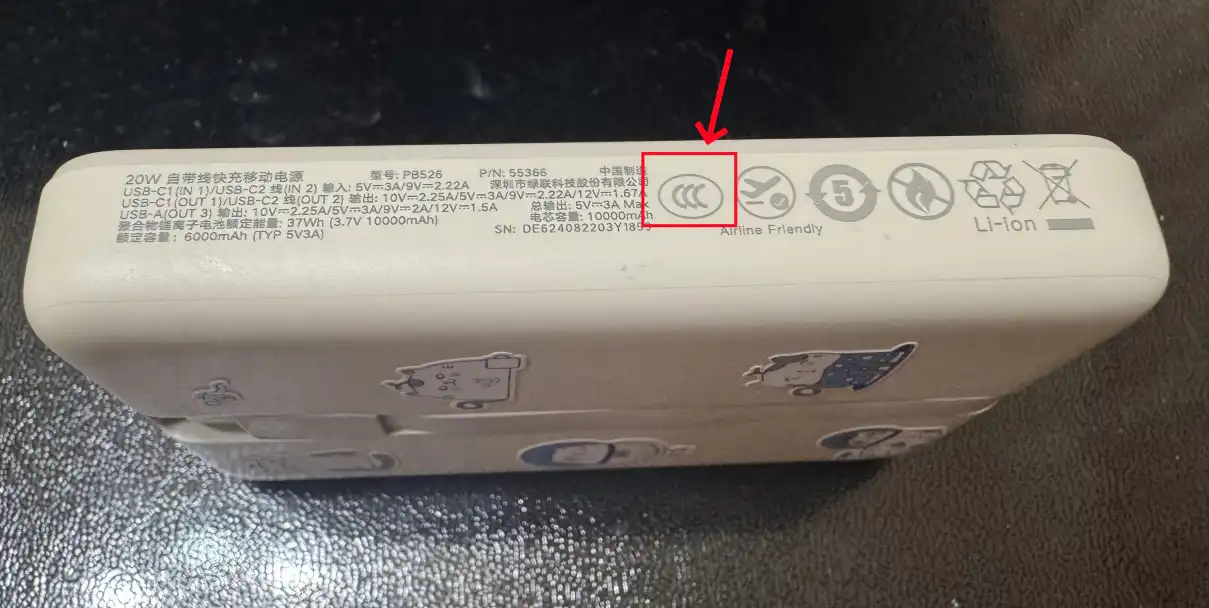
China High-Speed Rail Power Bank Restrictions: Can You Bring a Portable Charger?

China Power Bank 3C Certification

The answer is yes but with very strict limits on capacity and specifications!

Just like when you fly, high-speed rail has very strict screening for "power banks" (portable chargers/power banks). The latest security screening standards for 2026 are as follows, please review them one by one before you go:

1. Rated energy limit: cannot exceed 100Wh

High-Speed Rail rules state that the rated energy of any single power bank you bring on board must not exceed 100Wh.

  • How do you convert it? For example, using the common 5V voltage, 100Wh is approximately equal to 27,000mAh.
  • Buying tip: Standard 10,000mAh or 20,000mAh power banks usually breeze through security. But if you’re carrying a 30,000mAh or larger high-capacity model, there’s a good chance it won’t make it past security at West Kowloon Station and you won’t be allowed to bring it on the train.

2. Labeling must be clear

This is the detail travelers most often overlook! The casing of your portable charger must have a clear, complete, and undamaged manufacturer label, and it must clearly display:

  1. Brand and Model
  2. Rated capacity (shown in mAh or Wh)
  3. Input and output voltage
⚠️ Heads up: If a label is worn out, the text has rubbed off to the point it’s unreadable, or there’s no label at all (i.e., uncertified products without proper labelling), security screeners will treat it as a hazardous item and confiscate it.

3. 2026 New Regulations: About 3C Certification and QR Codes

Mainland China has officially implemented new CCC (3C) certification rules for power banks, requiring all newly manufactured power banks to print a "traceability QR code" (digital ID) next to the 3C mark for scanning to verify product specifications and certification status. The transition period will continue until March 2027, when the rules take full effect.

  • Current high-speed rail security screening update: For now, checks still mainly use the "100Wh capacity limit" and "clear labeling" as the inspection criteria, and there’s no mandatory requirement yet for all older power banks (portable chargers) to have a printed QR code in order to board the train.
  • Tips for buying a new power bank: If you’re planning to buy a new power bank for trips to mainland China soon, prioritize models with 3C (CCC) certification and a printed traceability QR code to get through customs without a hitch for the next few years.

4. Quantity and Carrying Methods

  • Quantity limit: We recommend each person carry no more than 2 items to stay within the "reasonable scope for personal use".
  • No checking in: Just like on flights, power banks on the High-Speed Rail must be carried with you; placing them in the hold or in checked baggage is strictly prohibited.

China High-Speed Rail Baggage Restrictions & Luggage Storage

High-Speed Rail Baggage Restrictions, Hong Kong High-Speed Rail Baggage Storage

Travelling with large suitcases or shopping bags? Some major railway stations in China offer luggage storage services, allowing you to leave your bags temporarily while exploring the city.

Here are a few stations where you can check for luggage storage:

Railway station

City

Luggage service

Beijing South Railway Station (北京南站)

Beijing

Luggage storage counters and railway luggage services

Beijing West Railway Station (北京西站)

Beijing

Luggage storage and Easy Travel luggage transfer

Shanghai Hongqiao Railway Station (上海虹桥站)

Shanghai

Luggage service centre and storage facilities

Hangzhou East Railway Station (杭州东站)

Hangzhou

Luggage service lockers and transfer services

Guangzhou South Railway Station (广州南站)

Guangzhou

Luggage service lockers and transfer services

Shenzhen North Railway Station (深圳北站)

Shenzhen

Luggage service lockers and transfer services

Chengdu East Railway Station (成都东站)

Chengdu

Luggage storage and transfer services

Hong Kong West Kowloon Station

Hong Kong

Staffed luggage storage and self-service lockers

China Railway's Easy Travel (轻装行) service also operates at selected stations, offering luggage collection and delivery between hotels or other addresses and railway stations. Reservations can be made through the 12306 app or WeChat mini-program.

Tips for Singaporean Travellers:

  • Look for the Chinese sign 行李寄存 (luggage storage) at railway stations.
  • Bring your passport for identification when using staffed storage counters.
  • Check opening hours, storage fees and collection deadlines before leaving your bags.
  • Don't assume every station has public lockers. Some railway luggage services require a valid train ticket and advance booking.
💡 Pro Tip: Activate your China eSIM before leaving the airport so you can access maps, hotel bookings, and transport apps right away.

China High-Speed Rail Station Transportation Guide

Hong Kong High-Speed Rail Transportation Guide

MTR

From anywhere in Hong Kong, take the Tuen Ma Line to Austin Station or the Tung Chung Line to Kowloon Station to connect straight to Hong Kong West Kowloon Station

Airport Express

From the airport, hop on the Airport Express to Kowloon Station, then connect to Hong Kong West Kowloon High-Speed Rail Station

Bus

You’ll find multiple bus routes connecting West Kowloon Station with neighborhoods across Hong Kong Island, Kowloon, and the New Territories, including late-night bus routes. Citybus: 20A, among others; for other routes, please check the Transport Department or MTR official website before you set out for the latest information.

Taxi

West Kowloon Station has a taxi pick-up and drop-off area

Drivers

West Kowloon Station has a parking garage, and you can also use the nearby Elements parking garage at Kowloon Station. Parking is charged by the hour or by the day

🔥Get 3% Off Your First Train Ticket Booking!

As a special treat, Trip.com is offering a 3% discount on your first train ticket booking. Simply claim your coupon and enjoy a seamless travel experience.

China High-Speed Rail Boarding Process for Singaporeans

China High-Speed Rail Luggage Rules

Hong Kong West Kowloon Station uses a "co-location" border-check model, letting travelers complete Hong Kong exit and Mainland China entry procedures all at once on the same floor—it’s super convenient! To make your journey even smoother, Trip.com has laid out 4 key steps for boarding the high-speed rail.

⏱️ When to arrive for your train: How early should you get to the station?

  • On regular days: We recommend arriving at West Kowloon Station 45 to 60 minutes before your train departs to complete the formalities.
  • On holidays or if you're traveling with a passport: Due to heavier crowds or the need to clear a staffed checkpoint, please allow at least 90 to 120 minutes.
  • Note: Passengers may enter the gates as early as 120 minutes before departure.

🚶 China High-Speed Rail Four-Step Border Clearance Process

Step 1: ID verification and ticket check for gate entry (B1 Level Ticketing Concourse)

After you arrive at the B1 Level, have your Home Return Permit, passport, or e-ticket ready, then head straight to the self-service gates or a staff-assisted counter. In one quick step, you'll complete both "ID verification" and "ticket check" and breeze through the gates.

Step 2: Baggage security screening (B1 Level Ticketing Concourse)

Follow the signs to the security checkpoint for baggage and security screening.

Speedy security tip: While you're waiting in line, go ahead and put your phone, keys, coins, and other small essentials into your carry-on or suitcase so that when you pass through the scanner you won't have to fumble around, and you'll breeze through security even faster!

Step 3: Co-located immigration clearance for exit and entry (Departures Hall on Level B3)

Head downstairs to the Departures Hall on Level B3. You'll pass through two immigration checkpoints in a row on the same level:

  1. First, clear Hong Kong immigration and leave the Hong Kong border control area.
  2. Take a few steps forward, and you'll enter the Mainland China border control area to complete entry procedures.

Step 4: Boarding (B3 Level Concourse ➔ B4 Level Platform)

Once you've cleared immigration on both sides, you'll enter the waiting hall. Keep an eye on the screens in the hall for boarding gate information:

  • Ticket gate hours: The gates open 15 minutes before the train departs.
  • Gate closing time: The gates close exactly 5 minutes before departure; if you're late, you won't be able to board.
  • Once the gates open, scan your ticket or boarding QR code to enter, then head down to the B4-level platform to hop on and set off!
High-Speed Rail Baggage Restrictions, Hong Kong High-Speed Rail Boarding Procedures
💡 Pro Tip: Midweek flights are often cheaper. Try flying to China on a Tuesday or Wednesday to get better deals on Trip.com.

Tips for Singaporeans Travelling with Luggage on China High-Speed Rail

China High-Speed Rail Luggage Rules

Flying from Singapore to China and continuing your journey by high-speed rail? Before packing, remember the train luggage rules different from airline baggage allowances.

Here are some practical tips to make your journey easier.

1. Check Your Suitcase Dimensions Before Leaving Singapore

China's high-speed rail has specific luggage size and weight limits. Measure your suitcase before your trip, including its wheels and handles.

Luggage requirement

Standard allowance

Adult passenger

20kg in total

Child passenger

10kg in total

Maximum weight per item

20kg

Maximum dimensions per item

130cm (length + width + height)

For example, a suitcase measuring 70cm × 45cm × 15cm has a combined dimension of 130cm, which is within the limit.

These are the standard free luggage allowances for Mainland China high-speed trains.

2. Pack Light if You're Visiting Multiple Cities

If you're planning a multi-city trip such as Shanghai, Hangzhou, Suzhou and Beijing, avoid bringing too many large suitcases. This makes it easier to move between railway stations, hotels and city attractions.

Consider these packing tips:

  • Bring one medium-sized suitcase and a small backpack per person.
  • Use packing cubes to organise clothes and personal belongings.
  • Keep frequently used items such as your passport, phone and wallet in a smaller bag.
  • Leave some space for souvenirs and shopping purchases.

3. Keep Your Valuables in Your Hand Luggage

Unlike checked baggage on a flight, your luggage stays with you throughout the train journey. Avoid placing valuables in large suitcases stored away from your seat.

Keep important belongings in a small bag that you can carry with you, including:

  • Passport and travel documents
  • Wallet, cash and bank cards
  • Phone and power bank
  • Camera and other electronics
  • Medication and essential personal items

4. Check Power Bank and Toiletry Restrictions

Singaporeans often pack power banks, sunscreen sprays, perfume and other toiletries for their holidays. However, China railway security rules may differ from what you're used to at Changi Airport.

Pay particular attention to:

  • Power banks and lithium batteries, which must meet railway requirements and have clear capacity markings.
  • Pressurised sprays such as sunscreen and hairspray, which have quantity restrictions.
  • Perfume and certain flammable liquids, which may also have limits.
  • Flammable, explosive and other dangerous substances, which are prohibited.

For example, Shanghai's published 2026 guidance sets a 100Wh limit for power banks and quantity limits for certain aerosols and flammable household products. Check the latest rules before travelling, as restrictions can be updated.

5. Check Luggage Delivery Service for Heavy Bags

If you're travelling with several large suitcases, check whether your departure or arrival station offers a luggage delivery service.

Some major Chinese railway stations offer luggage collection and delivery services, allowing passengers to send bags between their accommodation and the station. Availability, booking windows and charges vary by station.

This can be useful if you're travelling with children, elderly family members or shopping bags.

💡 Pro Tip: Book your hotels in China early, especially during weekends or festivals. Prices rise fast, and early bookings on Trip.com often come with extra discounts.

FAQs: China High-Speed Rail Luggage Rules

Disclaimer: This article has been provided by an individual contributor or third party platform. If there is any discrepancy regarding the copyright, please contact us directly and we will delete the content immediately.
Alex

Alex

Asia Explorer

View profile

Hi, I’m Alex! I started travelling as a way to take a break from my busy work life, but over the years, it became my passion. From weekend getaways around Asia to longer journeys exploring different cities, I love researching hidden gems, trying local food, and creating practical travel plans. Through my travel guides, I hope to share tips and useful recommendations to help fellow travellers plan meaningful adventures.

89 articles
Asia Travel Travel Planning Hidden Gems
> >
China High-Speed Rail Luggage Rules