China Train Food Guide: How to Order Food on Trains
By Leona
August 13, 2026
For Singaporeans travellers, high-speed rail is often far more convenient than short-haul domestic flights, but many first-time visitors arrive unaware of how to source food mid-journey. This guide breaks down every dining method on China train.
🔥Get 3% Off Your First Train Ticket Booking!
As a special treat, Trip.com is offering a 3% discount on your first train ticket booking. Simply claim your coupon and enjoy a seamless travel experience.

If you do not wish to plan ahead and pre-order meals, all modern G-series high-speed trains carry onboard food stock, available through four easy channels.
All onboard outlets accept Alipay and WeChat Pay; cash Chinese Yuan is legal tender but crew rarely carry small change for large notes. International credit cards cannot be swiped directly on trolleys, though you may link them to your Alipay account before travel for seamless payment.
1. Dining Carriage
Most long-distance high-speed trains position their dining carriage at Coach 5 or Coach 9, fitted with shared tables, window seating and full refreshment counters. Short-distance shuttle trains may operate a compact snack bar with limited seating instead of a full dining room.
What’s sold: Microwaved pre-packaged rice boxes, freshly stir-fried noodles (on premium intercity lines), dumplings, congee, instant noodles, beer, soft drinks, bottled water and fruit cups.
Price bracket:
Basic rice box meals: ¥15 (S$2.85) – ¥38 (S$7.22)
Premium stir-fry set meals: ¥48 (S$9.12) – ¥65 (S$12.35)
Instant noodles, bottled water and small snacks: ¥5 (S$0.95) – ¥28 (S$5.32)
Tips for Singapore travellers:
Seating operates on a first-come, first-served basis; crew expect all table occupants to purchase at least one item.
You may buy food in the carriage and carry it back to your seat to avoid crowding the dining area during peak lunch (11:30–13:30) and dinner (17:30–20:00) windows.
Halal meal options are available on request on major routes; speak to dining staff early to reserve as stock is limited.
2. Railway QR Code / 12306 App Train Self-Operated Orders
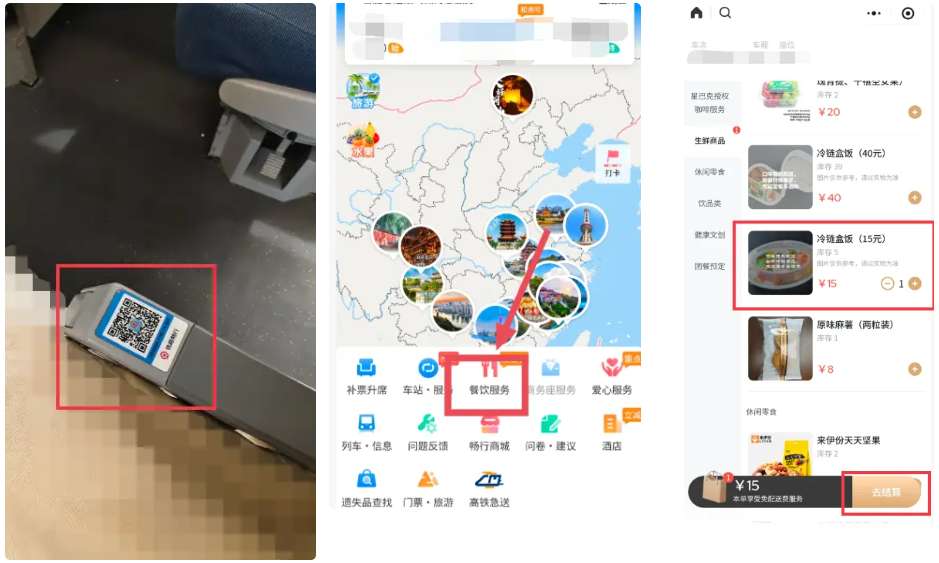
Every passenger seat armrest features a printed “Railway Travel QR Code”, scannable via WeChat or Alipay. You may also open the official 12306 mobile application and navigate to the tab marked “Catering & Specialities”, then select “Train Self-Operated” to browse onboard stock.
Pros: Order delivered straight to your seat without walking to the dining carriage; browse all available stock digitally.
Cons: The app frequently displays items as “out of stock” even when meals remain available in the train kitchen, a common pain point reported by foreign tourists.
Step-by-step ordering flow:
Scan seat QR code or log into 12306 app with your ticket details. Select “Train Self-Operated” (in-train stock, not station takeaway).
Add rice boxes, drinks or snacks to cart and complete payment via e-wallet.
Crew deliver your order to your designated carriage and seat number within 20–40 minutes during mealtimes.
3. Ask Train Attendants Directly
If the 12306 app marks all meals as unavailable, locate uniformed train stewards either walking the aisles or stationed near carriage restrooms. Crew maintain physical stock lists of heated box meals stored in train ovens that the digital platform fails to update in real time.
4. Mobile Food Trolleys
Stewards wheel snack and meal trolleys through every carriage at regular intervals throughout the journey, stocked with identical pre-packaged meals, soft drinks and instant noodles sold in the dining carriage. Best for short journeys under two hours where you do not want to leave your seat.
💡 Pro Tip: If you’re travelling onwards to other cities in China, consider using China high-speed rail. It's fast, comfortable, and efficient!
Option 2: Station Takeaway Delivery Service via 12306 (Train Seat Delivery)
One of the most popular premium catering features on China’s G and D high-speed trains is station-to-seat food delivery, exclusive to large transport hubs such as Shanghai Hongqiao, Beijing South, Nanjing South and Guangzhou South. Slow K/T/Z regular trains and small regional stations do not support this service.
This option lets you order food from well-known international chains (McDonald’s, KFC, Burger King) and local Chinese specialty restaurants, with couriers passing meals to train crew during brief station stops, who then deliver directly to your seat.
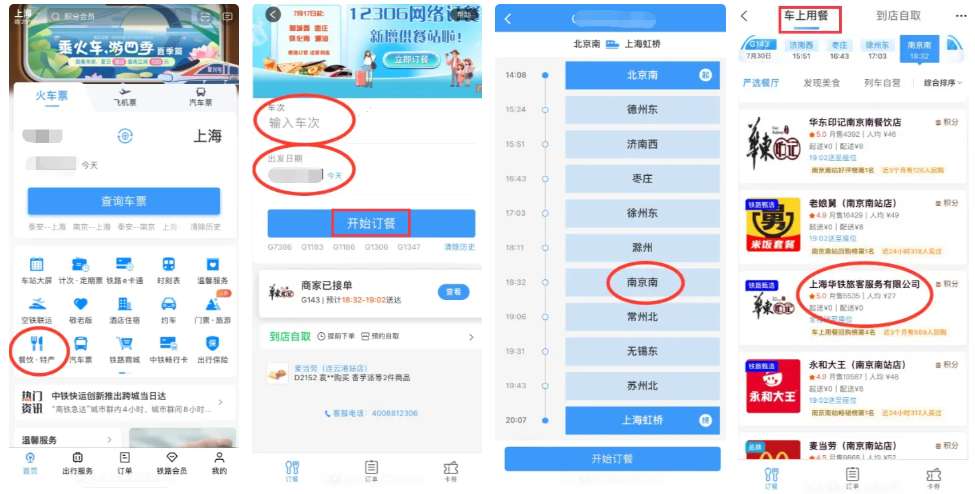
How to Order Food?
Launch the 12306 mobile app and tap the fork-and-knife “Catering & Specialities” icon on the homepage.
Enter your train number, travel date and tap “Start Ordering”.
Pick an upcoming major station your train will stop at from the journey timeline.
Browse listed restaurants, filter by Western fast food or local regional dishes, add meals to cart.
Complete payment via Alipay/WeChat Pay; no cash payment accepted for pre-orders.
Remain seated: station couriers hand food to onboard staff during the stop; crew bring meals to your seat.
Cost & Timing
Mandatory advance order window: Place your order at least 1.5–2 hours before your train arrives at the selected delivery station to guarantee preparation and handover.
Fixed delivery surcharge: ¥8 (S$1.52) per order, added to every transaction regardless of meal quantity.
Price comparison: Station takeaway meals cost roughly 30–50% more than equivalent food bought outside station gates, making it a premium choice suited for business travellers claiming corporate expenses rather than budget holidaymakers.
Station stop durations average only 2–5 minutes: Never attempt to step off the train to collect food yourself; you risk missing departure.
Option 3: Packing Your Own Food
Most regular Chinese passengers skip onboard catering entirely and bring their own food to cut costs, a trick highly recommended for Singaporean visitors watching travel budgets. Train meals carry a steep markup, while supermarket-bought sealed snacks and light meals cost a fraction of onboard prices.
Where to Buy Cheap Supplies Near Train Stations?
Avoid convenience shops inside station paid waiting halls, which inflate prices by nearly 100%. Instead:
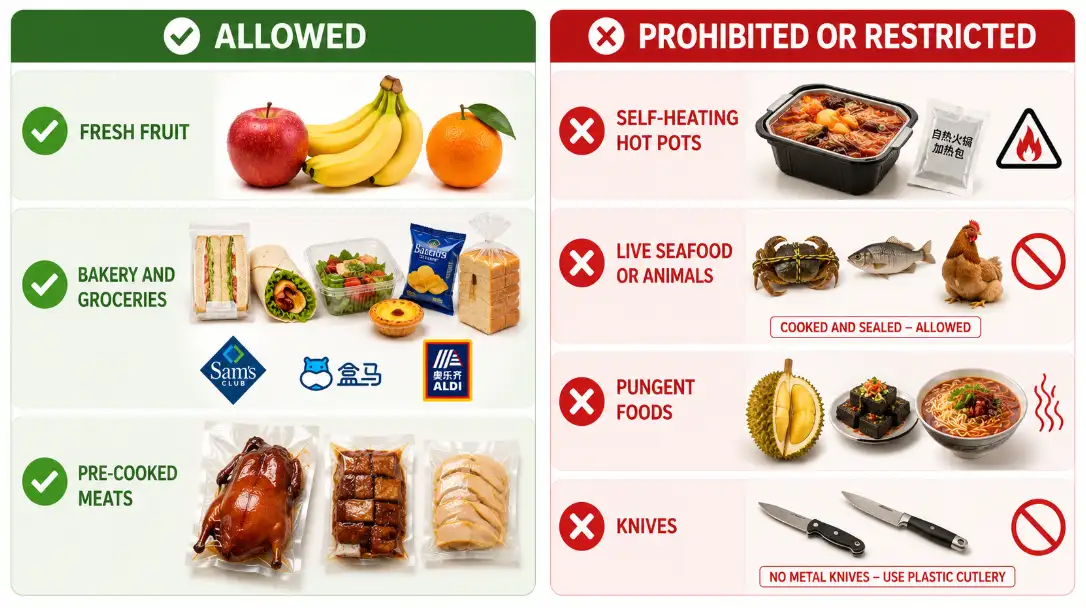
Shop at major supermarkets just outside station main gates (Hema Fresh, ALDI, Sam’s Club) – prices match standard city retail rates.
Underground metro malls connected to railway terminals host affordable snack, bakery and fruit stalls with no station premium.
Recommended Travel-Friendly Food
Opt for sealed, low-odour, spill-proof items that comply with carriage etiquette rules and pass security scanners without issue:
Fresh, easy-peel fruit: apples, bananas, oranges (pre-slice fruit at your hotel to avoid carrying metal knives).
Railway security screening mirrors airport-level checks, with non-compliant items confiscated before boarding. Rules split into fully prohibited and etiquette-restricted categories:
Fully Confiscated at Security
Self-heating hot pots/rice: Chemical heating packs pose fire hazards and trigger train smoke detectors, risking emergency speed reductions. No exceptions permitted.
Live seafood, poultry or animals: Live crabs, fish and chickens are banned; fully cooked, vacuum-sealed seafood is allowed.
Metal knives and sharp cutlery: Fruit knives, pocket blades and metal cutlery will be seized. Bring disposable plastic utensils only.
Strongly Discouraged (Etiquette Ban, May Lead to Crew Intervention)
While durian, stinky tofu and luosifen (river snail noodles) may pass scanners, their potent, lingering aromas violate carriage courtesy rules in sealed air-conditioned cabins. Crew will ask you to discard these items or move to the open-air carriage connection space to consume them, creating an awkward travel experience.
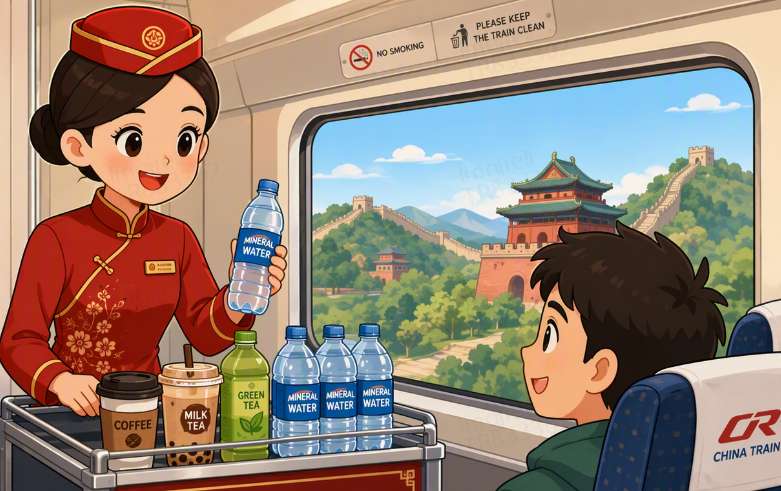
Drinks on China Train (Hot Water, Bottled Beverages & Alcohol Rules)
Free Hot Water Dispensers
Every train carriage features unlimited free boiling water taps located adjacent to restrooms, accessible 24 hours a day. Singapore travellers should pack insulated travel flasks to brew tea, instant coffee or prepare cup noodles without purchasing bottled hot drinks onboard. This is the most cost-effective refreshment hack for long journeys.
Bottled Water & Soft Drinks
Outside station supermarkets: ¥2 (S$0.38) mineral water bottles.
Inside station waiting halls: ¥5 (S$0.95) for identical bottles (double markup).
Train trolley/dining carriage: ¥6–¥10 (S$1.14–S$1.90) bottled water and canned soft drinks. Top tip: Stock up on all water and cold drinks before passing station security gates to avoid inflated onboard pricing.
Alcohol Carriage Restrictions
Factory-sealed alcoholic beverages are permitted, with strict volume and ABV limits enforced at security:
Total sealed alcohol limit: Maximum 3,000ml per passenger.
Spirits over 50% ABV (high-proof baijiu): Capped at two unopened bottles per person.
Unlabelled, bulk homemade rice wine or opened alcohol bottles: Fully confiscated. Drinking alcohol onboard is allowed, but disruptive intoxication resulting in complaints from fellow passengers will lead to intervention by railway staff.
Food by Train Class: Business, First & Second Class
Ticket Class
Complimentary F&B Amenities
Paid Catering Pricing
Best For Singapore Travellers
Business Class (商务座)
Free premium box meals during lunch/dinner, unlimited snacks, bottled tea and juices delivered by dedicated stewards; all refreshments included in ticket fare
No extra food costs
Business travellers with expense claims, long cross-country trips over 5 hours
First Class (一等座)
Small complimentary snack pack (nuts, biscuits, mini bottled water) at boarding; no full hot meals included
Matches standard onboard menu rates (¥15–¥65 / S$2.85–S$12.35)
Short luxury trips, travellers seeking extra space without full business fares
Second Class / Standing Ticket
Zero complimentary food or drinks; full access to trolleys, dining carriage and 12306 pre-order service
Base rice boxes start at ¥15 (S$2.85); station delivery adds S$1.52 surcharge per order
Budget Singapore holidaymakers, most common ticket tier for leisure travel
Can I pay for train food using Singapore credit cards directly?
No physical card terminals accept foreign credit cards on trolleys or dining carriages. Link your international card to Alipay before arriving in China to complete digital payments, or carry sufficient Chinese Yuan cash for small onboard purchases.
Do all high-speed trains offer station-to-seat takeaway delivery?
Only G and D bullet trains stopping at major tier-1 and tier-2 city hubs qualify. Regional short-distance trains and older K/T/Z regular trains do not support this service; verify availability on the 12306 app after boarding.
Are vegetarian or halal meals easy to source onboard?
Limited pre-packaged vegetarian rice boxes are stocked in dining carriages, and halal stir-fries can be requested from kitchen staff in advance. For consistent dietary options, pre-order Western vegetarian meals via the station takeaway delivery service.
Are train meal prices fixed year-round?
Menus and pricing adjust marginally during peak travel seasons (Chinese New Year, summer school holidays), with surcharges of up to ¥10 (S$1.90) on premium set meals. Budget travellers are advised to pack their own supplies during busy holiday windows.
Disclaimer: This article has been provided by an individual contributor or third party platform. If there is any discrepancy regarding the copyright, please contact us directly and we will delete the content immediately.