

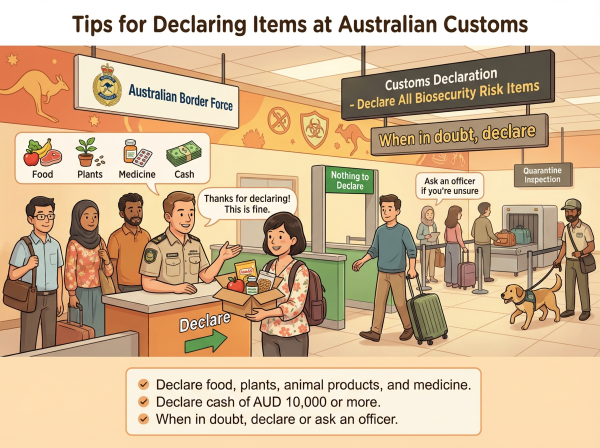
Planning a trip to Australia in 2025? Whether you’re arriving for work, study, or holiday, it’s important to know what you can and cannot bring into the country. Australia has strict biosecurity and customs laws to protect its environment, agriculture, and local industries.
This guide breaks down the essentials for travelers entering Australia.
Items You Can Bring Into Australia (Declare if Required) And Items You Cannot Bring Into Australia
Some items are allowed but must be declared on your Incoming Passenger Card (IPC). Officers may inspect them before approval. Certain items are strictly prohibited due to biosecurity risks, safety concerns, or legal restrictions.
Category | Allowed ✅ | Restricted ⚠️ (Declare & Check) | Prohibited ❌ |
|---|---|---|---|
Food & Drinks | - Baby food & formula (reasonable quantity) - Cooked or commercially packaged food (sealed snacks, chocolates, canned food) | - Some dairy, meat, and processed food (must declare, often confiscated) | - Fresh fruit, vegetables, eggs - Fresh, dried, or frozen meat and dairy |
Medication | - Personal medication with doctor’s prescription, in original packaging | - Large quantities may need prior approval | - Illicit drugs & controlled substances |
Personal Goods | - Clothes, electronics, cameras, and personal items for personal use | - High-value goods above duty-free allowance may attract tax | - None (unless counterfeit or illegal items) |
Tobacco & Alcohol | - Duty-free: 25 cigarettes (or 25g tobacco) + 2.25L alcohol per adult (18+) | - Extra amounts must be declared and taxed | - Unreported quantities above the allowance |
Plants & Animals | None | - Some processed plant/animal products may require permits | - Seeds, nuts, live plants, soil - Live animals, birds, reptiles, insects |
Other Items | - Travel essentials, souvenirs (duty-free within limits) | - Firearms, weapons, and explosives (allowed only with prior permits) | - Firearms, weapons, explosives without permits |
🛃 Tips for Smooth Entry into Australia

Always declare items on your Incoming Passenger Card, when in doubt, declare
Always declare items on your Incoming Passenger Card, when in doubt, declare them. Even if you’re unsure whether something is restricted, it’s better to list it than risk fines or confiscation.
Customs officers may simply inspect the item and allow it if it’s safe, but failing to declare can lead to penalties of up to thousands of dollars or even prosecution. Declaring shows honesty and helps you avoid unnecessary trouble at the border.
Check the official Australian Border Force (ABF) and Department of Agriculture, Fisheries and Forestry (DAFF) websites before you travel
Check the official Australian Border Force (ABF) and Department of Agriculture, Fisheries and Forestry (DAFF) websites before you travel. These government sites provide the most up-to-date information on what you can and cannot bring into Australia.
Rules may change depending on biosecurity risks, global health concerns, or updated customs regulations. By checking ahead, you’ll save time at the airport, avoid fines, and make sure you’re fully compliant with Australian entry requirements.
Keep receipts or documentation for valuables like jewelry or electronics
Keep receipts or documentation for valuables like jewelry or electronics. When bringing high-value items into Australia, customs officers may ask for proof of purchase to confirm they are for personal use and not for resale.
Having receipts or warranty documents on hand helps you avoid unnecessary delays or questions at the border. It also makes it easier if you need to declare the items or prove their value for insurance purposes while traveling.
Avoid bringing homemade food or fresh produce, it will almost always be confiscated
Avoid bringing homemade food or fresh produce—it will almost always be confiscated. Australia has very strict biosecurity laws to protect its agriculture and environment from pests and diseases.
Items like cooked meals prepared at home, fresh fruits, vegetables, and other perishable goods are not allowed. Even if you pack them carefully, they are almost certain to be taken away at customs.
To save time and avoid penalties, stick to sealed, commercially packaged snacks if you want to bring food.
Instant foods you can and cannot bring into Australia in 2025
| Category | Examples | Allowed? | Notes |
|---|---|---|---|
✅ Safe to Bring | Cup noodles (plain/vegetarian, sealed) | Yes | Must declare; no meat, seafood, or egg bits |
✅ Safe to Bring | Instant coffee, tea bags, 3-in-1 sachets | Yes | Sealed and commercially packaged |
✅ Safe to Bring | Chocolates, biscuits, candies | Yes | Sealed packs only |
✅ Safe to Bring | Powdered milk, baby formula | Yes | Sealed tins/packaging; for personal use |
✅ Safe to Bring | Packaged snacks (chips, crackers, energy bars) | Yes | Must be sealed |
❌ High-Risk | Cup noodles with meat, seafood, or egg flavoring | No | Likely to be seized by biosecurity |
❌ High-Risk | Fresh or homemade noodles | No | Not allowed |
❌ High-Risk | Instant meals with dried meat/fish/dairy | No | Must be declared, usually confiscated |
❌ High-Risk | Herbal soups or broth mixes with animal products | No | Restricted ingredients |
❌ High-Risk | Opened or unsealed food packets | No | Not allowed into Australia |
✈️ Conclusion

Australia takes biosecurity and customs regulations seriously. By knowing what you can and cannot bring in 2025, you’ll avoid fines, delays, and stress at the airport.
Declare all items, follow the rules, and enjoy a smooth arrival in Australia.
FAQ: Australia Customs Restrictions 2025
Can I bring snacks into Australia?
Yes, sealed and commercially packaged snacks like chips or chocolates are usually allowed, but you must declare them.What happens if I don’t declare items?
You may face on-the-spot fines (up to AUD 3,000) or prosecution for serious breaches.Can I bring cash into Australia?
Yes, but if you’re carrying AUD 10,000 or more, you must declare it at customs.