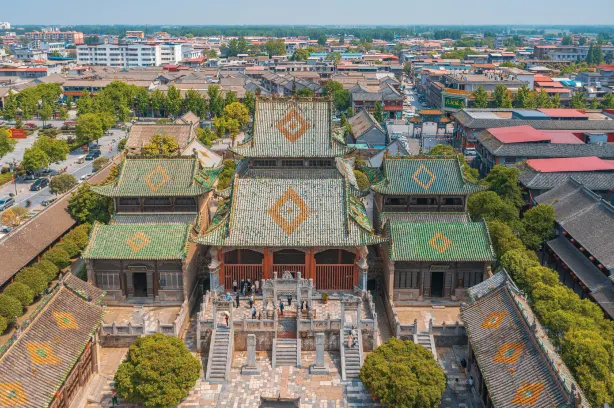
Sheqi

Things to do in Sheqi

Search attractions or local attractions & tours
Search

Explore top experiences

Top 10 attractions in Sheqi

View all Attractions
Sui And Tang Dynasties Luoyang City Yingtian Gate Site
No. 9 of Best Things to Do in Henan

Sui And Tang Dynasties Luoyang City Yingtian Gate Site

7.7
4.5/5
4.5k reviews

Yingtianmen is the south gate of Luoyang City Palace City in Sui and Tang Dynasties. It was built in the first year of Daye in Sui Dynasty, that is, in AD 605. It has gone through four periods of Sui, Tang, Five Dynasties and Northern Song Dynasty successively. The Jinbing was burnt and used for 523 years. Yingtianmen was an important place for holding major state celebrations and diplomatic activities at that time. If Yuanzheng, Winter Solstice, Chenle, banquets, pardoning sins, removing the old and clothing the new, when the tributary messengers of all countries, the guests of the four barbarians and other important celebrations, the emperors all came to listen to the government. Similar to the current Beijing Meridian Gate. This city gate has witnessed the prosperity of the dynasty when Emperor Yang Guang of Sui Dynasty entered the Eastern Capital, Emperor Gaozong of Tang Dynasty released King Fuyu of Baekje, the queen ascended the throne and became emperor, and Emperor Xuanzong of Tang received the eighth envoy from Japan to the Tang Dynasty. Every Shangyuan Festival, Yingtianmen Square will also hold a grand Baixi performance. When it is grand, the performance team will stretch from here to the main south gate of Guocheng, which is 4 kilometers away. Yingtianmen has different names in different periods: it was built in the early Sui Dynasty, according to the "Analects of Confucius", "Only the sky is the greatest, only Yao is the rule", taking the meaning of "taking the sky as the rule", so it is called "Zetianmen"; the first year of Tang Shenlong 705 During the reign of Emperor Zhongzong Li Xian of Tang Dynasty, after avoiding Wu, he was honored as "The Great Sage Emperor Zetian" and renamed Yingtianmen. During the Kaiyuan period of Emperor Xuanzong of the Tang Dynasty, this building was renamed Wufeng Building, and Wufeng Building was used until the Five Dynasties and Northern Song Dynasty. At the end of the Northern Song Dynasty, Jinbing invaded the Central Plains, Luoyang became a battlefield and was severely damaged. Jinbing burned down the building. The city of Luoyang in the Sui and Tang Dynasties, which was prosperous for more than 530 years, gradually faded out of people's sight. Yingtianmen is one of the buildings that can show identity and status in the Chinese etiquette system. "Yuan·Henan Chronicle" records: the main gate of the palace city is called Zetianmen, the gate has two views, the upper one is called Ziwei microscopic, the left and right are connected with the ques, and the ques are 120 feet high. Calculated at 29.4 centimeters per foot in the Tang Dynasty, equivalent to about 36 meters today, this magnificent tower is almost twelve or three stories high today. The Tang Dynasty poet Bai Juyi once looked south on Yingtianmen and wrote a poem: "Longmen Cui Dai Mei is opposite, Yishui Golden Line is a line". From Yingtianmen, you can see Longmen Yique, which is 15 kilometers away, showing the majesty of Yingtianmen.

China · Luoyang
Kaifeng Museum
No. 4 of Family-friendly Attractions in Henan

Kaifeng Museum

7.7
4.8/5
5.9k reviews

The Kaifeng Museum is a comprehensive museum integrating cultural relic collection, preservation, research, exhibition, and social education. It houses over 80,000 cultural relics, covering various categories such as pottery, porcelain, bronze ware, calligraphy and painting, stone carving, jade ware, and lacquerware. The museum was first established on Sansheng street in 1962, on the former site left after the Henan museum moved to Zhengzhou. The old museum by Baogong lake opened in 1988, and in March 2018, it relocated to its current new site. The new museum's layout draws inspiration from the triple-city design of Kaifeng during the Northern Song dynasty, consisting of an outer perimeter, a circular inner courtyard, and a central main structure. Following the principle of "classical exterior, modern interior," lower surrounding buildings embrace the towering central pavilion. From a distance, it appears as a Song-style architectural complex, immersing visitors in the essence of Song culture even before entering. The Kaifeng museum was established in March 1962. Its original site was located on Sansheng street, built on the former site of the Henan museum after it moved to Zhengzhou. In 1986, a new museum was expanded by the scenic Baogong lake and opened to the public in September 1988, becoming a major cultural event in Kaifeng. In recent years, to promote the continued development and prosperity of Kaifeng's museum industry and the construction of Kaifeng as an international cultural tourism city, the new Kaifeng museum officially began construction in March 2014 and opened to the public in March 2018. The new Kaifeng museum is located on the north side of Zhengkai avenue between the fifth and sixth streets in the Kaifeng new district, adjacent to Zhongyi lake to the east, with a total construction area of 54,286 m². The overall architectural design highlights the triple-city layout characteristic of Kaifeng during the Northern Song dynasty, consisting of an outer perimeter, a circular inner courtyard, and a central main structure. The design follows the principle of "classical exterior, modern interior," with lower surrounding buildings embracing the towering central pavilion, reflecting the architectural features of Song dynasty building complexes. The first floor of the Kaifeng museum's Zhongyi lake section consists of a public service area, exhibition area, and cultural relic restoration area. The public service area includes: a visitor center, an academic lecture hall, an educational experience zone, a cultural and creative display center, a 4D cinema, and a VIP reception room. The exhibition area features six thematic exhibition halls—"New year paintings of Zhuxian town in Kaifeng: Artistic charm of woodblock prints," "Kaifeng's modern and contemporary calligraphy and painting masterpieces: Elegance of ink and color," "Millennium imprints: A selection of stone carvings from the collection," "Imperial splendor: Royal artifacts of the Ming and Qing dynasties," "The premier prefecture: A special exhibition on the Northern Song Kaifeng government office," and "Science and technology of the Song dynasty"—along with two temporary exhibition halls, covering a total area of 5000 m². The second floor consists of a basic exhibition area, meeting rooms, and office space. The total exhibition area on the second floor is 7355 m², featuring 8 exhibition halls, including "Kaifeng ancient history and culture exhibition: A millennium capital of eight dynasties," "Kaifeng memories: Modern and contemporary social life exhibition," and the Dasheng music and dance performance hall. Among these, the "Kaifeng ancient history and culture exhibition: A millennium capital of eight dynasties" covers an area of 4840 m², highlighting the history of the Northern Song Dynasty as the capital. Within this section, approx. 700 m² is dedicated to a special exhibition hall for the Riverside Scene at Qingming Festival, displaying various versions, creative forms, and materials of artifacts and historical materials related to the painting across different periods.

China · Kaifeng
Henan Baoquan Tourist Area
No. 5 of Family-friendly Attractions in Henan

Henan Baoquan Tourist Area

7.7
4.5/5
7.9k reviews

Henan Baoquan Tourist Area is located in Huixian City, Xinxiang City, Henan Province, covering a total area of 110 square kilometers. It includes two parks: the Grand Canyon and the Henan Baoquan Tourist Area - Baoquan Cliff Tianxia Scenic Area. The two parks are connected via cableways and elevators, creating a large circular tour mode connecting both parks. The Baoquan tourist area in Henan has a forest coverage rate of 98%, an average elevation of 1150 meters, and an average annual temperature of 18°C, making it an ideal destination for sightseeing, vacation, water activities, and summer retreats. Henan Baoquan Grand Canyon is crowned by the Taihang Mountains, featuring high gorges and calm lakes, pools every five steps, waterfalls every ten steps, and more than ten different waterfalls in the Baoquan Tourist Area—including Jian Long Waterfall, Henan Baoquan Tourist Area Baoquan Double Dragon Waterfall, Jade Maiden Waterfall, Flying Dragon Waterfall, and Qingmoss Waterfall. The "Chinese Thousand Waterfalls Valley" is truly a spectacle of Taihang. Enjoy flowers in spring, play in the water in summer, pick fun in autumn, and play in the snow in winter—exciting activities throughout the year, making it a popular spot for mountain and water leisure and internet check-ins in the Central Plains. Henan Baoquan Tourist Area - Baoquan Cliff World Scenic Area, amazed by its cliffs, with thousands of zhang of red silk and hundred-li red cliffs, like a screen and painting. Hike the Danya Heavenly Road and experience the changing scenery with every step; Seeking the heart of Taihang, fully admiring the spectacular sights of Hump; Overlooking Youlong Bay, exploring China's winding gorges; Looking up at the overlapping peaks, one marvels at the craftsmanship of ghostly axes; Thrilling cliff experiences such as cliff coasters, bungee jumping, rock climbing, cliff swings, hanging boardwalks, and cliff lodgings create a "world-shaking cliff" journey.

China · Huixian
Shennongjia Tourism Area
No. 1 of Fall Viewing Attractions in Hubei

Shennongjia Tourism Area

7.7
4.6/5
5.3k reviews

The ancient and magical Shennongjia Tourism Area is said to be named after Yandi Shennongshi, the ancestor of the Chinese nation, who built scaffolds here to gather herbs, tasted hundreds of plants, and saved people from diseases. Shennongjia Tourism Area stands majestically at the eastern end of the Qinba Mountains, jointly guarding with the Wuling Mountains at close rangeYangtze River Three Gorges, it is a geological history book recording Earth's geological events and environmental changes, a climate yardstick integrating subtropical to cold-temperate zones, the watershed between the Yangtze River and the Han River, and the birthplace of Chinese agricultural civilization. It boasts a well-preserved northern subtropical forest ecosystem and rich biodiversity at mid-latitudes of the Northern Hemisphere, and features the diverse geological, geomorphological, meteorological, and hydrological views of the Shennongjia dome, known as the "Roof of Central China." It is home to world-fascinating natural mysteries such as the "wild man" and albino animals. It is a member of the UNESCO "Man and the Biosphere Reserve Network," a national park, a global geopark, a world natural heritage site, a national 5A-level tourist attraction, a nature reserve, a national forest park, a national geopark, and a national wetland park. Together with the Bermuda Triangle, the Egyptian Pyramids, the Sahara Desert, and Mount Everest, it showcases the magnificence and mystery along the 31°N latitude belt. Shennongjia Tourism Area holds the highest realm of the "Roof of Central China," presenting its unique and intact forest ecology, vertically distributed three-dimensional climate, rich and rare animal and plant species, profound and enduring Shennong culture, simple and sincere folk customs, and unfathomable natural mysteries across the Shennongding Tourism Area, Guanmenshan Attraction, andDajiuhu,Among the seven major attractions—Tianyan, Shennong Altar, Tiansheng Bridge, and Gallery Valley—are showcased to the world, becoming an earthly paradise for sightseeing, scientific research, health and leisure, vacation and wellness, ancestor worship, and outdoor experiences. In Shennongjia Tourism Area, only by stepping into it can you touch the primitive, listen to the silence, and perceive the mystery.

China · Shennongjia
Three Gorges Grand Waterfall
No. 13 of Best Things to Do in Hubei

Three Gorges Grand Waterfall

7.4
4.7/5
6.8k reviews

The Three Gorges Grand Waterfall, originally named the White Fruit Tree Waterfall, is located in the gorge of the Xiaofeng Tourist Area in Yichang, renowned for its natural waterfall clusters and canyon forest views. The strata here record the geological changes from ancient eras like the Sinian, Cambrian, and Ordovician periods. Scenic spots along the route, such as the "Cambrian scriptures" and "Earth's annual rings," transform geological relics into understandable views. The valley is lush with vegetation and abundant in moisture, offering a cool retreat even during midsummer. Following the valley trail upstream, over 30 waterfalls of various forms—such as the Tiger's Mouth waterfall, Thread waterfall, Pearl waterfall, Fork waterfall, Chain waterfall, and Five-Fan waterfall—appear one after another. Some are wide and gentle, plunging with a roar; others cling to the rock walls as slender, cascading streams; still others are interconnected in layers. Several uniquely shaped stone and wooden bridges span the stream, blending seamlessly with the rocks and waterfalls. At the end of the canyon, the main waterfall, with a drop of over 100 m and a width of dozens of m, cascades down the steep cliff, filling the valley with mist and a thunderous roar. On sunny afternoons, a rainbow often arches in front of the waterfall. Behind the main waterfall lies a corridor embedded in the cliff. Wearing a raincoat, visitors can "walk through the waterfall" from behind the cascading curtain, feeling the spray and coolness—a signature experience that sets this apart from ordinary waterfall viewing. The hike follows the valley to the main waterfall and loops back via another path, with key sights along the way; a half-day is sufficient for a leisurely visit. Passing through the waterfall inevitably leads to getting wet—a playful summer delight, but other seasons call for spare clothes.

China · Yichang
Hankou Beach
No. 3 of Family-friendly Attractions in Hubei

Hankou Beach

7.4
4.5/5
1.4k reviews

Hankou Beach is a landmark attraction of Wuhan, having witnessed the rise and fall of "Greater Wuhan." On one side of the beach is the busy Yanjiang Avenue, alongside which stand over a dozen century-old buildings in various architectural styles. The beach stretches about 7 km in total, and the section most frequently visited by residents and visitors is the stretch from the municipal government office building to the Jianghan Customs Museum. Hankou Beach, bordering the Yangtze River, witnessed a period of Wuhan's former prosperity. At that time, Wuhan was modern China's second-largest industrial and trade center after Shanghai, and a westernized metropolis in inland China. Today's Hankou Beach, alongside the busy Yanjiang Avenue, retains over a dozen century-old buildings in various architectural styles, each with a forgotten story behind it. Strolling here, you can see the German Consulate built in the early 20th century (now the municipal government), the HSBC Hankou Branch (now China Everbright Bank), the Citibank Hankou Branch (now Industrial and Commercial Bank of China), and others, while the Jianghan Customs Museum, completed in 1924, served as the office of Wuhan Customs until Wuhan Customs relocated in 2012. On the other side of Hankou Beach is the open-style riverside park, composed of three tiers of waterside viewing platforms, and it is a large leisure plaza in Wuhan. The second-tier platform is submerged by the rising Yangtze River for two months each year; if you come here during that time, you will have the feeling of "watching the sea within the city." The lower-tier platform reveals a sandy beach during the dry season, and you can walk down the steps and play directly in the Yangtze River. Next to the Jianghan Customs Museum is Wuhan's famous commercial street — Jianghan Road Pedestrian Street. Opposite the Jianghan Customs Museum is Wuhan Customs Pier, where you can take a ferry to Zhonghua Road Pier on the opposite bank of the Yangtze River.

China · Wuhan
Sheqi Today's weatherFoggy 9-19℃
Sheqi weather for the next 2 days11/7: 10-16℃, 11/8: 4-17℃

Free things to do in Sheqi

What travellers say about Sheqi

user-avatar
_TI***ob29 October 2026
4.0
Beautiful place to make photoes and enjoy old Luoyang atmosphere. Recommended to visit at 18 and later to see lights and lanterns. It is necessary to raise up the gates, view is really nice. But be aware a lot of people that want your money to dress you and make photoes. Or may be you will like this experience.

Sui And Tang Dynasties Luoyang City Yingtian Gate Site

user-avatar
Anonymous user2 October 2026
5.0
Kaifeng City Museum is located on Zhengkai Avenue, Sixth Street, Kaifeng City, Henan Province, east of Zhongyi Lake. It is a comprehensive local museum integrating cultural relic collection, preservation, scientific research, exhibitions, and public education. It is a unit under the Kaifeng Municipal Bureau of Culture, Radio, Television and Tourism. The museum is a national first-class museum. Admission is free on weekdays. It is open Tuesday through Sunday from 9:00 AM to 5:00 PM, and closed on Mondays (the schedule may be adjusted for public holidays). It is recommended to make a reservation in advance via the official WeChat account or mini-program using your real name. Entry is by presenting the reservation code and your ID card.

Kaifeng Museum
user-avatar
雨沐小雅30 October 2026
5.0
The cliffside roller coaster hurtles along the cliff face, offering a breathtaking panoramic view of the canyon as it plunges down – a truly unique experience. The cliffside swing overlooks a deep abyss, providing about two seconds of weightlessness – thrilling yet safe. Some young people remarked that their legs were weak but they still wanted to ride it again. The cable car and L-shaped cave elevator (reaching the cliff top in 52 seconds) alleviate the fatigue of the climb, requiring minimal physical exertion.

Henan Baoquan Tourist Area

user-avatar
因佛卡吉尔祖冲之4 November 2026
5.0
If you're going to Shennongding multiple times, this is very worthwhile. I went to Shennongding four times just to wait for the weather, and also visited Guanmenshan, Guanmenshan, Tianshengqiao, and Dajiuhu. It was definitely worth it!

Shennongjia Tourism Area

user-avatar
賢賢君25 October 2026
5.0
Teacher Zhou's professional explanations, both in detail and easy to understand, helped us understand the history of Baima Temple and its related Buddhist culture. It was a pity that two halls were under renovation, which we could only consider a minor disappointment, but it will serve as motivation for our next visit.

White Horse Temple

user-avatar
陌染MM17 October 2026
5.0
The ruins of Luoyang City during the Sui and Tang Dynasties are located in the suburbs of Luoyang City. Construction began during the reign of Emperor Yang of Sui, and its layout was modeled after the Sui Dynasty's Daxing City. At that time, it was known as the Eastern Capital or Tokyo. It served through the Sui, Tang, Five Dynasties, and Northern Song Dynasties, lasting for over 500 years, acting as the Eastern Capital of the Sui and Tang Dynasties and the Western Capital of the Northern Song Dynasty. During the reign of Emperor Yang of Sui, the palace city, imperial city, and outer city were built successively. Five wards were established south of the outer city, and three more were opened to the northeast. In the second year of the Qianfeng era of Emperor Gaozong of Tang (667 AD), the Yang Palace was built southwest of the imperial city.

Sui and Tang Luoyang City National Heritage Park

user-avatar
Anonymous user10 October 2026
5.0
The banks of the Bian River are brightly lit at night, which is very beautiful. There are also many performances along the way. After dinner, you can take a boat to enjoy the scenery, which is perfect. It costs 50 yuan per person, which is not bad. After boarding the boat, you can stroll around the Xisi Night Market and have a late-night snack.

Bian River Cruise

user-avatar
泫起17 October 2026
5.0
The Three Gorges Waterfall experience is excellent. The waterfall has a large drop and is very impressive. A unique feature is that you can walk under the waterfall and immerse yourself in the water mist. August, the height of summer, is the best time to visit, as it's cool and refreshing. It's recommended to bring your own raincoat if you visit in summer; they can be purchased at the entrance of the scenic area at a reasonable price. I haven't experienced it in winter, so I can't comment on that yet.

Three Gorges Grand Waterfall

user-avatar
陈忆玲24 December 2024
5.0
Well built. We all like it here. Good

Xiaofeng Scenic Area

user-avatar
Jerry_Z*^_^*1 June 2026
5.0
The south entrance of Hankou River Beach is very close to Jianghan Road Pedestrian Street. It's a free attraction with excellent greenery, walkways, plenty of benches and trees, and a pleasant environment. You can see ships coming and going on the Yangtze River, and across the river, the skyscrapers of Wuchang stand tall. You can also see the Wuhan Yangtze River Bridge and the Second Yangtze River Bridge, which integrate urban living, green spaces, and exercise facilities. Enjoying the river breeze is very pleasant.

Hankou Beach

Trip Moments in Sheqi

Popular cities near Sheqi

Frequently asked questions

How can I contact Trip.com customer support?

Get help anytime, anywhere within 30 secondsContact customer support

Change and cancellation policies vary by attractions and tours. Please check the product details page for more information.

Ticket prices may vary between weekdays and weekends, as well as during peak and off-peak seasons. When booking with Trip.com, you can also use Trip Coins to get extra savings. For more tips on booking discounted tickets, please visit Trip.com for the latest information.