
Things to do in Guangling
Explore top experiences
Top 10 attractions in Guangling


Nuanquan Ancient Town
Originally built during the Yuan dynasty (1279-1368), Nuanquan Ancient Town holds many ancient-style structures that are perfect for photographing. Compared to certain other ancient towns that have become popular via the Internet, Nuanquan appears simpler and more tranquil, and many locals reside within the town. The town is not particularly large but has an ancient west wall (an ancient gate tower) and several large courtyard complexes open to visitors. The “Make Treeflower Fungus” show is a famous event here. The show is a unique traditional festival light show with over 300 years of history. It involves villagers heating iron to 1500˚°C to become molten iron and then splashing it against the city wall to create a majestic scene of “fire trees and silver flowers” that is truly stunning.Yu County · 13.9km from Guangling

Shengquan Temple
Shengquan Temple is a cultural tourist attraction. There is a pot mountain in the south of Guangling County, Shanxi Province, on which is the "Little Hanging Temple", which is collectively known as the Dashi Temple and the Water Temple. The temple is built on the top of the mountain. Founded in the Northern Wei Dynasty, it is a relic of the Ming Dynasty. The Xiaoxuankong Temple is a flat octagonal building with a mountain gate, a main hall, an east-west hall, and a bell tower. The carving technique of the hall is delicate, the structure of the bell tower is exquisite, there are tuck doors passing through in front, and there are cloisters around it. In the southeast corner of the temple, there stands an octagonal seven-story pavilion-style brick tower about 20 meters high.Guangling · 9.5km from downtown

Xuankong Temple
Xuankong Temple is located between the cliffs of Cuiping Peak in Jinlong Gorge, Hengshan. It was built in the Northern Wei Dynasty and has a history stretching longer than 1,500 years. It is a well-preserved high-altitude wooden cliff building in China. At the foot of Hengshan, from a distance, you can see the Hanging Temple suspended over the mountainside. The entire temple is hung on the steep cliff, skillfully utilizing and building into the concave and convex portions of the cliff, making it exceptionally staggered and yet rhythmic. Visitors walk along the wooden plank road suspended within the temple to feel the magical architectural charm of the Hanging Temple.Hunyuan · 49.8km from Guangling

Badaling Great Wall
The Badaling Great Wall is renowned as one of the Nine Strategic Passes under heaven, combining majestic cliffs with picturesque greenery to form the most spectacular section of the Ming Dynasty fortifications. Living up to the Chinese saying "He who has never been to the Great Wall is not a true hero," this remains the premier choice for most Chinese visitors to experience the Wall. The fortress gate exhibits a trapezoidal shape, narrower on the east and wider on the west, featuring two gate towers. The eastern arch bears the inscription "Juyong Waizhen" (Frontier Town of Juyong), while the western gate displays "Beimen Suoyue" (Key to the Northern Gate). North of the fortress stretches the 12-tower Northern Wall section, while to the south lies the less crowded Southern Wall with 7 watchtowers. If time permits, we recommend exploring the Southern Wall first before tackling the more popular Northern section. ▲Walk Through Six Centuries of Golden History: A Visual Feast of Vermilion Foliage Blanketing the Great Wall ▲ As night descends, the Badaling Great Wall transforms into a gilded dragon winding through shadowed peaks, its illuminated battlements whispering tales of millennia - where imperial splendor meets enduring mystery beneath constellations of golden light. ▲Cloaked in winter's crystalline mantle, the Badaling Great Wall becomes a silver serpent coiled between snow-draped peaks, its ancient stones gilded by dawn's golden raysChina · Beijing

The Palace Museum
The Forbidden City, also known as the Imperial Palace, was the imperial palace of the Ming and Qing dynasties, and is also the symbol of ancient China. When you are in the majestic and orderly high walls and deep courtyards, you can truly feel its former glory. ▲The long history has left behind large-scale precious buildings and countless cultural relics, which have also become the main attraction of visiting the Forbidden City today. ▲Classic attractions: The Forbidden City Corner Tower is a polygonal building with a convex plane on all four sides. It is located in Dongcheng District, Beijing. The roof has three layers. The upper layer is a hip roof with vertical and horizontal intersections. It is composed of a gable roof with flowing water on two slopes and a hip roof with four slopes. Because there are nine main ridges on this roof, it is called the Nine-ridge Hall. ▲Sundials are divided into two types according to their installation principle: equatorial and horizontal. The sundial installed using the equatorial principle is called an equatorial sundial. The key points of its production are that it must have a time plate, a latitude arc and a gnomon. When operating, the time plate must be parallel to the equatorial plane of the earth, the gnomon must be in the same direction as the earth's axis, and the shadow cast by the gnomon on the gnomon is the desired time. ▲The Treasure House is located in the Ningshou Palace area. It has a rich collection of treasures, including Buddhist supplies, ornaments, daily utensils, and treasures for appreciation. Among them, the red coral lion about 14 cm high, the Dongzhu court beads about 130 cm long, and the gold "Fengtianzhibao" seal are all rare treasures. ▲The Clock and Watch Museum is located in the Fengxian Hall in the palace. Most of the clocks on display are British products, but there are also clocks from other countries such as France and Switzerland. In addition to the timing function, these clocks are decorated with figures, birds, beasts, flowers, etc., which can also make various different movements. They are very delicately made. Among them, the copper-plated gilded writing clock, the copper-plated gilded enamel gourd-top fishing and woodcutting farming clock, and the copper-plated gilded rotating flower running man rhinoceros carrying clock are very rare.China · Beijing

Universal Beijing Resort
Beijing Universal Studios is a highly anticipated theme park destination, including Universal Theme Park, Beijing Universal CityWalk, and two resort hotels. It features brand new selected Attraction and includes popular entertainment facilities and attractions from Universal Theme Parks around the world. ▲Universal Studios Beijing: Blending Chinese cultural elements to create a unique experience, it has seven theme Attraction, 37 rides and entertainment facilities and landmark attractions, 24 performances, 80 Dining and 30 retail stores. ▲Minion Land: It is a colorful world full of joy! At this moment, these naughty Minions are walking around the streets, ports and city centers, having fun all over the world without restraint! At the same time, Gru is also recruiting soldiers for the Minions Army, so hurry up and sign up at Gru's house! ▲The Wizarding World of Harry Potter™: Here you can leave the ordinary world behind and experience the wonderful rides and endless magical adventures, which will lead you step by step into a thrilling and interesting magical world! ▲Transformers Metrobase: This is a Cybertron-style base, which is transformed by Transformers the size of a city. If you are ready to become an agent, then accept Optimus Prime's recruitment, join the Beijing Nest Force, fight side by side with the Autobots, and fight against the Decepticons to protect the earth! ▲Kung Fu Panda Land of Awesomeness: This is an ancient place like a paradise, and also a legendary place that combines the beauty of nature and craftsmanship. Come here to explore your own Kung Fu! There's also Jurassic World Isla Nublar, Hollywood, and Waterworld waiting for you to explore! ▲The Universal Studios Grand Hotel The Universal Studios Grand Hotel is located at the entrance of Universal Studios Beijing and offers Hollywood-themed accommodation and the privilege of Early Park Admission via the Universal Studios Beijing VIP Experience entrance; NUO Resort Hotel is a 5-minute walk from the entrance. Guests can enjoy a well-equipped fitness center, indoor swimming pool, and spa center (NUO SPA). Guests can also enjoy Early Park Admission via the Universal Studios Beijing VIP Experience entrance. Both hotels combine themed features with high-end facilities to create an immersive vacation experience.China · Beijing

Shuishen Hall
Guangling · 783m from downtown

Heng Shan Mountain
Mount Heng is the northern mountain of the famous "Five Sacred Mountains". Mount Heng Scenic Area comprises the Tianfengling Scenic Area, the Cuipingfeng Scenic Area and the Qianfoling Scenic Area. Generally speaking, "visiting Mount Heng" refers to touring the Tianfengling Scenic Area. Mount Heng not only has beautiful scenery but is also an important birthplace of Taoism. There are many Taoist temples on the mountain. It is said that Zhang Guolao, one of the “Eight Immortals”, practised and achieved the Tao on the mountain.Hunyuan · 48.7km from Guangling

Yungang Grottoes
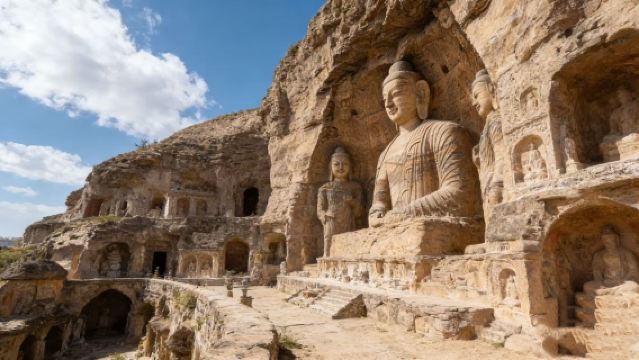
Yungang Grottoes Scenic Area is divided into a landscape zone and the grottoes. It is one of the three largest grottoes in China. The sculpture combines Chinese and Western art. Here you can experience the artistic charms of Northern Wei Dynasty. Yungang Grottoes not only embodies traditional Chinese art style but also integrates art styles of ethnic groups from ancient India, countries west of China and China's central plains. It is a famous historical site in Datong City.China · Datong

Weizhou Ancient City
Weizhou Ancient City is located on a platform on the south bank of Huliu River. At present, the south and east walls of Weizhou Ancient City have been completely demolished. The remaining well-preserved are the north wall and the northern section of the west wall, which is about 1,600 meters long. The east and west gates have been destroyed, and only the south gate remains. Wanshan Tower and Wenchang Pavilion in the city were restored and rebuilt in 1998. The east, west and south sides of the moat basically exist, and the stone bridge outside the three gates still exists. According to the Records of Weizhou, the ancient city of Weizhou is seven li and thirteen steps in circumference, with a wall three feet and five feet high, three city gate towers, and four corner towers. The tower is Jingyang Tower, the south gate is Jingxian Gate, the tower is Wanshan Tower, the west gate is Qingyuan Gate, and the tower is Guangyun Tower. There are tall and majestic urn cities outside the three gates. The moat is connected to the inner city by a suspension bridge. Outside the city is a moat more than three feet deep and seven feet wide. The Weizhou city is irregular in shape, wide in the south and narrow in the north, with many bends on the east and west sides. There is only the east, west, and south gates in the city, but no north gate, and the Jade Emperor Pavilion is built on the north city wall. The four main streets in the city are east, west, south, and north, forming an architectural pattern with Wenchang Pavilion (Drum Tower) and the south gate (Wanshan Tower) symmetrical, and the north-south streets as the central axis. Due to historical reasons, the ancient city of Weizhou suffered some damage, but the style of the ancient city has remained basically unchanged. In addition, there are many government offices, temples, pavilions and houses in the ancient city, and the legacy of the ancient cities of Ming and Qing dynasties is still there. In the history of Weizhou, Han culture was the mainstream. However, the ancient city's form was contrary to the strict "ritual system" of the traditional Han nationality: it was square and dignified, with clear longitude and latitude, and symmetrical planning along the central axis, which is the characteristic of Weizhou ancient city.Yu County · 26.2km from Guangling
Experiences you can't miss in Guangling
Featured Day tours in Guangling
View all Day tours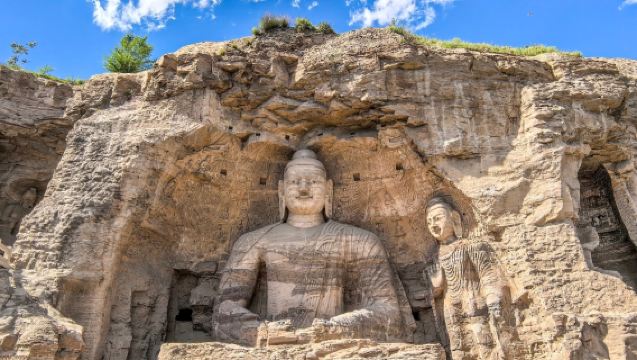
5.0/5
· 1 reviewFree cancellation
Instant confirmation
FromDKK 339.89
4.9/5
· 48 reviews· 203 bookedFree cancellation
Instant confirmation
48 consecutive positive reviews
5% off
Limited-time sale
FromDKK 360.57DKK 379.55
![※1-day private charter tour to Xuankong Temple + Yungang Grottoes in Datong [Hotel pickup included]](https://ak-d.tripcdn.com/images/10040v000000jhuz86DE4_C_568_320.jpg?_fr=wc)
4.9/5
· 46 reviews· 241 bookedFree cancellation
Instant confirmation
46 consecutive positive reviews
5% off
Limited-time sale
FromDKK 376.71DKK 396.54
![※※Private chartered tour: 1-day tour to Datong Xuankong Temple + Yungang Grottoes + Yong'an Temple with private charter [city pickup]](https://ak-d.tripcdn.com/images/0104z120008ab62gc27C1_C_568_320.jpg?_fr=wc)

4.9/5
· 201 reviews· 325 bookedFree cancellation
Instant confirmation
99% of travelers recommend
FromDKK 396.54
![※Xuankong Temple + Yungang Grottoes + Huayan Monastery 1-day tour by private charter [Exclusive private charter with hotel pickup]](https://ak-d.tripcdn.com/images/0353f12000r5t42q553B0_C_568_320.jpg?_fr=wc)
4.8/5
· 17 reviews· 77 bookedInstant confirmation
FromDKK 424.87

5.0/5
· 10 reviews· 46 bookedFree cancellation
Instant confirmation
FromDKK 203.94
![※Datong Xuankong Temple + Ying County Wooden Pagoda Private Charter 1-Day Tour [Flexible Departure Time | Train Station Pickup]](https://ak-d.tripcdn.com/images//0581j12000ne8yzqg9E18_C_568_320.jpg?_fr=wc)
5.0/5
· 6 reviews· 37 bookedInstant confirmation
FromDKK 385.21
5.0/5
· 3 reviews· 36 bookedFree cancellation
Instant confirmation
FromDKK 691.12
Free things to do in Guangling
Nuanquan Ancient Town
Yu County · 13.9km from Guangling
National Museum of China
China · BeijingBook now for tomorrowWeizhou Ancient City
Yu County · 26.2km from Guangling
Datong Ancient City
Datong · 91.5km from Guangling
Shanxi Museum
China · Taiyuan
Xinzhou Ancient City
China · Xinzhou
Sun Park
China · Beijing
Shichahai Scenic Area
China · Beijing
Tiananmen Square
China · Beijing
Taiyuan Ancient County
China · Taiyuan
What travellers say about Guangling

Anonymous user10 August 2026
4.0
I heard it's the birthplace of the "Iron Flower" performance, with over 300 years of history, so I went to see it. Compared to other live performances in scenic areas across the country, the show wasn't particularly exciting. All four sections of the "Iron Flower" performance were the same, lacking variation and originality compared to other attractions. However, if you haven't seen it before, it's still worth checking out.
Nuanquan Ancient Town

M43***1830 August 2025
5.0
Shengquan Temple, a unique ancient suspended structure in China, is renowned for its precarious location and exquisite architectural craftsmanship. The following review is based on reliable information:
Architectural Features and Historical Value
Suspended Structure: Shengquan Temple, located in Guangling County, Shanxi Province, was built over 1,500 years ago during the Northern Wei Dynasty, 20 years before the Hanging Temple of Hengshan Mountain. The temple rests on 32 pillars suspended from the cliff face. The main structure is supported by beams embedded in the cliff face (using the expansion principle of wooden wedges), demonstrating the superb craftsmanship of ancient craftsmen.12
Risky Experience: Climbing the temple requires climbing narrow steps and chains, with sections reaching near vertical heights, a significant test of both physical strength and courage. Reaching the summit offers breathtaking mountain views, but those with a fear of heights should exercise caution.2
Safety and Touring Recommendations
Restricted Areas: For safety reasons, some access roads to the Hanging Temple are closed, preventing visitors from getting a close-up look at the underlying structure, which is somewhat disappointing.1
Best View: The "F" sign midway up the mountain is the recommended spot for panoramic views of the temple. The three-story building is staggered and arranged in a rhythmic pattern, a stroke of genius.
Cultural Significance
Shengquan Temple is not only a religious site but also a living fossil of ancient engineering. Its thousand-year-old miraculous standing demonstrates the ancients' profound understanding of mechanics and the environment, making it a worthwhile visit for visitors interested in historical architecture.
Shengquan Temple
Anonymous user11 October 2026
5.0
This has been by far my best temple experience. Booking tickets online was very competitive needing hours of planning and flexibility. The temple was far from the city and we took the tourist bus and had some difficulty finding the bus stop. The line to climb the temple was long and it was busy inside the temple. Despite it all, the experience in the temple was worth every effort. It is very unique temple, very beautiful, ancient, and not specific to one religion. We still felt the spiritual environment despite the crowds.
Xuankong Temple
Anonymous user11 October 2026
5.0
The cable car takes you directly to the top of the Great Wall, saving you the hardship of climbing. Looking out, the Great Wall stretches like a giant dragon across the mountains, its grandeur breathtaking. Only by standing here in person can you truly appreciate its magnificence that transcends millennia. A perfect visit to Badaling!
Badaling Great Wall

拉布布_11 October 2026
5.0
The Palace Museum is the imperial palace of the Ming and Qing dynasties. It is very large and reservations are a must. It is very cost-effective and a must-visit place when you come to Beijing.
The Palace Museum

_TI***qo12 October 2026
5.0
I set aside just five hours to visit Universal Studios; in the end, I managed to visit Hogwarts, ride the roller coaster there, drink some Butterbeer, and even go on another ride featuring pandas! I was absolutely thrilled with the experience! There were long lines, of course, but the wait times displayed on the boards didn't match reality at all—the actual wait turned out to be even shorter, which I was really happy about!
Universal Beijing Resort

永新松山1 November 2021
5.0
This is a spiritual place. When you first see the water and the tower in the courtyard, you will find it very exquisite. You will see the stone steps that seem to be randomly stacked in the shade. The tower with exquisite carvings stands in the small courtyard. The murals in the courtyard are very unique. There are also corridors on both sides of the courtyard wall facing the water. It is actually very elegant...
Shuishen Hall

M25***5611 October 2026
5.0
I've visited 3/5 of the Five Sacred Mountains and Three Great Mountains. Hengshan Mountain isn't difficult to climb, but it's still quite tiring. The scenery is beautiful, and the mountain itself is very unique, especially the section of road leading to the summit. The most distinctive feature is the four-legged staircase. I also climbed the Hanging Temple on Hengshan Mountain, so happy!
Heng Shan Mountain

Seriouslee May11 October 2026
5.0
Super magnificent. No words for it. Area is super well maintained
Yungang Grottoes

水漫三楼3 June 2026
4.0
Weizhou Ancient City, also known as Rabbit City or Iron City, is located in Weixian County, Zhangjiakou City, Hebei Province. It was first built in the second year of the Daxiang era of the Northern Zhou Dynasty (580 AD) and rebuilt in the tenth year of the Hongwu era of the Ming Dynasty (1377 AD), covering an area of 1.6 square kilometers. The ancient city has a circumference of over 3800 meters, with city walls 11.5 meters high. It has three city gates: Anding Gate (Jingyang Tower) to the east, Jingxian Gate (Wanshan Tower) to the south, and Qingyuan Gate (Guangyun Tower) to the west. There are also four corner towers, 24 watchtowers, and over 1100 crenellations. Outside the city gates are barbicans and outer walls, and a moat surrounds the city. The ancient city boasts numerous historical sites and scenic spots, with temples, palaces, altars, halls, government offices, towers, and residences scattered throughout. It possesses nine national key cultural relics protection units (Jade Emperor Pavilion, Nan'an Temple Pagoda, Sakyamuni Temple, Zhenwu Temple, Changping Granary, Lingyan Temple, Guandi Temple, Tianqi Temple, and the ancient city wall), all possessing high historical and cultural value, folklore research value, and architectural art value. Weizhou Ancient City is a national historical and cultural city. The existing Weizhou city was built in the fifth year of the Hongwu reign of the Ming Dynasty, with earth excavated and city walls constructed on the original site. In the tenth year of the Hongwu reign, the walls were rebuilt with bricks and stones, forming a "magnificent iron city surpassing all others on the border."
Weizhou Ancient City


