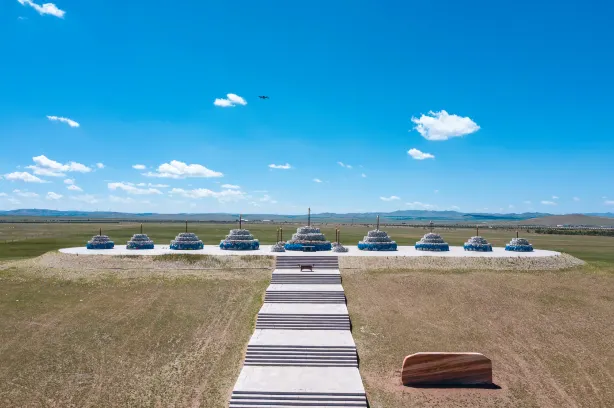
Zhengxiangbai Banner

Things to do in Zhengxiangbai Banner

Search attractions or local attractions & tours
Search

Explore top experiences

Top 10 attractions in Zhengxiangbai Banner

View all Attractions
Wulanhada Volcano Geopark

Wulanhada Volcano Geopark

7.8
4.3/5
1.6k reviews

Wulanhada Volcano Geopark is hidden deep in the grasslands of Ulanqab. It is an exceptionally young volcanic chain, with geological surveys indicating eruption records within the last approx. 10,000 years. The park features a complete array of landscapes, including volcanic cones, lava flows, and barrier lakes, and is hailed as a natural "volcano museum," having even graced the cover of Chinese National Geography magazine. The volcanic cones are spread across the grassland like beads on a string, and local herdsmen have named them based on their shapes and colors: Red Mountain, Fire-Burning Mountain, North Alchemy Furnace, Black Brain Bag, Middle Alchemy Furnace, South Alchemy Furnace, North Sharp Mountain, and South Sharp Mountain. Half the fun of exploring this place lies in "finding the mountains by number." Popularity is concentrated on several "alchemy furnaces": Volcano no. 3 (North alchemy furnace) has a wooden boardwalk, allowing easy access to the summit for panoramic views of the entire volcanic chain and grasslands, with particularly photogenic light at sunset; Volcano no. 5 (Central alchemy furnace) features a well-preserved, rounded cone without boardwalks—hiking up the scree slope is more strenuous but rewards visitors with rare tranquility; Volcano no. 6 (South alchemy furnace), whose body was split open by early quarrying, exposes layers of reddish-brown and gray-black volcanic rocks, earning it the nickname "naked volcano." Combined with scattered volcanic debris, its desolate landscape resembles the surface of Mars. Renting a spacesuit to take "Mars landing" photos here is the park's highly popular signature activity. Further south, Volcano no. 7 and no. 8 are also called North and South pointy mountains. The base of Volcano no. 8 was once famous for its abundant agate deposits. The grassland is open and unobstructed, with strong winds, intense sunlight, and significant temperature differences between day and night. Windproof jackets and sun protection items are worth packing. On clear nights, there is little light pollution, and you can often see the Milky Way when looking up. The park and its surroundings have stargazing cabins and RV campsites, making it suitable to leave the itinerary for the night. The entire volcanic cluster is a protected geological heritage. Agates and volcanic rocks should only be admired, as digging them would damage the grassland. Vehicles should also stick to existing roads and avoid driving into the pastures.

China · Qahar Right Rear Banner
Shanhua Temple
Selected for Best Things to Do in Shanxi

Shanhua Temple

7.5
4.8/5
2.4k reviews

Shanhua Temple, commonly known as the "southern temple," is located in the southern corner of the ancient city of Datong. The temple was first built during the Kaiyuan era of the Tang Dynasty and was initially named Kaiyuan Temple. It was renamed Dapu'en Temple during the Later Jin Dynasty but was destroyed in the war at the end of the Liao Dynasty. It was rebuilt on the original site during the Jin Dynasty and was officially named Shanhua Temple in the Ming Dynasty, a name that has been used ever since. The temple's mountain gate, Three Saints Hall, Mahavira Hall, and Puxian Pavilion are all original structures from the Liao and Jin periods, making it one of the relatively well-preserved temple architectural complexes from that era in China. The halls are gradually elevated along the central axis from south to north, with the layout of the Tang Dynasty temple still faintly discernible. Unlike most temples, the mountain gate here combines with the heavenly king hall into one structure: the five-bay Jin dynasty gate houses Ming dynasty statues of the four heavenly kings, immediately visible upon entry with imposing majesty. The central three saints hall, also a Jin dynasty construction, features strikingly large and ornate bracket sets under its eaves that project in layers resembling blooming flowers—a distinctive hallmark of this hall. It enshrines the original Jin dynasty "Flower Adornment three saints": Vairocana Buddha at the center flanked by Manjusri and Samantabhadra bodhisattvas, their forms full and expressions serene. The main hall of the great hero on the northern high platform is the temple's principal hall, built during the Liao Dynasty and renovated in the Jin Dynasty. The altar enshrines the five wisdom buddhas arranged from east to west: Aksobhya in the east, Ratnasambhava in the south, Vairocana at the center, Amitabha in the west, and Amoghasiddhi in the north—all surviving Liao sculptures with Jin-era repainting. Twenty-four deva polychrome sculptures stand on brick platforms along the eastern and western walls, twelve on each side, representing masterpieces of Jin Dynasty sculpture. Some appear armored and weapon-wielding with fierce expressions, while others wear official robes with flowing sashes. Among them, the benevolent and graceful Sridevi particularly captivates viewers. The hall's western and southern walls preserve Buddhist narrative murals painted during the Kangxi era of the Qing Dynasty. Before entering the temple, consider viewing the glazed five-dragon wall in front of the mountain gate. This Ming dynasty Wanli-era relic was originally the screen wall of Xingguo Temple in the southern city, relocated here in the 1980s. Five coiling dragons surge amid turbulent clouds and waves on the wall, with the central "main dragon" holding a fire pearl and facing directly forward toward the ancient temple's gate. During your visit, pay special attention to the hall of three saints' diagonal arches and the Liao- and Jin-dynasty polychrome sculptures in the main hall. The dim lighting in these ancient halls invites slower observation of the statues' expressions and drapery details, allowing deeper appreciation of these Liao-Jin treasures.

China · Datong
Natural History Museum of China
No. 5 of Family-friendly Attractions in Beijing

Natural History Museum of China

7.4
4.7/5
2.1k reviews

The Natural History Museum of China is a large natural history museum built by New China relying on its own strength, and its predecessor is the "Beijing Museum of Natural History" remembered by many people, with hundreds of thousands of specimens in its collection. The museum's dozen or so permanent exhibition halls take biological evolution as their main thread, telling the story from the ancient oceans all the way to humans themselves, and a full walk-through is like flipping through a three-dimensional history of life on Earth. The "Rise of Vertebrates" hall in the center of the first floor was upgraded from the former "Ancient Reptiles" hall: a Jingyan Mamenchisaurus skeleton over 20 m long almost spans the entire hall, beside it stands the Lufengosaurus huenei independently excavated and studied by Chinese researchers, and Yangchuanosaurus, Tuojiangosaurus, and others are grouped in a scattered array; the adjacent ancient mammal hall centers on a mammoth skeleton, while the mouse-sized early eutherian "Juramaia" bears witness to the origin of mammals. The "Plant World" on the second floor brings together over a thousand plant fossils and modern plant specimens, among which the angiosperm fossil "Archaefructus liaoningensis" from more than 100 million years ago is the star; the "Yellow River Elephant" (Stegodon zdanskyi) fossil, written into primary school textbooks, is also a well-known treasure of the collection here. The "Dinosaur Park" on the basement level is now an immersive experience project called "Dragon's Mouth Escape": centered on characters such as Sinoceratops, Tarbosaurus, and Confuciusornis, it gathers more than 20 kinds of native Chinese dinosaurs including Sinosauropteryx, Microraptor, and Psittacosaurus, backed by full-CG imagery and glasses-free 3D technology, with 6D motion seats combined with water mist, wind, and vibration, as well as a live-action mechanical giant Tarbosaurus, and the roughly half-hour Cretaceous adventure is especially popular with children. The aquatic life hall is one of the few live exhibit areas in the museum, with schools of live aquatic creatures swimming in the shark pool and undersea tunnel; "Magical Africa" uses a 360-degree circular panorama to recreate the African wilderness, where the necks of ancient and modern giraffes are displayed side by side, and the answer to evolution is clear at a glance. The "Origin of Humans" hall hidden on the second floor is inconspicuous in location but suitable as the finale for a careful look: the Australopithecus "Lucy" from more than three million years ago, the "Nariokotome Boy" from 1.6 million years ago, and Neanderthals from tens of thousands of years ago appear in turn, condensing millions of years of human evolutionary history into over a hundred specimens, and a complete human nervous system specimen is even more unforgettable. Families with children can visit "Animals—Friends of Humans" along the way to see polar animal specimens such as polar bears and the lively insect hall, and the museum's "Exploration Corner" also runs science popularization activities such as hands-on experiments and nature crafts year-round. When touring, you may follow the order of ancient life on the first floor, plants and the African savanna on the second floor, and the Dinosaur Park and "Origin of Humans" on the basement level, seeing the story of life from ancient times all the way to yourself.

China · Beijing
Thaiwoo Resort
2026 Asia 50 - Ski Resorts

Thaiwoo Resort

7.4
4.8/5
2.1k reviews

Located in the mountains of Chongli, Zhangjiakou, Hebei, Thaiwoo Resort is one of the area's large comprehensive ski resorts. The resort is built in the style of a North American mountain town, and its most distinctive detail is that all the trails are named after dances—Rumba, Waltz, Tango, Cancan—so even the trail map has a sense of rhythm. The beginner, intermediate, and advanced trails are evenly balanced, and multiple high-speed cable cars connect the base with the summit, so novices, families, and advanced skiers can all find what they need. Advanced skiers can make a special trip to the mogul course to experience the continuous bumps—Thaiwoo has hosted the FIS Freestyle Ski Moguls World Cup multiple times. Those who love freestyle shouldn't miss the terrain park "Rave Park," which is fully equipped with large and small jumps, rails, and box features. Once the ski season ends, the town switches to mountain summer retreat mode: summers here are much cooler than in Beijing. In the forest-covered valleys, mountain biking, hiking, go-karting, mountain coasting, and pump track cycling take turns on offer. In summer, the ropeway also serves as a sightseeing cable car, taking visitors up to the summit to overlook the layered mountain forests. The living area at the foot of the mountain is equally worth exploring: the North American-style commercial street is home to multiple international ski and outdoor brand stores, with a full range of accommodations including Hyatt, Hyatt Place, Westin Element, and town-operated hotels; dining options range from hot pot and craft beer all the way to Austrian cuisine at the Alpine Lodge at over 2,000 m above sea level at the mid-station of the gondola, and familiar names like Starbucks and KFC are also there. After skiing, catching a show at the Phoebe Theater or unwinding with a SPA is a common choice for evenings in town.

China · Zhangjiakou
Yuanmingyuan Park
2026 Global 50 - Spring Outings

Yuanmingyuan Park

7.4
4.8/5
28k reviews

Yuanmingyuan Park is a royal garden of the Qing dynasty, composed of three gardens: Yuanmingyuan, Changchun garden, and Qichun garden. Once renowned as the "garden of gardens," it was looted and burned by Anglo-French allied forces in 1860, leaving its main structures in ruins. Today, it serves both as a memorial park reflecting on a historical period and as a scenic destination with expansive lakes and lush vegetation. The garden's landscaping excels in water features. Fuhai Lake's expansive surface, named for the idiom "boundless happiness like the eastern sea," once served as the imperial water recreation center. Three square islands connected by bridges at its heart form the Pengdao Yaotai (Jade Terrace on Penglai Isles). Smaller water bodies meander around, with piled rocks forming hills and gathered earth creating ridges—mountains and waters intertwine as if naturally formed. West of Fuhai, the Rear Lake encircles nine islets symbolizing the "nine provinces," each with distinctive scenery that borrows views from others to create harmonious interplay. Qichun garden, also known as Wanchun garden, was one of the emperor's main residential gardens during the Jiaqing era. After the Daoguang period, it primarily served as the residence for empress dowagers and imperial concubines. The garden features numerous small scenic spots, making it a collection of miniature water landscapes. It also serves as the main venue for the annual summer lotus festival. In midsummer, when lotuses are in full bloom and the garden is bathed in vibrant red, taking a cruise through the lotus leaves offers a uniquely delightful experience. Changchun garden features large water landscapes as its main attraction, with its core architectural complex, Hanjing Hall, serving as Emperor Qianlong's retirement residence. The northeast corner replicates Suzhou's Lion Grove garden under the same name. The northern section houses a group of European-style palaces commonly known as the Western mansions, where structures like the Harmonious Wonder, Haiyantang Hall, Yuanyingguan Observatory, Great Fountain, and Water Viewing Fountain were once scattered—now only stone ruins remain. Among them, the arched stone remnants of the Great Fountain have become Yuanmingyuan Park's iconic image. The Huanghua maze, a European-style rectangular labyrinth within the attraction, is said to have hosted imperial festivities where palace maids carried yellow flower lanterns through its paths during mid-fall nights while the emperor watched from its central pavilion. Visitors today can still attempt navigating this historic maze. To get an intuitive sense of the park's appearance at its peak, visit the Yuanmingyuan Park full-scale model exhibition northeast of the Hanjing Hall in the Eternal Spring Garden. With the guidance of an on-site guide, you can imagine the past through a large sand table. The Yuanmingyuan Park exhibition hall in the Western-style buildings ruins area also screens the documentary "Yuanmingyuan" on loop. Watching it before visiting the ruins will give you a more three-dimensional experience.

China · Beijing
Zhengxiangbai Banner Today's weatherCloudy -7-10℃
Zhengxiangbai Banner weather for the next 2 days11/14: -10-7℃, 11/15: -9--1℃

Free things to do in Zhengxiangbai Banner

What travellers say about Zhengxiangbai Banner
user-avatar
行万里路不如读万卷书24 September 2026
4.0
Tiananmen Square is a place that hundreds of millions of people yearn for; it is a symbol of the Republic, and every tourist visiting Beijing takes a photo in front of Tiananmen. However, advance reservations are essential, and security checks are a must. The only parts of the Tiananmen area open to the public are the Zhengyangmen Gate Tower, the Chairman Mao Memorial Hall, the Tiananmen Gate Tower, and the National Museum. Every year during the National Day holiday, Tiananmen Square is decorated with flowers for photos, and you can arrive early to watch the flag-raising ceremony. In short, a day trip to Beijing can include both Tiananmen and the Forbidden City, leaving a lasting impression of the capital's splendor.

Tiananmen Square
user-avatar
Janniz9 November 2026
5.0
Amazing and fascinating place to visit. Great architecture and interesting artefacts exhibited. Sadly quite a few things are only in chinese and weren’t available in english :( There’s also an audio guide available however I forgot my earphones so that sadly wasn’t part of my visit :D

Lama Temple

user-avatar
蓝蓝姐姐16 October 2026
4.0
The volcanoes were spectacular, especially number six. I didn't get a direct view of the others, only from a distance, so they weren't that impressive. The sunset was truly beautiful, definitely worth seeing. However, the signage inside was somewhat inadequate; there weren't enough, and sometimes it was easy to get lost. Also, the gravel road for parking wasn't ideal for low-chassis minivans, and the section from the ticket gate to the park was riddled with potholes.

Wulanhada Volcano Geopark

user-avatar
Anonymous user13 November 2026
4.0
Overall, it was pretty good. While there weren't actually 10,000 horses, there were still a couple hundred, which was quite impressive. The only downside was the ticket price; the prices at the ticket booths varied wildly, with prices ranging from quite a bit, making the pricing seem chaotic.

Wulan Butong Granssland Scenic Area

user-avatar
Anonymous user21 October 2026
5.0
Shanhua Temple, located in the ancient city of Datong, Shanxi Province, is commonly known as the South Temple. It was among the first batch of national protected sites. Originally built during the Kaiyuan era of the Tang Dynasty, it was destroyed by fire and rebuilt by Master Yuanman during the Jin Dynasty. It was named Shanhua Temple during the Zhengtong era of the Ming Dynasty. It retains four original Liao and Jin Dynasty buildings: the Liao Dynasty Mahavira Hall (with the Jin Dynasty Twenty-Four Deities painted sculptures inside, which are masterpieces of Liao and Jin sculpture, especially the auspicious goddess), the Jin Dynasty Heavenly King Hall (the largest Jin Dynasty hip-roofed mountain gate in China), the Three Saints Hall (famous for its magnificent sloping arches and Jin Dynasty vermilion tablet), and the Puxian Pavilion. The whole temple faces south and has a complete layout. It is the best-preserved Liao and Jin Dynasty temple complex in China and was highly praised by Liang Sicheng. There are also remnants of the Ming Dynasty Five Dragon Wall in front of the temple.

Shanhua Temple

user-avatar
M10***259 August 2026
5.0
Having a good guide is crucial when visiting the National Museum, as they can not only introduce the important artifacts we see but also share some previously unknown historical facts.

Natural History Museum of China
user-avatar
eagle208626 October 2026
5.0
During the hottest days of summer, the whole family came to Chongli for a vacation. The weather was cool and the grass was lush and green. There were many food options, including barbecue, stir-fries, and hot pot. There were also performances, go-karts, and a cable car, making it a worthwhile place to visit.

Thaiwoo Resort

user-avatar
_TI***ox11 November 2026
5.0
Jade was our guide. @Jade thank you again for the awesome tour. What to expect: An organize meeting time/point with information sent to you via WeChat the day before. Jade spoke English very well, was happy to answer all questions and gave us many insights of the forbidden city. Do not expect to see every part - for this the city is just to large . Jade will show you the most important places. All in all 5/5 you get what you have booked.

Jingshan Park

user-avatar
最可靠谱的朋友啊1 May 2026
5.0
If you're visiting the Old Summer Palace (Yuanmingyuan) during the May Day holiday, the most worthwhile attraction is undoubtedly the ruins of the Western-style buildings. Although only the ruins of its former glory remain, you can still feel the awe-inspiring splendor of this "Garden of Gardens," reminiscent of the "Versailles of the East." Today, the magnificent scenery of Fuhai Lake within the Old Summer Palace rivals that of Kunming Lake, offering a Beijing version of West Lake's beauty. Also, don't miss the Old Summer Palace Museum located at the south gate, which displays the actual horse head from the 12 Chinese zodiac animals. This is a priceless treasure, a precious artifact donated to the motherland by a Macau gambling tycoon after a high-priced auction. A must-see!

Yuanmingyuan Park

Trip Moments in Zhengxiangbai Banner

Popular cities near Zhengxiangbai Banner

Frequently asked questions

How can I contact Trip.com customer support?

Get help anytime, anywhere within 30 secondsContact customer support

Change and cancellation policies vary by attractions and tours. Please check the product details page for more information.

Ticket prices may vary between weekdays and weekends, as well as during peak and off-peak seasons. When booking with Trip.com, you can also use Trip Coins to get extra savings. For more tips on booking discounted tickets, please visit Trip.com for the latest information.