




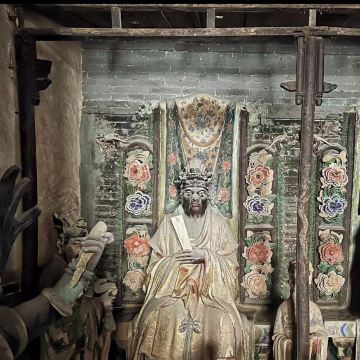

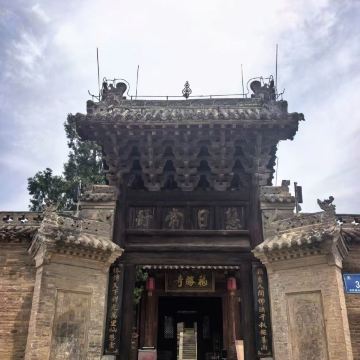
▲ Xinjiang Sanguan Temple is a national key cultural relics protection unit, hailed as "a pocket-sized Taoist site of the Yuan Dynasty on the land of Shanxi". It is not only a precious relic of the Yuan Dynasty, but also considered the prototype of the "Gourd Temple" in Dream of the Red Chamber due to its local nickname "Hulu Temple". According to the inscription on the wooden pillar inside the temple's painted sculptures, it was built in the first year of the Zhizheng era (1341 AD) of the Yuan Dynasty. Sanguan Temple, facing west, currently consists of two closely connected buildings: the offering hall and the main hall, covering an area of approx. 100 square meters, making it a "pocket-sized temple". Its compact and exquisite layout also resembles the description in Dream of the Red Chamber: "a temple in the alley, with narrow space".
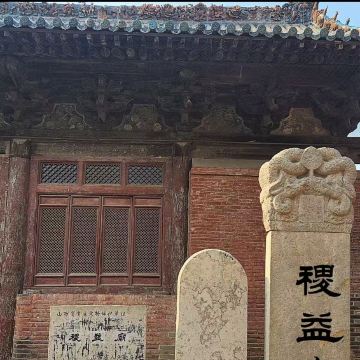

▲ The Jiyi Temple, commonly known as the Yangwang Temple, is dedicated to the agricultural deity Houji and the wise minister Boyi, who controlled floods. The main attraction is the Ming Dynasty murals on the east and west walls of the main hall. Unlike typical Buddhist or Taoist themes or water-land rituals, these murals uniquely depict China's agricultural heritage, vividly portraying the millennia-old epic of slash-and-burn farming, cultivation, and harvest on the walls.
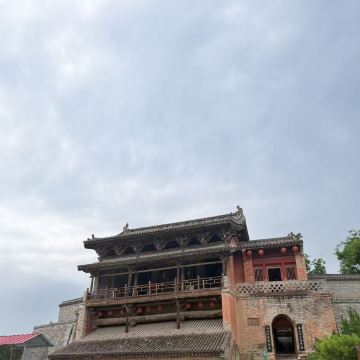

▲ Baitai Temple was originally a monastery in Xinjiang with abundant painted sculpture resources, but it was nearly destroyed due to repeated thefts, which is lamentable. In the Three Drops Fazang Pavilion, the central Bhaisajyaguru Buddha's body is original, while the Buddha's head and the flanking attendants, Suryaprabha Bodhisattva and Candraprabha Bodhisattva, were all restored after being stolen. In the Sakyamuni Hall, there are statues of Sakyamuni Buddha, attended by disciples Ananda and Kasyapa, as well as Manjusri and Samantabhadra Bodhisattvas, along with six arhats on the side walls. The Buddha's head, the bodhisattvas' and arhats' profile pictures were all stolen, and the two disciple statues were even taken entirely. The original Skanda Bodhisattva statue, possibly due to later repainting, lost its original charm. In the Amitabha Hall, the statues of Amitabha Buddha and his attendants, Mahasthamaprapta and Avalokitesvara Bodhisattvas, also fell victim to theft of their profile pictures and were subsequently restored. Most of these stolen painted sculptures remain missing to this day.
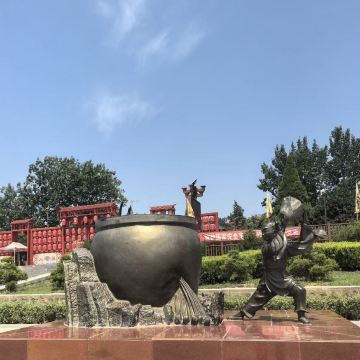

▲ Simaguang temple, located on Mingtiao Ridge in Shuitou Town, Xia County, Yuncheng, is the ancestral burial ground of Sima Guang, a renowned official of the Northern Song Dynasty. It now consists of five parts: the burial area, Wengong ancestral hall, Yuqing Buddhist temple, Sushui academy, and Zhongqing Cuide stele tower. Sima Guang, courtesy name Junshi, was a native of Sushui Township in Shanzhou (present-day Xia County, Shanxi) during the Northern Song Dynasty. He was widely known as "Master Sushui" and was a famous statesman, historian, and writer of the Northern Song period. Serving through the reigns of Emperors Renzong, Yingzong, Shenzong, and Zhezong, he rose to the position of chancellor. He is best known for compiling China's first comprehensive chronicle history, the Zizhi Tongjian. He died in office in the first year of the Yuanyou era at the age of 68 and was posthumously honored as Grand Preceptor and Duke of Wen, hence the name "Sima Wengong." His posthumous title was "Wenzheng."

▲ Originally built during the Northern Qi Dynasty in Guang Village, a renowned Chinese historical and cultural village and the birthplace of Chengni inkstones. The four famous inkstones are Duan inkstone, She inkstone, Taohe inkstone, and Chengni inkstone. Originally the Lin family temple built during the Tang Dynasty by the family of Lin Xiangru. Main hall - Amitabha Hall. Statues: Yuan Dynasty, featuring Amitabha Buddha at the center, flanked by Guanyin and Mahasthamaprapta Bodhisattvas. Buddha - flat face, square jaw, robust chest, and elegantly crafted lower robe, exuding compassion. Bodhisattvas - Tang-style influence, bare-chested with protruding bellies, adorned with flowing scarves behind. Well-proportioned faces, strong yet natural physiques, heroic yet gentle expressions, radiating grace. Four Heavenly Kings - Hongzhi era of the Ming Dynasty, highly realistic. Sixteen Arhats - Arhat heads, mostly stolen in the 1990s, leaving only about five remaining. Rear fan wall: Guanyin crossing the sea - dignified face, vivid posture, and fluid drapery.
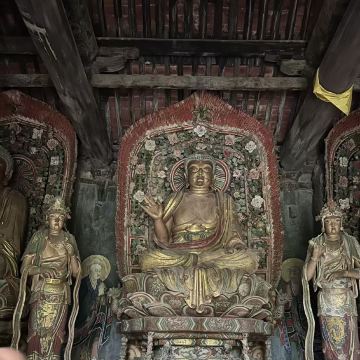

▲ Yuqing Buddhist temple, the incense temple of Sima Guang's ancestral graves, was granted the plaque "Yuqing Buddhist temple" in the eighth year of the Yuanfeng era (1085). The existing Mahavira Hall is a surviving structure from the Northern Song Dynasty, featuring five bays. Inside the hall, there are nineteen painted sculptures including the Buddhas of the Three Ages, Manjusri, Samantabhadra, and sixteen arhats, along with a wooden statue of a guardian vajra, all original works from the Song Dynasty that were refurbished during the Qianlong era, showcasing exquisite artistry.
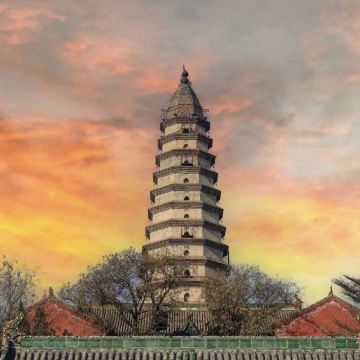

▲ Liang Sicheng mentioned in "A pictorial history of Chinese architecture": "The pagoda in Xinjiang county, Shanxi belongs to the columnless style." Longxingsi was built in the Tang dynasty. Its predecessor was the Biluo temple. It is renowned for its "three national treasures": The "Biluo stele," the Song and Jin dynasty painted sculptures of the "Buddhas of the three periods," and the Longxing pagoda