


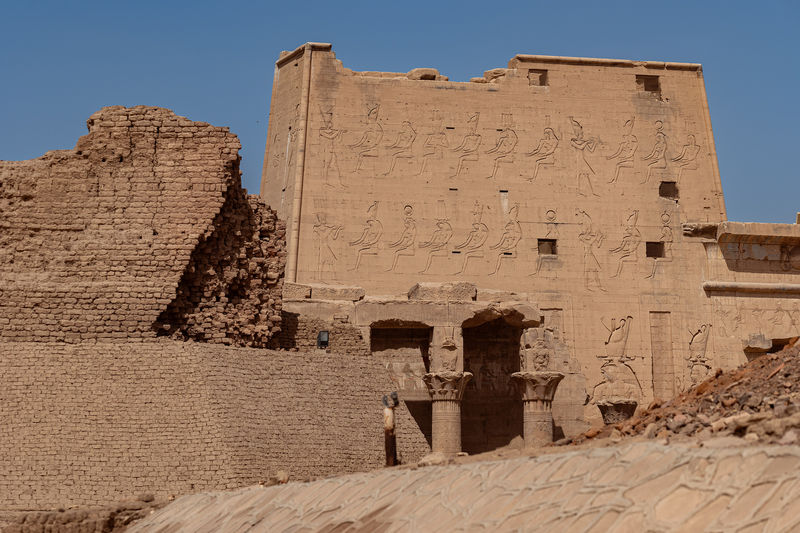
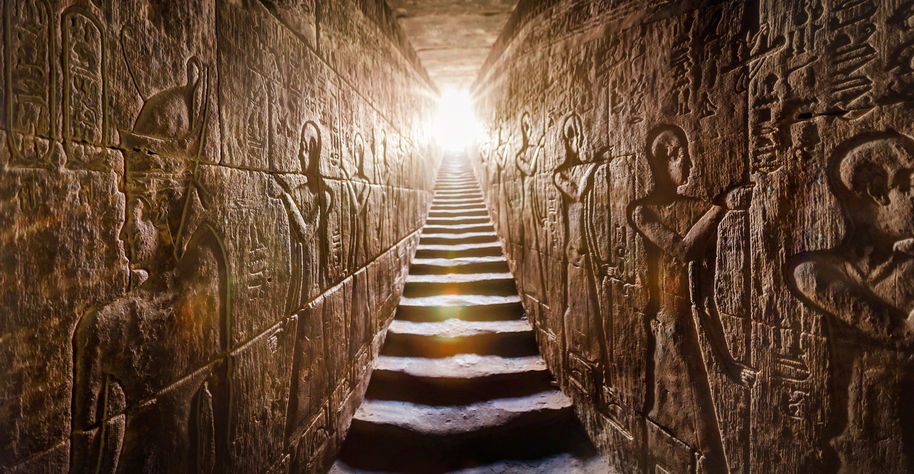
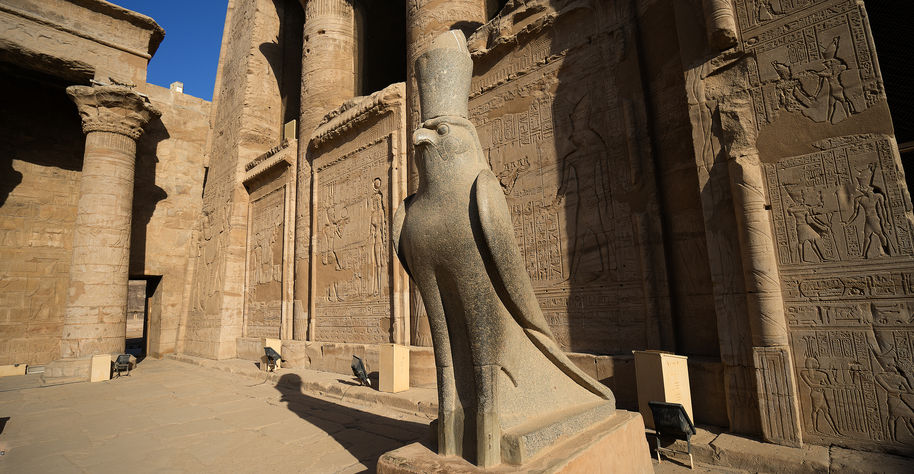

▲ Edfu Temple, located on the western bank of the Nile River in the city of Edfu, is one of the best-preserved ancient Egyptian temples and one of the most impressive archaeological monuments in Upper Egypt. Dedicated primarily to Horus, the falcon-headed god of kingship, protection, and the sky, the temple offers visitors an exceptional opportunity to experience the grandeur of ancient Egyptian architecture almost as it appeared thousands of years ago. Construction of the present temple began during the Ptolemaic period in 237 BC, under King Ptolemy III Euergetes I, and was completed approximately 180 years later in 57 BC during the reign of Ptolemy XII Auletes. Although the temple was built during the Greek and Roman period of Egyptian history, its architecture, inscriptions, and decoration deliberately followed traditional ancient Egyptian styles and beliefs. As a result, Edfu Temple provides an important connection between the traditions of pharaonic Egypt and the later Ptolemaic rulers. The temple was built to honor Horus of Edfu, who was believed to have defeated his enemy Seth as part of one of the most important myths in ancient Egyptian culture. According to the legend, Horus fought Seth to avenge the death of his father, Osiris. The struggle between the two gods represented the eternal conflict between order and chaos, a central concept in ancient Egyptian belief. Many of the temple's beautifully carved reliefs and inscriptions depict scenes connected with this mythology, royal rituals, spiritual ceremonies, and offerings to the gods. One of the first features visitors encounter is the massive entrance pylon, decorated with enormous reliefs of Ptolemy XII standing before the gods. Two monumental granite statues of Horus in the form of a falcon stand in front of the entrance, symbolically guarding the sacred temple complex. These statues are among the most recognizable features of Edfu Temple and provide an impressive introduction to the monument. Beyond the entrance is a large courtyard surrounded by columns, followed by several impressive halls and chambers. The walls and columns are covered with detailed hieroglyphic inscriptions and reliefs showing kings making offerings to the gods, participating in sacred ceremonies, and receiving protection and blessings from the divine world. Because so much of the temple's decoration has survived, visitors can study the ancient Egyptian symbolism and artistic traditions in remarkable detail. The temple also contains a hypostyle hall, where massive columns support the roof and create a dramatic architectural space. The columns are decorated with elaborate floral designs and scenes, while the walls contain inscriptions describing important rituals and myths. Deeper inside the temple, the rooms become smaller and more sacred, eventually leading toward the sanctuary, where a sacred shrine once housed the cult image of Horus. One of the most fascinating aspects of Edfu Temple is its extensive collection of hieroglyphic inscriptions. These inscriptions provide valuable information about ancient Egyptian culture, temple rituals, mythology, astronomy, offerings, and the relationship between the king and the gods. The temple's walls also preserve detailed representations of sacred ceremonies that help modern visitors understand how the ancient Egyptians worshipped and celebrated their deities. The temple was not simply a place of worship; it was a major institution with priests, ceremonies, storage areas, and sacred spaces. Its design reflects the ancient Egyptian concept that a temple was the earthly home of a god. Every section of the complex had a sacred purpose, and access to the most protected areas became increasingly restricted as visitors moved deeper into the temple. Another important feature is the Nilometer, which was used to monitor the level of the Nile River. The annual flooding of the Nile was essential to agriculture and the survival of ancient Egyptian civilization, making the river's water level an important economic concern. Edfu Temple is also famous for its connection with the ancient Festival of the Sacred Marriage, during which Horus of Edfu was associated with the goddess Hathor of Dendera. According to the tradition, Hathor would travel from her temple at Dendera to visit Horus at Edfu. This annual celebration was an important occasion and symbolized the union of the two deities. Today, Edfu Temple is considered one of the most significant surviving monuments of ancient Egypt and is an essential stop for travelers exploring the Nile Valley and Upper Egypt. Its excellent state of preservation allows visitors to see enormous pylons, columns, statues, sanctuaries, reliefs, and hieroglyphic inscriptions with exceptional clarity. A visit to Edfu Temple is particularly rewarding for travelers interested in ancient Egyptian history, mythology, archaeology, architecture, and photography. The combination of monumental architecture, detailed carvings, legendary stories, and well-preserved inscriptions makes the temple one of the highlights of a Nile cruise between Luxor and Aswan. Visitors can explore the temple's courtyards, halls, columns, reliefs, and sacred chambers while learning about the fascinating story of Horus and the traditions of ancient Egypt. The monument's impressive scale and preserved decoration make it possible to imagine how magnificent the temple must have been when it was an active center of worship. Edfu Temple is more than an archaeological site; it is a remarkable journey into the ancient world. Its monumental entrance, falcon statues, beautifully preserved reliefs, hieroglyphic inscriptions, and sacred chambers offer an unforgettable experience and provide travelers with a deeper understanding of the civilization that flourished along the Nile for thousands of years.

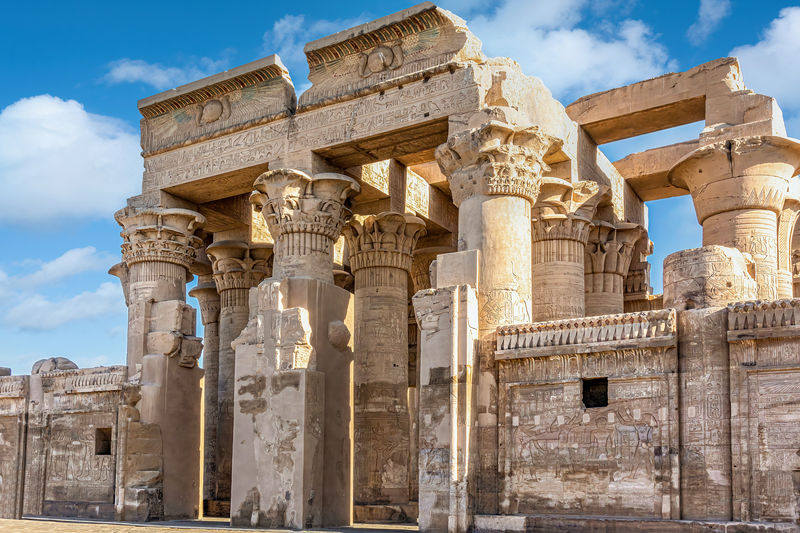
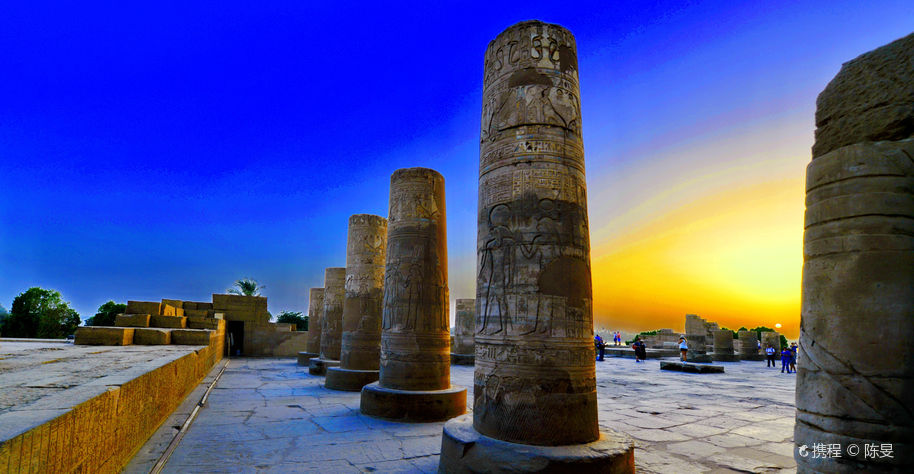
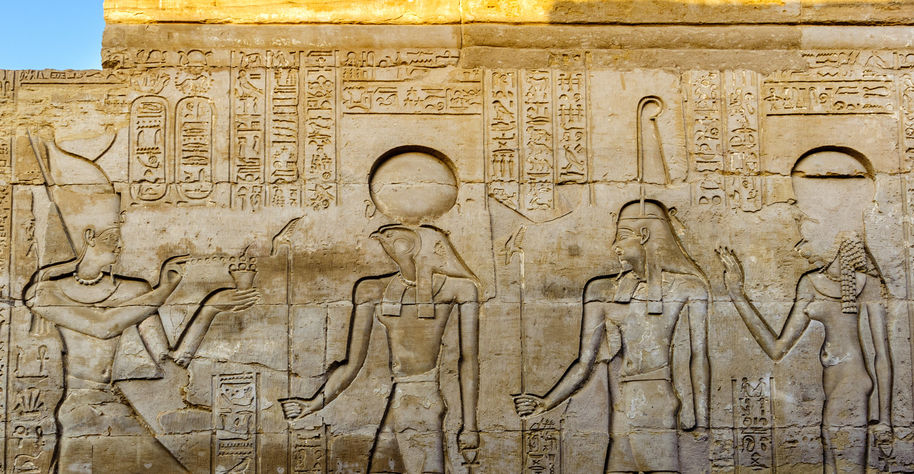
▲ The Temple of Kom Ombo is one of the most remarkable ancient Egyptian temples along the Nile River and a fascinating destination for travelers exploring Upper Egypt. Located on a scenic bend of the Nile between Luxor and Aswan, the temple is famous for its unusual double design, with two parallel sanctuaries dedicated to two different gods: Sobek, the crocodile god, and Horus the Elder, the falcon-headed god. Unlike most ancient Egyptian temples, which were generally dedicated to a single principal deity, Kom Ombo was designed as a symmetrical double temple. Its two sides contain separate entrances, halls, sanctuaries, and religious spaces associated with Sobek and Horus. This unique arrangement makes Kom Ombo particularly interesting for visitors who want to understand the diversity and complexity of ancient Egyptian religion. As visitors approach the temple, they can admire the remains of its monumental architecture and the impressive stone columns that once formed part of its grand halls. The temple was constructed during the Ptolemaic period and was later expanded and decorated during the Roman period. Despite the passage of thousands of years, many of its carved reliefs and inscriptions remain visible, providing an extraordinary glimpse into the religious traditions of ancient Egypt. The temple's southern side was dedicated to Sobek, the crocodile god associated with the Nile, fertility, protection, and the power of nature. Crocodiles were closely connected with the Nile and played an important role in the religious beliefs of the people living along the river. Sobek was often represented with a human body and a crocodile head, symbolizing both the dangerous and life-giving aspects of the Nile. The northern side of the temple was dedicated to Horus the Elder, one of the ancient Egyptian gods associated with the sky, kingship, and protection. He is traditionally represented with the head of a falcon. The presence of Horus alongside Sobek reflects the temple's distinctive religious character and the ancient Egyptians' ability to combine different divine traditions within one sacred complex. One of the highlights of a visit to Kom Ombo is the temple's beautifully carved reliefs and hieroglyphic inscriptions. The walls preserve scenes showing ancient Egyptian kings making offerings to the gods, religious ceremonies, divine figures, and important symbols associated with Egyptian mythology. These carvings provide valuable information about the beliefs, rituals, and daily religious practices of the period. Among the most interesting carvings are representations of ancient medical instruments. These reliefs have attracted considerable attention because they provide a fascinating look at how medical practices and surgical tools were represented in ancient Egyptian temple art. Visitors can observe these detailed carvings while learning about the advanced knowledge and traditions of ancient Egyptian society. Another important feature of Kom Ombo is its connection with the ancient Egyptian calendar and religious festivals. The inscriptions throughout the temple demonstrate how closely religion, astronomy, agriculture, and the seasonal cycle were connected to life along the Nile. Near the temple, visitors can also discover the Crocodile Museum, which displays preserved crocodile mummies and objects connected with the worship of Sobek. The museum provides additional insight into the religious importance of crocodiles and explains why these powerful animals were associated with the Nile and with divine protection. The location of Kom Ombo makes the experience especially memorable. The temple stands directly beside the Nile, offering beautiful views of the river and surrounding landscape. For travelers arriving by Nile cruise, seeing the temple rising above the riverbank creates a unique atmosphere and provides an excellent opportunity for photography. The Mythology of Sobek and Horus The religious significance of Kom Ombo is closely connected with its two principal gods. Sobek represented the power of the crocodile and the life-giving force of the Nile, while Horus the Elder represented divine protection, kingship, and the sky. The combination of these two deities reflects the importance of both nature and divine kingship in ancient Egyptian culture. The temple's architecture and inscriptions allowed worshippers to honor both gods while maintaining separate sacred spaces for their rituals. Architecture and Ancient History Kom Ombo's double layout is its most distinctive architectural feature. The temple is organized around two symmetrical axes, creating two interconnected religious complexes. Visitors can walk through the remaining courtyards, columns, halls, and sanctuary areas while observing the detailed decorations covering many of the surviving walls. The temple was primarily developed during the Ptolemaic dynasty, beginning in the 2nd century BCE, and continued to be used and modified during the Roman period. Its architecture demonstrates how traditional Egyptian religious design continued to flourish even under foreign rulers. An Unforgettable Nile Experience A visit to Kom Ombo Temple combines ancient history, mythology, architecture, and the natural beauty of the Nile. Its unusual double design makes it different from other Egyptian temples, while its well-preserved inscriptions and reliefs allow visitors to explore the beliefs and traditions of ancient Egyptian civilization. Whether visiting as part of a Kom Ombo and Edfu Temple tour or during a Nile cruise between Luxor and Aswan, Kom Ombo offers an unforgettable opportunity to step into the religious world of ancient Egypt. From the crocodile symbolism of Sobek to the falcon imagery of Horus, every part of the temple tells a story about the gods, kings, nature, and the Nile. For travelers interested in ancient Egyptian history, archaeology, mythology, and photography, Kom Ombo Temple is an essential stop in Upper Egypt and a memorable highlight of any journey along the Nile.

▲ Comfortable and Convenient Transportation Enjoy a comfortable and convenient journey to Kom Ombo and Edfu Temples with reliable private transportation throughout your tour. Travel in a clean, well-maintained, and air-conditioned vehicle designed to provide a comfortable experience during your journey through Upper Egypt. Your transportation is arranged to make the sightseeing experience smooth and hassle-free, allowing you to relax and enjoy the beautiful landscapes of the Nile Valley along the way. Our professional and experienced driver will provide safe and comfortable transportation between the designated pickup location and the historical sites. The vehicle is selected according to the number of travelers, providing sufficient space for passengers and luggage while maintaining a comfortable journey. Air conditioning helps ensure a pleasant environment, particularly during the warmer months in Egypt. The journey gives you the opportunity to travel through the scenic landscapes of Upper Egypt and experience the countryside and Nile Valley between the ancient temples. You can enjoy the trip without worrying about navigation, parking, or transportation arrangements. Upon arrival at Kom Ombo Temple, the driver will assist with convenient drop-off close to the sightseeing area whenever access permits. After exploring Kom Ombo, continue your journey comfortably to Edfu Temple, where you can discover the magnificent Temple of Horus and its well-preserved ancient architecture. At the end of the tour, your transportation will take you back to the designated drop-off location, completing a comfortable and well-organized sightseeing experience.