



▲ Xibaipo is located in Pingshan County, Shijiazhuang City, Hebei Province. The attraction covers a total area of 390,000 square meters and was once the headquarters of the Central Committee of the Communist Party of China. Here, the Party Central Committee commanded the three major campaigns of Liaoshen, Huaihai, and Pingjin that shocked the world, convened the historically significant Second Plenary Session of the Seventh Central Committee and the National Land Conference, and liberated all of China. Hence it earned the reputation of "New China was born here" and "China's destiny was decided in this village." As one of China's revolutionary holy sites, it is a National Key Cultural Relics Protection Unit and a National AAAAA-level tourist attraction.

▲ Xibaipo Memorial Hall is located in the Xibaipo Scenic Area. It served as the headquarters of the Central Working Committee, the Central Committee of the Communist Party of China, and the People's Liberation Army during the Liberation War. Opened to the public on May 26, 1978, it covers an area of 13,400 square meters with a building area of 3,344 square meters. The hall houses over 2,000 revolutionary artifacts and preserves significant historical sites, including the venue of the Second Plenary Session of the Seventh Central Committee of the Communist Party of China, the September Conference site of the Central Committee, the headquarters of the People's Liberation Army, and the former site where the Central Committee received Kuomintang peace representatives.

▲ The site of the Second Plenary Session of the Seventh Central Committee of the Communist Party of China is located in the northwest corner of the former site of the Central Committee of the Communist Party of China in Xibaipo. With a floor area of 112 square meters, it was originally a communal kitchen built by the Central Working Committee in 1948. From March 5 to 13, 1949, the Second Plenary Session of the Seventh Central Committee of the Communist Party of China was held here, where the Party's shift in focus from rural to urban work was proposed, setting the political and economic transformation direction for the new China.


▲ The former site of the Central Committee of the Communist Party of China in Xibaipo is located in Xibaipo Village, Xibaipo Town. It mainly includes former residences, the site of the Second Plenary Session of the Seventh Central Committee of the Communist Party of China, the former site of the Military Commission's Operations Room, and the site of the September Conference. The buildings are flat-roofed structures made of brick and wood, totaling 154 rooms with a 232-meter air-raid shelter. On March 11, 1982, the site was designated as a Major Historical and Cultural Site Protected at the National Level by the State Council.
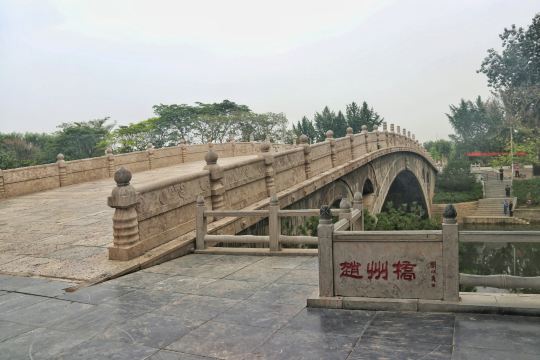
▲ Zhaozhou Bridge, also known as Anji Bridge and locally called the Great Stone Bridge, was built between 595 and 605 AD during the Sui Dynasty, with a history spanning over 1,400 years. Designed and constructed by master craftsman Li Chun of the Sui Dynasty, it was later named "Anji" by Emperor Zhezong during his northern inspection in the Northern Song Dynasty. As a large single-span open-spandrel stone arch bridge, Zhaozhou Bridge features a main arch composed of 28 parallel arch ribs arranged longitudinally. The bridge measures 64.4 meters in total length with a deck width of 9 meters, expanding to 9.6 meters at the arch abutments. The main arch has a clear span of 37.02 meters and a rise (vertical distance from the crown to the springing line) of 7.23 meters. Two smaller arches near each abutment have clear spans of 3.81 meters, while the two arches closer to the bridge center span 2.85 meters each.
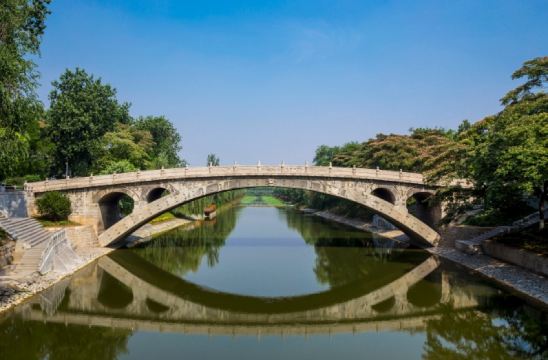
▲ Zhaozhou Bridge is an ancient stone arch bridge renowned for its long history, excellent preservation, advanced scientific design, and exquisite artistic form. It holds an extremely important position in the history of world architecture and has been celebrated since ancient times as "the most magnificent bridge under heaven." Today, it is honored as "the world's foremost bridge." In 1961, it was designated by the State Council as one of China's first batch of major historical and cultural sites under state protection. In September 1991, the American Society of Civil Engineers selected it as the 12th "International Historic Civil Engineering Landmark" and erected a commemorative plaque and monument in its honor.