
Things to do in Nara City
Explore top experiences
Top 10 attractions in Nara City


Nara Park
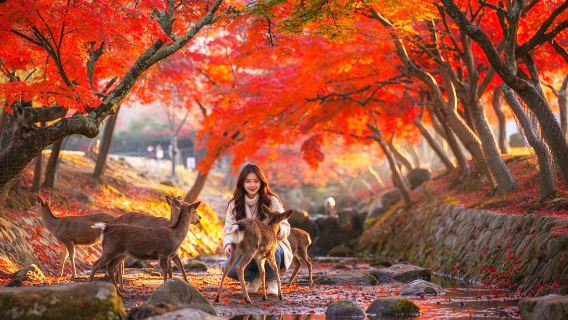
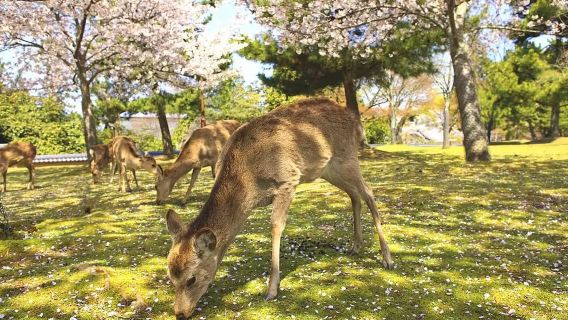
Nara Park is a historic city park in Nara City, Japan, opened in 1880 and famous for its herds of free-roaming deer. The park features expansive lawns, lush trees, and scattered ponds and streams, and is home to a large number of deer designated as natural monuments. The deer often forage and play on the grass, and will also approach visitors. There are stalls in the park selling deer crackers, which visitors can purchase to feed the deer. When feeding the deer, it is best to take one piece at a time and put the food away promptly after feeding to avoid teasing the deer by holding the crackers for too long. The park is backed by the Mt. Kasuga Primeval Forest and is surrounded by a rich natural environment, with unique scenery in each of the four seasons. In spring, fresh greenery contrasts with cherry blossoms; in the fall, you can enjoy the autumn leaves; and on ordinary days, it is also suitable for strolling along the lawns and forest paths. Tobihino is an open lawn where you can often see deer moving about freely. Historic buildings and cultural heritage sites such as Tōdai-ji, Kasugataisha Shrine, and Kohfukuji Temple are located around the park, blending natural scenery with the atmosphere of the ancient capital. Every February and August, Kasugataisha Shrine holds the Mantoro (Ten Thousand Lanterns) festival, where the stone lanterns along the approach and the hanging lanterns are lit one by one, creating a tranquil and traditional night view.Nara City · 3.5km from downtown

Kasugataisha Shrine
Kasuga Taisha Shrine is a religious place of worship for Shintoism in Japan. It was established in 710 and has been included in the list of world cultural heritage. It is dedicated to the four guardian deities of the Fujiwara family, and is now an important worship site in Japan. The entire shrine rests on the foot of Kasuga Mountain, surrounded by lush and beautiful vegetation. Kasuga Mountain has always prohibited logging, so everything here seems natural and ancient. There are beautiful views along the way. At the intersection near the Nara Prefectural Office, you can see a tall Ichino Torii, and go all the way along the long Omotesando. From time to time, there will be lively and cute deer coming to you. If you happen to buy deer cookies, you can feed them all the way. Walking near Feihuoye, on the left is the Nara National Museum. If you are interested in Buddhist culture, you can visit it. The Nara Buddha Museum inside has a very good collection. And in the woods on the right side of the path, is the home of the lovely deer - Luyuan. Continue along Omotesando, from here, stone night lights will gradually appear on both sides of the path, and there are dense forests on both sides. There is a Manyo Botanical Garden at the right turn of the access road. There are more than 300 kinds of plants in it. It is recorded in the ancient Japanese song collection "Manyoshu". You can enjoy different plants according to different seasons. In winter, it is limited. During the lantern festival to be held, you may wish to go on a night tour. The spectacular stone lanterns on the access road turn right and then walk forward to a small crossroads, facing a squatting stone deer, and in front of them are the washbasins of the shrines, where you can clean your hands and prepare to worship to show your respect to the gods . According to legend, the horse of the god of the shrine is a deer, so people believe that the deer in the nearby mountains and forests are the messengers of the god. There are dense stone lanterns on both sides of the access road. These are donated and built by believers and believers. The rows are uneven and spectacular. There are currently about 1,800 lanterns. You can see that these stone lanterns are covered with moss, which is very ancient and Zen. At this time, walk north for a few minutes along the path on the left, and you can visit the Treasure Hall, but until the summer of 2016, it is still under maintenance and temporarily closed. The cute little deer sign and the ancient wisteria go up the stairs, pass the south gate, and officially enter the Kasuga Taisha Shrine. On the left side of the door, you can buy a wishing royal guard, write an ema or smoke a deer. sign. In this courtyard, there is a wisteria plant that is over 700 years old. The branches are on the wooden shed, and the purple flower sea when it blooms in spring is very beautiful. You need to buy a ticket to enter the main hall. The first is the shrine for worship and prayer, and the main hall of the shrine is inside. There is a row of scattered copper lanterns hanging between the West Corridor and the Zhihui Hall, with the Japanese shrine architecture in vermilion, which is very distinctive. It is also a popular location for tourists to take pictures. After passing through the dance hall, you will enter the Apple Garden, so named because of the presence of an apple tree. Nestled on the front of the Zhihui Hall is a huge cypress tree, which is said to have a history of 800-1000 years. The unique thing is that there is a branch that emerges from the roof of the Zhihui Hall and grows vigorously. The manifestation of vitality. The main hall and the apse are located in the shrine. The entire surface of the building is painted in vermilion. There are also many Japanese religious buildings in the courtyard, such as the Taga Shrine, which prays for longevity. You only need to put 200 yen in the "Housing Box". There are a large number of small shrines on the wayNara City · 4km from downtown

Universal Studios Japan
There are thrilling rides themed around Hollywood's superstar movies, fantastic performances by popular cartoon characters, and more, so everyone can have fun! Featuring the world's first Nintendo theme park, experience the world of Super Mario in an immersive way! Festive limited parades and float tours! Everyone is a protagonist in this enthusiastic parade where everyone is full of passion and vigor! Universal Studios Japan (“USJ”) in Osaka is one of the world's five Universal Studios theme parks, which opened for business in 2001 and is a classic and wonderful world of fun in the hearts of many visitors. It is similar in design to Universal Studios Orlando in the U.S., with popular parks such as Jurassic Park, Hollywood, and Waterworld, and more than 60 fun-filled attractions. With these attractions, you can enjoy a day of fun and entertainment at Universal Studios Japan. Universal Studios Japan is also home to popular themed IP parks such as “Super Nintendo World (Mario/Super Mario)”, “Minion Park” and “The Wizarding World of Harry Potter”. Whether it's interacting with the minions, riding on Mario Kart, or traveling through the Wizarding World of Hogwarts, it's an unforgettable experience that is full of excitement. △“Super Nintendo World” is the world's first Nintendo theme park built by Nintendo in cooperation with Universal Studios Japan. With the globally popular Super Mario as the protagonist, the game's Kuba Castle, Princess Brigitte's Castle, and the Mushroom Kingdom are reproduced 1:1 in a super-realistic way, providing immersive experiences of the world of Super Mario! △The “Freeze Ray Sliders” and “Despicable Me: Minion Mayhem” will get you involved in a huge farce and heat wave with the minions! The Minions have finally fulfilled their ambitions! All of humanity will be a part of the mayhem at the Minion Park! △Embracing a variety of areas with unique characteristics, wonderment and surprise, Universal Studios Japan covers a whole spectrum of world-class entertainment through thrilling rides and shows themed on blockbuster Hollywood movies, as well as seasonal events for all ages to enjoy. The Wizarding World of Harry Potter™ will reproduce the world from the Harry Potter™ stories, bringing it to life on a phenomenal scale at Universal Studios Japan.Osaka · 34.1km from Nara City

Mount Wakakusa
Wakakusa Mountain is located near Todaiji Temple and Kasuga Taisha Shrine. Visitors can climb it from the Spring Festival to the autumn, and you can see the scenery of Nara from the middle of the mountain. On the top of the mountain, there is an ancient burial mound with a round front and a back, and you can enjoy the beautiful night view of Nara from the top of the mountain at night. Wakakusa Mountain is very famous for the "Wakakusa Burning Mountain" festival, which is a traditional event held every January with fireworks and burning the mountain.Nara City · 4.6km from downtown

Osaka Castle Park
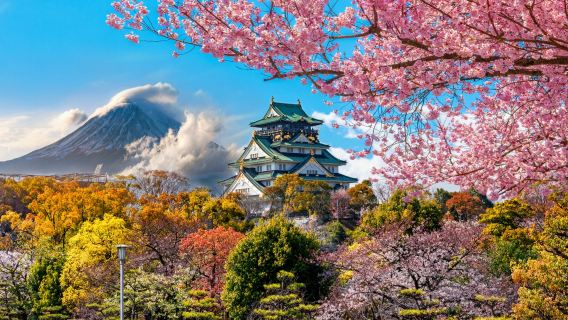
Osaka Castle Park is located in the center of Osaka. The iconic view in the park is Osaka Castle tower, along with Nishinomaru Garden where you can enjoy seasonal flowers and Osaka Castle Plum Grove. It also has well-equipped public facilities such as a softball field, outdoor music hall, and rugby/soccer field. Osaka Castle Park is lush with vegetation, and during the flower season, groups of visitors come to enjoy the scenery. Scenery varies with the seasons Osaka Castle Park is surrounded by various vegetation and planted with numerous trees. Cherry blossoms are everywhere in Nishinomaru Garden, and you can also enjoy night cherry blossoms in spring. The plum grove has thousands of plum trees with many varieties. There is also the peach garden in the north and the stunning red leaves of the memorial forest. Its ever-changing scenery throughout the seasons captivates countless travelers. Stone walls and moats The massive stone walls built with huge rocks are a symbol of the impregnable Osaka Castle of the Tokugawa shogunate. The moat is 70-90 m wide, with towering stone walls on both sides, often exceeding 20 m in height. Travelers visiting the site are all amazed by the grandeur of the architecture. Osaka Castle Main Tower (Osaka Castle Museum) The Osaka Castle Main Tower standing in the park is very famous. You can enjoy a panoramic view of the city from the top floor of Osaka Castle Main Tower. Other facilities Osaka Castle outdoor music hall and Osaka Castle gymnasium often host concerts. In addition, there are sports facilities such as an archery range and a dojo.Osaka · 25.5km from Nara City

Tōdai-ji
Todaiji Temple is located on the north side of Nara Park, also known as Dahuayan Temple, Jinguangguang Sitianwang Huguo Temple, etc. It was established in 728 by Emperor Shengmu who believed in Buddhism. The Great Buddha Hall of Todaiji Temple is the largest ancient wooden building in the world. Inside the hall is a statue of Lucena Buddha about 16 meters high, which is the largest bronze Buddha statue in the world. As a landmark of Nara, it is always packed with tour groups and students from all over Japan. The entire Todaiji Temple covers a wide area. In addition to the Great Buddha Hall, there are many unmissable sights, including the South Gate, Eryuetang, Sanyuetang, Zhengcangyuan, etc. Before visiting the main hall, remember to take a look at the south gate. There are two huge Niwang statues on both sides of the gate. They are more than 8 meters high, look fierce, and are very beautifully carved and vivid. There is a Todaiji Museum on the west side of the South Gate, where you can learn about the history of Todaiji and watch cultural relics. Entering from the west side of the south gate, you can reach the main hall of the Todai Temple - the Great Buddha Hall, also known as the Golden Hall. Standing in front of the Great Buddha Hall, you will definitely feel its shock, majestic and revealing a simple charm. The existing Great Buddha Hall was built in 1709. Although it is the largest ancient wooden building in the world, it is only about two-thirds of the original building. Walking into the Great Buddha Hall, you can see the bronze statue of Lucena Buddha more than 10 meters high, which has a strong visual impact. After centuries of vicissitudes, the head of the Big Buddha has been stolen several times. If you look closely, you will find that the color of the head and body is slightly different. The hall also enshrines the Void Tibetan Bodhisattva, Ruyi Wheel Avalokitesvara and so on. Walking around the Buddha statue, you will see a hole at the bottom of a wooden pillar, called "Buddha's nose", it is said that if you can pass through it, you will get peace and happiness. Usually there will be many children waiting in line here, if adults also want to try it will be more difficult, but fortunately a staff will pull you out. In addition, you may wish to go to the model of Todaiji Temple to study the scene of the temple in its heyday. Climb up and overlook the Great Buddha Hall and go to the Ergakudo on the top of the eastern hill, where you can overlook the scenery of Nara, especially at dusk. Turn left outside the exit of the Great Buddha Hall, walk along the fence through the pond, and then walk up the mountain along the stone road. The scenery along the way is very charming. Soon you will reach the platform at the top of the mountain, where there is Er Yue Tang. A few steps further south is Sanyuedo (Hokaido), an ancient building of Todaiji Temple, which houses some exquisite statues from the Nara period. When you walk into Todai-ji Temple or take a walk in the temple, you can see deer all over the place. If you come here in spring and autumn, it is also a very elegant experience to enjoy the cherry blossoms or red maples while strolling.Nara City · 3.2km from downtown

Osaka Castle Museum
The Osaka Castle Museum is the core structure of Osaka Castle. In 1583, Toyotomi Hideyoshi began construction of the castle here, earning it the nickname "Hideyoshi's castle." The current museum, seen today, is a reinforced concrete reconstruction completed in 1931 based on the design from the Toyotomi era. Its interior has been converted into a museum showcasing the history of Toyotomi Hideyoshi and Osaka Castle. Standing atop a tall stone foundation, the building features white walls adorned with green roof tiles. Its upturned eaves are decorated with gold-leaf tigers and golden shachihoko (mythical creatures with tiger heads and fish bodies), making it an instantly recognizable landmark of Osaka. Visiting the tower and viewing exhibitions are the main activities here: the small theater on the first floor loops several short films about Toyotomi Hideyoshi and Osaka Castle, with Chinese subtitles; the second floor introduces basic knowledge about Osaka Castle and Japanese castles, where visitors can try on restored Sengoku-period helmets and jinbaori for photos, with optional women's kosode available, and also see full-scale replicas of the golden shachihoko and crouching tiger roof ornaments; the third and fourth floors display historical materials about Toyotomi Hideyoshi and the Sengoku period, which are rotated approximately every two months, with the third floor also featuring a restored model of the golden tea room and Osaka Castle models from both the Toyotomi and Tokugawa periods—note that photography is prohibited on these two floors; the fifth floor recreates the fierce battle scenes from the "Summer Siege of Osaka" folding screens using miniature figurines and projections; the seventh floor's "Mechanized Taikoki" uses dynamic miniature dioramas to depict Hideyoshi's life from humble origins to unifying the nation; the eighth floor is an observation deck approximately 50 m above ground, offering panoramic views of Osaka Castle Park and the cityscape. The elevator inside the building only goes up to the fifth floor directly, and the remaining floors require stairs, so visitors with elderly or young children should plan accordingly. The surrounding scenery offers seasonal highlights: cherry blossoms bloom in clusters along the moat and in the park during spring, while fall foliage contrasts with stone walls and white walls, making it another photogenic season beyond the castle tower.Osaka · 25.5km from Nara City

Abeno Harukas 300 Observatory
The iconic building, which combines three squares, is the distinctive appearance of Abeno Harukas, and at the same time represents a "vertical city" where various facilities such as department stores, hotels, offices, art museums, and observation decks coexist. The design is not only symbolic of the distinctive features of Abeno Harukas, but also familiar to many people. The colors are "akane-iro" (red madder) and "sumi-iro" (black ink), which have been used since ancient times in Japan. Akane is a plant that is used to make red dye, and in waka poetry it is also used as a pillow word for "sun" (sun) and "shine". It is a warm color that is fitting for Abeno Harukas, which is "the first to shine in the morning sun and the longest to be dyed in the evening sun" in Osaka. Abeno Harukas, a 300m-tall skyscraper complex, is directly connected to Kintetsu Osaka Abenobashi Station and JR and Osaka Metro Tennoji Station. There are a variety of shops, including one of Japan's largest department stores, an observation deck, an art museum, and a hotel, so you can enjoy yourself all day long. There is also a wide selection of delicious gourmet food, including lunches and sweets that can be enjoyed along with Osaka's most spectacular views.Osaka · 27km from Nara City

Toshodaiji
Tangshoti Temple is located in Gojo-cho, Nara. It is a temple founded by the eminent monk Jianzhen of the Tang Dynasty. It still has a strong style of the Tang Dynasty. The golden hall and the lecture hall are all wooden buildings in the 8th century, which are extremely precious. Historical Background Monk Jianzhen accepted the invitation of Emperor Shengmu to come to Japan to promote Buddhism and reform Japanese Buddhism. However, after 5 times of distress at sea and blindness, it took him 12 years to finally arrive in Nara. In 759 AD, Tang Zhaoti Temple was established by Emperor Ling Jianzhen on the basis of the old house of the Seventh Prince of Emperor Tenmu. "Zhaoti" means a dojo for practice beside the Buddha, and Tang Zhaoti Temple means that this temple is an exclusive dojo built for monk Jianzhen who came from the Tang Dynasty to practice, for him to set up an altar to preach scriptures. After Jianzhen passed away, the temple was still under construction, and most of the courtyards were not completed until the Heian period. Therefore, the style of Tangshoti Temple combines the architectural features from the Tianhe period to the Heian period, and is a very valuable world cultural heritage. After paying respects to Master Jianzhen, Jianzhen was buried here. There is Jianzhen's tomb in the temple, and many devout Buddhists from China and Japan will come here to pay respects. In front of the tomb, there is a Qionghua tree transplanted from Yangzhou, the hometown of Master Jianzhen. In addition, the Yuying Hall, where the statue of the master is placed, preserves the precious woodcut statue of Jianzhen. The eyes are closed, the demeanor is dignified, and there is a firm and unswerving temperament between the eyebrows. Every year, it is only displayed on the day of Jianzhen's death (June 6).Nara City · 2.1km from downtown

Kohfukuji Temple
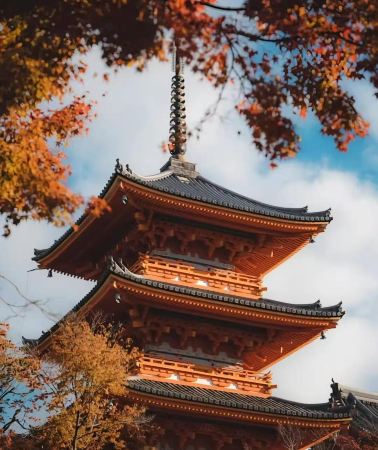
The predecessor of Kofuku-ji Temple can be traced back to Sanjie-ji Temple in Asuka, which was built in 669. After the Fujiwara family moved the capital to Heijo-kyo in 710, it was all moved to present-day Nara and renamed as Kofuku-ji Temple. Because it is the family temple of the Fujiwara family, the temple has received a certain degree of attention and protection, and it has become one of the seven major temples in the Heian period. Later, due to a series of power struggles, many buildings were destroyed. Today's Xingfu Temple was rebuilt during the heyday of the Hei clan. landmark building. The temple also houses many national treasure-level balances and Buddhist sculptures from the Kamakura period. We can see their treasures in the National Treasure Museum, such as the statue of Asura, the head of the six-sixth Buddha, as well as some paintings and historical materials.Nara City · 2.4km from downtown
Experiences you can't miss in Nara City
Featured Day tours in Nara City
View all Day tours

4.9/5
· 1.8k reviews· 21.4k bookedFree cancellation
Instant confirmation
Book now for tomorrow
98.3% of travelers recommend
FromBRL 186.84
4.5/5
· 29 reviews· 675 bookedFree cancellation
Book now for tomorrow
50% off
Limited-time sale
FromBRL 160.67BRL 321.34
![[Guaranteed Departure] Kyoto Fushimi Inari Taisha + Arashiyama + Kinkaku-ji + Nara Park 1-day Tour](https://ak-d.tripcdn.com/images/0353t12000trzoqyaBE96_C_568_320.png?_fr=wc)
4.6/5
· 55 reviews· 321 bookedFree cancellation
Instant confirmation
92.7% of travelers recommend
65% off
Limited-time sale
FromBRL 114.07BRL 325.93
4.9/5
· 39 reviews· 293 bookedFree cancellation
Instant confirmation
Book now for tomorrow
97.4% of travelers recommend
10% off
Limited-time sale
FromBRL 231.36BRL 257.07

4.8/5
· 850 reviews· 4.1k bookedFree cancellation
Book now for tomorrow
100 consecutive positive reviews
14% off
Limited-time sale
FromBRL 228.14BRL 265.29
4.9/5
· 86 reviews· 958 bookedFree cancellation
Instant confirmation
Book now for tomorrow
73 consecutive positive reviews
10% off
Limited-time sale
FromBRL 231.36BRL 257.07
4.8/5
· 107 reviews· 1k bookedFree cancellation
Book now for tomorrow
26 consecutive positive reviews
FromBRL 173.17
4.8/5
· 326 reviews· 3.1k bookedFree cancellation
Book now for tomorrow
43 consecutive positive reviews
FromBRL 253.51
Featured Cultural experiences in Nara City
View all Cultural experiences
![Osaka departure [lazy route] Nara deer interaction + Uji matcha tasting + Japanese-style healing](https://ak-d.tripcdn.com/images/0353u12000lwbkvv5A898_C_568_320.jpg?_fr=wc)
4.9/5
· 80 reviews· 636 bookedFree cancellation
Book now for tomorrow
97.5% of travelers recommend
7% off
Limited-time sale
FromBRL 236.51BRL 257.07

Free cancellation
Book now for today
20% off
Limited-time sale
FromBRL 29.60BRL 37.01

FromBRL 126.64

5.0/5
· 9 reviewsFree cancellation
Book now for today
5% off
Limited-time sale
FromBRL 121.61BRL 128.02

Free cancellation
Book now for tomorrow
8% off
Limited-time sale
FromBRL 143.63BRL 156.12

Free cancellation
Book now for today
5% off
Limited-time sale
FromBRL 537.75BRL 566.06
4.0/5
· 1 reviewFree cancellation
Book now for tomorrow
FromBRL 270.04
Featured City sightseeing in Nara City
View all City sightseeing
5.0/5
· 1 reviewFree cancellation
Book now for tomorrow
FromBRL 84.40
FromBRL 270.04
FromBRL 594.47
FromBRL 632.90
4.5/5
· 2 reviewsFree cancellation
Book now for tomorrow
5% off
Limited-time sale
FromBRL 244.42BRL 257.29
Featured Food & drink in Nara City
View all Food & drink

Free cancellation
Book now for today
5% off
Limited-time sale
FromBRL 293.34BRL 308.78


![[Floral Wall Cuisine] Chef's Recommended Package - Choose One of Two Dining Vouchers](https://ak-d.tripcdn.com/images/0351r12000qf60rn69707_C_568_320.jpg?_fr=wc)

Free things to do in Nara City
Nara Park
Nara City · 3.5km from downtownKasugataisha Shrine
Nara City · 4km from downtownUniversal Studios Japan
Osaka · 34.1km from Nara CityBook now for todayMount Wakakusa
Nara City · 4.6km from downtownOsaka Castle Park
Osaka · 25.5km from Nara CityTōdai-ji
Nara City · 3.2km from downtownOsaka Castle Museum
Osaka · 25.5km from Nara CityImmediate access, Book now for todayAbeno Harukas 300 Observatory
Osaka · 27km from Nara CityImmediate access, Book now for todayToshodaiji
Nara City · 2.1km from downtownKohfukuji Temple
Nara City · 2.4km from downtown
More ways to travel from Nara City
Private Tours in Nara City
View More Private Tours in Nara City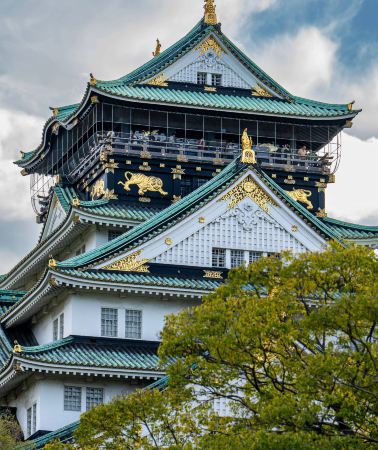


Group Tours in Nara City
View More Group Tours in Nara City


What travellers say about Nara City

Jason Egg29 June 2026
5.0
Nara Park is a beautiful place to enjoy nature and experience one of Japan’s most famous attractions. The friendly deer roaming freely throughout the park made the visit unique and unforgettable. Feeding the deer with special crackers and watching them bow before receiving food was a fun experience. The park is spacious, with peaceful walking paths, large green lawns, and beautiful scenery. I also enjoyed visiting the nearby temples and shrines, which added to the cultural experience. The atmosphere was relaxing, especially in the morning when there were fewer crowds. It is a perfect place for families, couples, and photographers. I highly recommend visiting if you are looking for a mix of nature, history, and memorable interactions with the famous Nara deer.
Nara Park

Jenny in Sydney1 September 2024
5.0
We departed from Osaka, took the train to Nara Station, and then took a bus to Kasuga Taisha. The bus stop is on the other side of the road after exiting the station, and many cars go there. It is recommended to take a bus for about 30-40 minutes on foot, and walk back to Nara Park to feed the deer. I remember that the ticket for Kasuga Taisha is 500 yen. The building is mainly red, and there is a secret room that is dark and I don’t know what it is for. I also went in to see it. There are many stone lanterns, which is also a Japanese feature.
Kasugataisha Shrine

Mrs Roeper15 October 2026
5.0
Must go attraction with your kids, the best amusement park, lovely people working in the park, very helpful and have a big smile on their face, which is amazing ❤️🩷💚🧡🙏🏻
Universal Studios Japan

鹰鲨3 June 2025
5.0
The scenery is beautiful. You must buy tickets before 17:00, otherwise you can't get in. There are many deer inside. Almost half of the tourists are Chinese compatriots. Climb to the top of the peak and watch the sunset. It's very pleasant. Walk carefully, the mountain is a bit steep, watch the children, there is a toilet inside, the entrance and exit are different, and you will reach Todaiji Temple when you go out.
Mount Wakakusa

_TI***sk10 October 2026
5.0
Hidden within this room lies the charm of nature. Pushing open the door, verdant greenery greets you first. Leaning against the window, the murmuring of a spring fills the air, while mist and haze drift into the room along the window sill. Each season presents its own unique beauty here: spring brings forth new bamboo shoots, summer offers lush shade, autumn fills the courtyard with the fragrance of osmanthus, and winter sees snow tapping against the window. Every detail in the room reflects thoughtful consideration: the mattress's firmness perfectly supports a tired back, the toiletries have a pleasant, non-irritating scent, and a warm, yellow light awaits you at the door when you return late at night. This is not just a temporary resting place, but a sanctuary for the soul. After a few days, even the most tense nerves gradually relax, allowing you to rediscover your most relaxed state.
Osaka Castle Park

Miasmile5 June 2024
5.0
Record of 2019.11 Kansai Late Autumn Trip~
When you come to Nara during the maple leaf season, Todaiji Temple is a must-visit place for maple viewing. Before coming here, I didn't know that Todaiji Temple was so large. With the Great Buddha Hall as the center, there are East and West Seven-story Pagodas, South Gate, Lecture Hall, Kaidan-in, Shoso-in, Nigatsu-do, Hokke-do, Kaisan-do, etc. It is really magnificent. It is said that the Great Buddha Hall is the largest wooden building in the world.
It was only evening when I came all the way from Nara Park to Todaiji Temple. I didn't have enough time to visit them one by one, so I only visited Nigatsu-do.
But just such a quick and hurried tour is enough to be shocked by the red maple landscape. If I have the chance, I must come again!
Tōdai-ji
_TI***fr12 October 2026
5.0
It’s showed the related historycal knowledge in a very intresting manner. It gives a lot of information and you don’t need to wait for the tickets office, where always has big line.
Osaka Castle Museum

Paul Ivan12 October 2026
5.0
Honestly, I'm so glad I decided to visit Abeno Harukas 300. I went during the day because of my schedule, and it turned out to be a great choice. It wasn't busy at all, which meant I could take some really nice photos without having to worry about crowds or people getting in the way.The observatory is spread across multiple floors, and there's also a café with an open-air area where you can enjoy the views of Osaka without looking through glass. That was definitely one of my favourite parts of the experience.Getting in was easy and straightforward, and I didn't have to wait long. Overall, it's a great spot to enjoy the city from above, take some photos and relax for a while. If you prefer a quieter experience and want to avoid the crowds, I'd definitely recommend visiting during the day. I really enjoyed it and would happily recommend it to anyone visiting Osaka!
Abeno Harukas 300 Observatory

VOVO逍遥行12 June 2025
5.0
It was built by the Tang Dynasty monk Jianzhen in 759 AD and completed in 770 AD. It is the main temple of the Vinaya School of Japanese Buddhism. It is listed as one of the two major temples for the dissemination and research of Vinaya along with the Kaidan-in of Todaiji Temple. The banner on the gate of the temple, "Tōshōdaiji", was written by the Japanese Empress Koken in the style of Wang Xizhi and Wang Xianzhi. There are lecture halls and ordination platforms from the Tenpyō era, golden halls from the Nara era, and drum towers from the Kamakura era in the temple. The golden hall, sutra collection, drum tower, and statue of Jianzhen are known as national treasures. Jianzhen also brought the high level of civilization of the Tang Dynasty in China, and promoted the improvement of the level of Buddhism, medicine, architecture, and sculpture in Japan. In 1980 and 2010, the statue of Jianzhen returned to Yangzhou twice to "visit relatives". In 1998, Toshōdaiji was listed as a World Cultural Heritage as an important part of the "Cultural Heritage of the Ancient Capital of Nara".
Toshodaiji

一直在路上的猫23 April 2025
4.0
• Origin and migration: In the eighth year of Emperor Tenji (669), Fujiwara no Kamatari no Namuro Kagami established Yamashina Temple in Taoyuan, Yamashina Village, Yamashiro. In the first year of Emperor Tenmu (672), it was moved to Umayano, Yamatotakaichi County, and renamed Umayano Temple. In the third year of Wasedo (710), when the capital was moved to Heijo-kyo, Fujiwara no Fuhito moved the temple site to the present site and changed its name to Kofuku-ji Temple.
• Development and rise and fall: It prospered with the prosperity of the Fujiwara clan and became one of the seven major temples in Nanto. In the Heian period, it also managed Kasuga Shrine, and its power was even greater. After the Kamakura and Muromachi periods, due to frequent wars and the recovery of the estate, the temple gradually declined. During the Meiji Restoration, it was affiliated with the Shingon sect. In the fifteenth year of the Meiji Restoration (1882), it became independent and once again became the head temple of the Hosso sect.
• Chukin-do: Built by Fujiwara no Fuhito, it is the central building of Kofuku-ji Temple. When it was first built, it was the largest temple in the Nara period. It was burned down many times and rebuilt in October 2018. It has the characteristics of the Tenpyo style.
• Five-story pagoda: First built by Empress Komyo in 730, the current pagoda was rebuilt in 1426. The pagoda is 50.1 meters high and is the second tallest pagoda in Japan. It is an important protected cultural relic in Japan.
• Three-story pagoda: Built by Empress Sutoku in 1143, the current pagoda was built in the early Kamakura period. 1,000 statues of Yakushi Nyorai, Shakyamuni Nyorai, Amida Nyorai, and Maitreya Nyorai are depicted on the internal wall panels of the first floor.
• Hokuen-do: Built to commemorate Fujiwara no Fuhito, it is an octagonal building similar to the Yumedono of Horyu-ji Temple. It was first built in 721 and the current building was built in 1210.
• Cultural Relics Collection: The temple has rich treasures, with more than 100 valuable cultural relics of national treasure and important cultural property level. The National Treasure Museum houses the famous Asura statue, the six-foot-tall Sakyamuni head statue, Buddha statues, paintings, crafts, historical materials, etc.
• Religious Status: Xingfu Temple is the main temple of the Dharma-Appearance Sect, one of the six sects in Nandu, and is also one of the seven major temples in Nandu. It is the central dojo of Dharma-Appearance and Abhidharma-Sasana teachings, and has produced many talents.
Kohfukuji Temple


