Fanshi

Things to do in Fanshi

Search attractions or local attractions & tours
Search

Explore top experiences

Top 10 attractions in Fanshi

View all Attractions
Wu Tai Shan
No. 2 of Fall Viewing Attractions in Shanxi

Wu Tai Shan

7.8
4.6/5
8.7k reviews

Wu Tai Shan is located in Wutai County, Xinzhou City. It is named for its five peaks, whose summits are flat like platforms and cluster together. As the sacred site of Bodhisattva Manjushri, it is dotted with numerous temples and is one of China's Four Sacred Buddhist Mountains. It is also a well-known summer resort, with a cool and pleasant climate in summer. What makes it unique is the coexistence of Yellow Temples (Tibetan Buddhism) and Blue Temples (Han Buddhism); visitors can see both Han Buddhist monks and Tibetan lamas, and this pattern of Han and Tibetan Buddhism coexisting is quite rare among China's sacred Buddhist mountains. If the five fingers are likened to the towering "Five Terraces," the palm is Taihuai Town—the geographic center of the attraction, where most temples are concentrated and which serves as the main base for visitors. To the northwest of the town lies a cluster of essential temples, which can be explored on foot or by the attraction's eco-friendly shuttle bus. The Great White Stupa of Tayuan Temple is the landmark structure of the attraction; in front of the gate of Luohou Temple stand a pair of ancient stone lions; Xiantong Temple is the largest Qingmiao (Chinese Buddhist) temple on the mountain; and Pusading is a highly representative Yellow Hat (Tibetan Buddhist) monastery. From Taihuai Town, crossing the Qingshui River to the north, you reach Dailuoding. Ascending the Dazhi Road with over a thousand stone steps, you can pay homage to the Five Directional Manjushri statues, known as the "Little Pilgrimage," or take a round-trip cable car. Heading south along the road, Bishan Temple is a Ten Directions Zen Monastery, housing a Burmese jade Buddha and a statue of the future Buddha Maitreya; Shuxiang Temple contains a tall painted clay statue of Manjushri; Nanshan Temple is renowned for its dazzling array of stone carvings and offers distant views of the South, North, and Central Terraces. Zhenhai Temple is serene and secluded, preserving painted murals within, and local folklore tells of legends related to Emperor Shunzhi's renunciation. In addition to the main temples above, there are also Nanchan Temple, Longquan Temple, Baiyun Temple, and others on the mountain, each with its own distinctive features. If you wish to reach the summit of the five terraces—known as the "Great Pilgrimage to the Terraces"—the East Terrace, Wanghai Peak, is a great place to watch the sunrise, with spectacular views of the sea of clouds and the rising sun; the South Terrace is covered with wildflowers in summer; on the West Terrace on an autumn night, the moon hangs like a mirror above the peak; the North Terrace is a high peak in North China and an excellent spot for enjoying snowy scenery, offering panoramic views of the surrounding mountains after snowfall.

Wutai County · 37.3km from Fanshi
Yanmenguan
No. 8 of Fall Viewing Attractions in Shanxi

Yanmenguan

8.1
4.7/5
8.2k reviews

Yanmenguan, located approx. 30 km northwest of Dai County in Xinzhou, is a pass on the inner Great Wall of the Ming Dynasty, andNingwu Pass, together with Pianguan, they are known as the "three outer passes". There is no public transportation from Dai County town to the attraction, so you can only get there by private charter. Inside the attraction, you have to rely entirely on walking.YanmenguanSince ancient times, it has been a crucial pass for the Central Plains dynasties to defend against invasions from northern nomadic tribes. Its earliest history can be traced back to the Warring States period when King Wuling of Zhao fought against the Xiongnu here. Han Dynasty generals Li Guang, Wei Qing, and Huo Qubing once led troops to battle the Xiongnu in this area. During the Northern Song Dynasty,YanmenguanIt became the main battlefield between the Song and Liao dynasties, and the prototype of the well-known story of the Yang family generals took place here. A statue of Yang Liulang stands in the attraction. ExistingYanmenguanIt was built in the seventh year of the Hongwu era of the Ming Dynasty (1374) (with multiple reconstructions in recent years). Currently, there are three gates (east gate, west gate, and small north gate). A wild goose tower stands atop the east gate, and the lintel of the small north gate (i.e., the barbican gate) is inscribed with "Yanmenguan"Three large characters flanked by brick-carved couplets: 'Foremost strategic pass in three frontiers, most revered fortress among nine passes,' both inscribed by the great calligrapher Fu Shan of the late Ming and early Qing dynasties. You can visit the ruins of Ming and Qing military barracks on the hill north of the fortress. To the right outside the west gate areGuan Yu templeOutside the east gate stands the Jingbian Temple, dedicated to Li Mu, a renowned general of the Zhao state during the Warring States period. If you are a fan of the Great Wall, when you visit Yanmenguan, you can walk along the ancient pass trail here. The ancient pass trail in the attraction is built along the local mountain terrain, winding through the peaks. Climbing this section of the trail may be slightly tiring for those who usually work in offices, but when you ascend a peak along the ancient path and gaze at the vast expanse of withered grass outside the pass, quietly feeling the weight of history, you'll find the physical effort well worth it. There are some farmhouse inns near Yanmenguan that can provide food and stay, but most visitors return to Dai County or go to other counties or cities for accommodation. Walking the ancient pass consumes a lot of energy, so you can bring some dry food and drinking water.

Dai County · 33.3km from Fanshi
Yanshan Temple

Yanshan Temple

3.9
4.8/5
15 reviews

Yanshan Temple, originally named Lingyan Temple, was founded in the third year of the Zheng Long reign of the Jin Dynasty (1158). It was repaired several times during the Yuan, Ming, and Qing Dynasties. Yanshan Temple faces south and has an irregular rectangular floor plan. The main hall has been destroyed. The existing buildings mainly consist of a three-bay south hall, three-bay east and west side halls, four other halls, three meditation rooms, a hanging flower gate, and a bell tower that also serves as the mountain gate. Except for the south hall, the rest are buildings from the late Qing Dynasty to the folk period. The temple grounds are lush with green pines, and the ancient halls are majestic and serene, like a dazzling pearl set in the mountains. The south hall is the Manjushri Hall, five bays wide and six rafters deep, with a single-eave hip roof. Inside the hall are remnants of Jin Dynasty painted clay sculptures of the Water-Moon Guanyin, attendants, and Manjushri's mount. The Water-Moon Guanyin has a full face, a dignified expression, and flowing robes as if she is about to take flight.The inner walls are surrounded by Jin Dynasty murals, covering a total area of ​​approximately 90 square meters. Completed in the seventh year of the Dading era of the Jin Dynasty (1167 AD), they were painted by Wang Kui, a court painter of the Jin Dynasty. The murals depict Buddhist stories. The west wall portrays the life of Shakyamuni; the east wall depicts the story of Prince Yangsheng offering his own flesh to his parents as a sign of filial piety; the north wall depicts a group of pagodas and temples and the story of five hundred merchants who were shipwrecked at sea and rescued by a Rakshasa woman; the south wall depicts pavilions, figures, and donors. The artistic images depicted, whether emperors and generals, concubines and talented women, farmers and merchants, or palaces, mills, taverns, flags, and carriages, all reflect the social structure of the Northern Song Dynasty. Many of these scenes can be considered a microcosm of social life during the Song and Jin periods. They are invaluable materials for the study of Song and Jin history, society, religion, architecture, and art, and together with the Yongle Palace murals, they are considered the "twin peaks" of Shanxi murals.

Fanshi · 34.3km from downtown
Yingxian Wooden Pagoda
No. 3 of Best Things to Do in Shanxi

Yingxian Wooden Pagoda

8.6
4.8/5
26k reviews

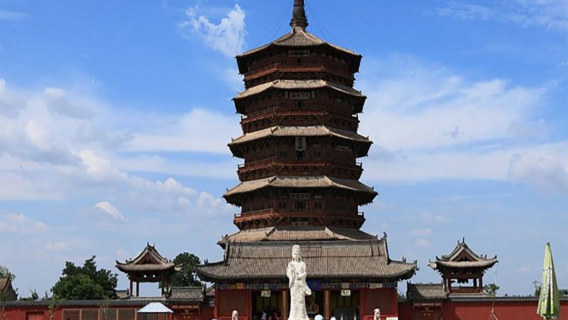
Yingxian Wooden Pagoda is centered on the Sakyamuni Pagoda of Fogong Temple. This pure wooden pavilion-style pagoda was first built in the second year of Qingning of the Liao Dynasty (1056) and later expanded and completed during the Mingchang period of the Jin Dynasty. It is the oldest surviving wooden pagoda in China. The pagoda has five visible stories, with concealed stories inserted between them, making nine stories in total, and stands about 67 m tall. Apart from the stone platform base on the first story, the main body of the pagoda is built entirely of wood, connected using traditional mortise-and-tenon craftsmanship, and the whole pagoda uses more than 50 types of bracket sets, demonstrating exquisite structural design. For more than nine hundred years, the pagoda has withstood many major earthquakes and modern artillery bombardment and still stands today. Due to the need for cultural relic protection, visitors may only visit the first floor inside the pagoda. There is a door on each of the north and south sides of the first floor. In the center of the inner chamber is a seated statue of Shakyamuni about 10 m tall, with a dignified face and a solemn expression. Looking up, you can see the exquisite coffered ceiling at the top. On the walls of the inner chamber are painted six Buddha images of Tathagata, and on the walls on both sides of the doorway are painted Liao Dynasty-style murals featuring Vajra, disciples, and offering figures, with bright colors and lifelike figures. Multiple plaques from various dynasties hang under the eaves of each story of the wooden pagoda, two of which were written by Ming emperors and are particularly striking. Under the south eaves of the fifth story hangs the plaque "Supreme Divine Craftsmanship," written by Zhu Di, Emperor Chengzu of Ming, when he climbed the pagoda during a northern military campaign in the Yongle era; under the south eaves of the fourth story hangs the plaque "Wonder of the World," written by Zhu Houzhao, Emperor Wuzong of Ming, when he ascended the pagoda to feast and reward his ministers after the Yingzhou victory in the Zhengde era. These plaques are not only calligraphic treasures but also record the intersection of the wooden pagoda with historical figures, together with the architecture itself forming a distinctive cultural view of the attraction.

Ying County · 42.8km from Fanshi

Experiences you can't miss in Fanshi

Featured Culture & history in Fanshi

View all Culture & history
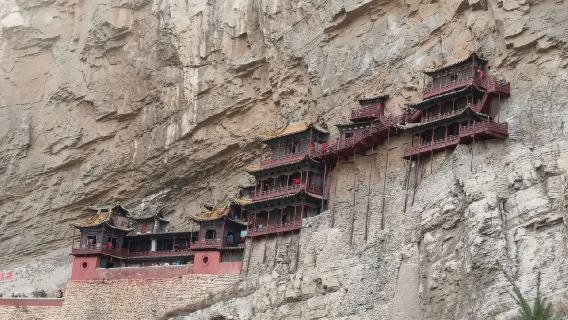
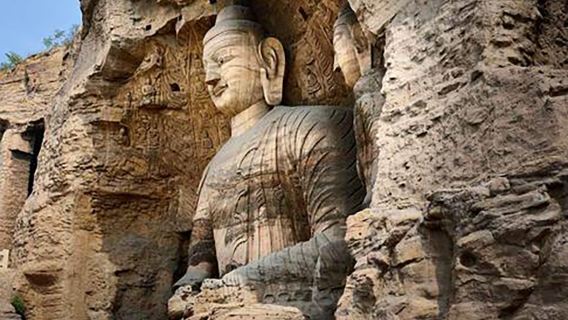
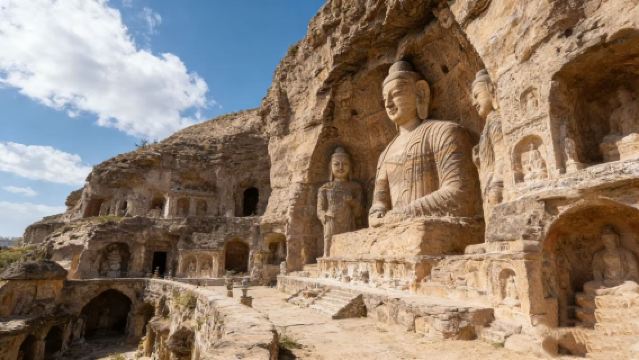
※1-day private charter tour to Xuankong Temple + Yungang Grottoes in Datong [Hotel pickup included]
󱌍
4.9/5
· 63 reviews· 293 booked
Duration: 9.8 hrs
English
Free cancellation
Instant confirmation
63 consecutive positive reviews
FromMYR 203.00
Shanxi Datong Hanging Temple+Yungang Grottoes 1-Day Transfer Service [Private Car]
󱌍
4.0/5
· 3 reviews
Duration: 3.7 hrs
English
Free cancellation
Instant confirmation
FromMYR 85.56
※1-day private charter tour to Xuankong Temple + Ying County Wooden Pagoda + Yungang Grottoes | Door-to-door pickup in Datong city
󱌍
4.9/5
· 55 reviews· 227 booked
Duration: 11 hrs
English
Free cancellation
Instant confirmation
55 consecutive positive reviews
FromMYR 217.00
Datong Classic Day Tour to Yungang Grottoes,Hengshan Hanging Temple,Yingxian Wooden Pagoda
󱌍
4.5/5
· 12 reviews· 96 booked
Duration: 5.5 hrs
English
Instant confirmation
FromMYR 329.00
※Datong Xuankong Temple + Ying County Wooden Pagoda Private Charter 1-Day Tour [Flexible Departure Time | Train Station Pickup]
󱌍
FromMYR 238.00
※Xuankong Temple + Yungang Grottoes + Huayan Monastery 1-day tour by private charter [Exclusive private charter with hotel pickup]
󱌍
FromMYR 262.50
Datong: Hanging Temple & Yungang Grottoes Classic Day Tour | CITS × ZANBUS
󱌍
5.0/5
· 3 reviews· 38 booked
Duration: 8.5 hrs
English
Free cancellation
Instant confirmation
FromMYR 427.00
Tour to Yungang Grottoes and Hanging Temple (Entrance Fees Not Included)
󱌍
4.5/5
· 10 reviews· 32 booked
Duration: 8.8 hrs
English
Free cancellation
Instant confirmation
FromMYR 210.18
Fanshi Today's weatherClear -6-7℃
Fanshi weather for the next 2 days11/23: -10-3℃, 11/24: -9-4℃

Free things to do in Fanshi

What travellers say about Fanshi

user-avatar
SNSD- Sone11 November 2026
5.0
Overall, the Wutai Mountain scenic area was quite nice! There are many temples, and the routes are relatively simple; you can easily see everything by following the signs! The shuttle bus service was less frequent due to the off-season, but it didn't take too long! The fewer crowds made for a more comfortable experience, which was great!

Wu Tai Shan

user-avatar
行走毛毛17 December 2025
5.0
Shanxi is truly a place where murals are everywhere, a place full of surprises. Visiting here made me realize that even in such remote places and villages, there are such exquisite murals. I hope to have the opportunity to come back again, because I feel I haven't seen enough yet.

Gongzhu Temple

user-avatar
Anonymous user22 November 2026
4.0
Take the bus from the square at the North Gate of Xinzhou Ancient City. It takes about an hour and a half to reach Yanmen Pass Scenic Area. There aren't many people during the off-season, so you can finish your visit around 1:00 PM. Then, return to the North Gate of Xinzhou Ancient City stop and get off.

Yanmenguan

user-avatar
M43***2017 August 2022
5.0
Those who study art should go and see it. He once studied in the Northern Song Dynasty Painting Academy and was a painter in the Jin Dynasty court. Although the light is not good and the murals are mottled, the pavilions and towers in the green mountains and waters are vivid and delicate, which is worth seeing. The hanging sculptures in the main hall have fallen off, and only a few groups of statues remain. The Guanyin statue is great. There are pictures on the Internet, and taking photos is prohibited inside.

Yanshan Temple

user-avatar
M34***1513 October 2024
5.0
It was National Day when we went there. The weather was a bit cold and the wind was a bit strong, but it did not affect the scenic spot. It is a niche scenic spot, very attentive, and the performances were great. It's just that there are not many foods around, only barbecues and snacks. It would be better if there were stir-fried dishes.

Hanshan Cultural Tourism Scenic Spot

user-avatar
本巢市独孤皇后22 November 2026
5.0
The Yingxian Wooden Pagoda is a marvel of the ages. Built in the Liao Dynasty with pure wood and no nails, its mortise and tenon joints and brackets are ingenious. It has stood for a thousand years, and its plaques and Buddha statues are simple yet awe-inspiring. It is a gem of ancient Chinese architecture and a worthwhile trip!

Yingxian Wooden Pagoda

user-avatar
柯少的诗和远方13 September 2025
4.0
Overall it's good, worth a visit, and has a heavy sense of history.

Sansheng Temple

user-avatar
大眼世界2 June 2021
5.0
The name of Kichijoji sounds like a very good temple. I didn't expect it to be so big. There are temples and bridges inside. Because of its great geographical location, surrounded by mountains, you can't help but marvel at the magic of nature and the ingenuity of human beings.

Mount Wutai Scenic Area - Jixiang Temple

Trip Moments in Fanshi

Popular cities near Fanshi

Frequently asked questions

How can I contact Trip.com customer support?

Get help anytime, anywhere within 30 secondsContact customer support

Change and cancellation policies vary by attractions and tours. Please check the product details page for more information.

Ticket prices may vary between weekdays and weekends, as well as during peak and off-peak seasons. When booking with Trip.com, you can also use Trip Coins to get extra savings. For more tips on booking discounted tickets, please visit Trip.com for the latest information.