Forbidden City Tickets: Booking, Prices and Entry Guide
Contents
- Do You Need a Ticket for the Forbidden City?
- Tickets are online only
- Peak dates sell out in minutes
- Forbidden City Ticket Prices in 2026
- Admission prices
- Free and discounted tickets - and what a Singapore passport qualifies for
- How to Book Forbidden City Tickets
- When tickets go on sale
- Booking step by step with a passport
- What to do if tickets are sold out
- Opening Hours and Closed Days
- Seasonal opening hours
- The Monday rule
- Getting In: Gates, Security and What You Can Bring
- One way in, two ways out
- ID checks and security
- What you cannot bring inside
- How Long You Need and What to See
- How much time to allow
- The two paid galleries
- What to see, and what to do next
- Practical Tips Before You Go
- Cancellations, no-shows and refunds
- The best time to arrive
- Audio guides, luggage and getting there
- Sort out the practical side before you fly
Show more
The Forbidden City is the one Beijing sight you cannot simply buy your way into on the day. The Palace Museum sells timed, real-name tickets online only, releases each day's allocation seven days in advance at 8pm Beijing time, and caps visitors at 40,000 a day. On weekends, school holidays and public holidays the tickets are gone within minutes.
This guide covers what matters before you book: what tickets cost in 2026, the exact booking steps for a foreign passport, opening hours and closed days, the entry gates and security rules, and what a cancelled or missed ticket will cost you.

Source: Trip.com
Yes. Everyone needs a ticket or a reservation, including children and visitors who qualify for free admission, and there is no ticket window to fall back on when you arrive. A booking made before you travel is the only way in.
Chinese New Year, the May holiday, Golden Week in early October and summer weekends are the hardest dates of the year. If you are travelling then, be on the booking page at 8pm Beijing time exactly seven days before - the same clock as Singapore, so no time-zone maths is needed - with every passport number ready. Cancelled tickets do return to the pool, so it is worth refreshing later the same evening and again the day before your visit.

 Trip is fabulous!! Susie is a very good tour guide, all tour and sightseeing arranged well
The free-admission list is narrower than most guides suggest, because the headline rule is written for Chinese citizens. Here is how it reads for a Singapore passport holder:
Tickets are released seven days ahead at 20:00 Beijing time, in one daily release. There is no second window, no waiting list and no queue to join - a few returned tickets simply reappear in the pool as other visitors cancel.
- Open the official booking site ticket.dpm.org.cn (or the multilingual portal for international visitors) or the 故宫博物院 mini-program inside WeChat, and register an account.
- Add each visitor's passport details exactly as they appear on the document - name order and passport number.
- Choose the date and the session: morning entry must be checked in by 12:00, afternoon entry opens at 11:00.
- Add the Treasure Gallery and Clock and Watch Gallery in the same order if you want them.
- Pay, then save the confirmation and screenshot the QR code, because you may not have mobile data at the gate.
Try again rather than paying a stranger. Returned tickets go back on sale, so the evening of release and the day before are the moments to refresh. Beijing has been cracking down on ticket touting, and the Palace Museum has not authorised anyone else to sell its tickets, so a 代订 agent cannot promise you a real reservation. If you would rather not handle the booking yourself, a guided tour product wraps the official ticket into a day with a guide, but the ticket itself is still a Palace Museum reservation.

The Palace Museum is closed every Monday except public holidays, and it also closes on Chinese New Year's Eve. When a public holiday falls on a Monday the palace usually opens, but the arrangement is announced case by case, so check the official notice for your date instead of assuming.
Visitors enter through the Meridian Gate (午门) at the south end only, and leave through the Shenwu Gate (神武门) to the north or the Donghua Gate (东华门) to the east. The route has been one-way since 2011 and re-entry is not allowed, so plan the visit as a single south-to-north walk rather than looping back for lunch.
Bring the original passport you booked with. The electronic gates read it, and the alternative documents the museum lists - household register, medical card, driving licence - are no help to a foreign visitor. Expect two security checks, one around Tiananmen and one at the palace gate, and allow 15 to 20 minutes at peak times. There is a no-bag lane on the east side of Meridian Gate if you are travelling light.
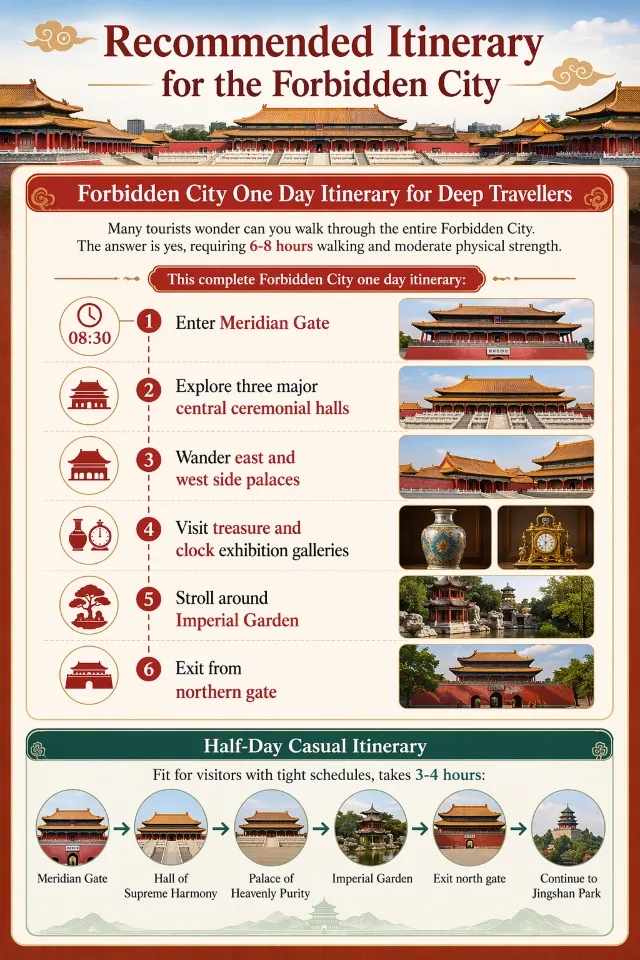
Three to four hours covers the main halls and the central axis. A thorough visit, with the side courtyards and both galleries, takes four to six hours and about 3.5km of walking. If your schedule is tight, the core route from the Meridian Gate to the Imperial Garden can be walked in roughly 90 minutes.
Source: Trip.com
The Treasure Gallery and the Clock and Watch Gallery are the two add-ons most visitors are glad they paid for - imperial gold, jade and ceremonial objects in one, and Qing-era European clocks and automata in the other. Budget an extra hour for the pair, and go early in your walk while you still have energy.
The three central halls - Supreme Harmony, Central Harmony and Preserving Harmony - are the ceremonial heart of the palace, followed by the Palace of Heavenly Purity and the Imperial Garden at the north end. Many visitors never leave the central axis, which is why the eastern and western courtyards feel calmer and photograph better. Trip.com's Forbidden City guide walks through every hall in more detail. When you exit at the north gate, Jingshan Park across the road gives you the classic view back over the golden rooftops.

Source: Trip.com
The entry peak runs from 08:30 to 11:00, and tour groups flood the central axis between 10:00 and 14:00. The quieter windows are around 12:00 to 13:00, or after 14:00 - as long as you are through the gate before the last-entry cut-off, which is 16:00 in peak season.
A few small things make the booking day and the visit itself much easier. Save your booking QR code offline, because the gate area is busy and mobile data can be patchy - a China eSIM installed before you fly keeps you online. Set up Alipay so you can pay for the audio guide, a taxi or a snack with a QR code, and keep the China travel apps you will need for maps and translation on the home screen.
Popular recommendations
China Arrival Card 2026: How to Fill It Online Before You Fly
 _TI***ff
Travel to China from Singapore 2026: Top Places & Key Things to Know
 蝦餃愛旅行|Travel Guides
Top Attractions in China
 _TI***fn