Things to do in Taibai County
Explore top experiences
Top 10 attractions in Taibai County


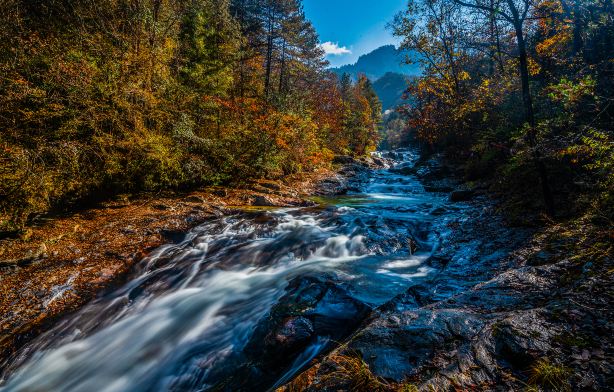
Qinling Mountains
The Qinling Mountains are a massive mountain range spanning central China, with the main body located in southern Shaanxi, stretching over 1,000 km from east to west. The northern foothills hug the Guanzhong Plain, which was formed by the alluvial deposits of theWei River, while the southern slopes gently descend into theHan Rivervalley. The ridgeline serves as the watershed between the Yellow River and Yangtze River systems and, together with the Huai River, forms the geographical boundary between northern and southern China: the north of the mountains is dry with little rain, where wheat fields connect to loess plateaus; the south is warm and humid with plenty of rain, where paddy fields and evergreen broad-leaved forests gradually unfold. The Baxiantai Summit on the main peak,Mount Taibai, has an altitude of 3,771.2 m. The high-altitude areas preserve cirques, horns, and stone seas carved by Quaternary glaciers. Along the climbing route, you can also encounter alpine lakes such asDaye Lake. Snow on the summit can last from late fall until the following midsummer, and even in July or August, you may encounter residual snow and biting mountain winds. From the foot of the mountain to the summit, vegetation changes layer by layer in the order of warm temperate, temperate, cold temperate, and frigid zones. This mountain range is also home to rare animals: giant pandas, golden snub-nosed monkeys, takins, and crested ibises all inhabit this area, and nature reserves such as Foping and Changqing protect theQinling giant panda. Famous mountains such as Mount Hua and Maiji Mountain also belong to this range. In ancient times, people chiseled plank roads such as the Baoxie Road and Chencang Road along the canyons. The "difficulty of the road to Shu is harder than ascending to heaven," as lamented by Li Bai, refers precisely to this perilous route.Taibai County · 13.5km from downtown

Baoji Bronze Ware Museum
The Baoji Bronzeware Museum is in the Chinese Shi-ku Garden of Baoji City, "the hometown of bronzeware." The museum has four exhibition halls, and Halls 1 and 2 are the focuses of the tour. The museum displays high quality bronzeware, such as the Hu gui from the period of King Li of Zhou and the treasures of Qin Duke Bo. The He zun, which is inscribed with the words "Here in China I dwell," is kept here.Baoji · 34.1km from Taibai County

Baoji Xueshan Cave Forest Park
Baoji Xueshan Cave Forest Park is located in the southeast of Baoji City and is a tourist destination that blends natural scenery with Taoist culture. The park is divided into two major scenic areas: Xueshan Cave and Shijiegou, each with its own unique features. Xueshan Cave is famous for its naturally formed cave, which is approx. 23 m deep and 5 m high. It is said to be the place where Qiu Chuji, a representative figure of the Quanzhen School of Taoism, practiced in seclusion. The temple complex outside the cave was built spontaneously by pilgrims. The 7-story pavilion was built against the mountain and resembles a pagoda, showcasing a unique Taoist architectural style. Shijiegou Scenic Area is the center of the park's natural attractions, gathering rich animal and plant resources and unique geological landscapes. In Shifogou and Shuilonggou, unique rocks and streams complement each other, forming attractions such as the Great Stone Buddha, Daughter's Cliff, and General's Gorge, which are lifelike and breathtaking. Attractions in Shuilonggou, such as Tiger Claw Cliff and Dingtianzhu, attract visitors with their masterful natural formations. Baoji Xueshan Cave Forest Park is not only a paradise for nature lovers but also an ideal place to explore Taoist culture and appreciate the beauty of unique rocks.Baoji · 18.8km from Taibai County

Shi-ku Garden in China
Shi-ku Garden in Chinais located on Shigu Mountain on the south bank of the Wei River in Baoji, to the north it overlooks the Wei River, to the east it borders the Yinxiang River, and to the south it adjoins Tiantai Mountain National Forest Park. Legend has it that the pre‑Qin stone drums unearthed in the early Tang were found in this area. The ten granite, drum‑shaped stones are inscribed with stone drum script, a writing that follows bronze script and anticipates small seal script. The Tang writer Han Yu wrote the "Song of the stone drums" to praise their value, and the original artifacts are now kept at The Palace Museum in Beijing, soShigu Mountaintook its name from this association. The park spreads along the mountain slope, integrating site conservation, bronze exhibitions, stone drum culture displays, garden sightseeing, and archaeological research into a cultural ecology park. At a high point in the park, the Shigu Pavilion is the landmark building. Modeled on Qin and Han styles, its outer‑five, inner‑nine tiering is especially striking, and from the pavilion you can look down on the urban areas on both banks of the Wei River. At the foot of the mountain, the Baoji Bronze Ware Museum houses Western Zhou bronze masterpieces such as the He zun and the Lai pan. The museum and the Shigu Pavilion, one high and one low, form the main tour route. You can also walk past the Zhou Culture Wall, the Han character gallery, the plaza for heaven worship and ancestor veneration, and the Shigu Mountain corridor bridge. At night, the Shigu Pavilion and the corridor bridge are illuminated, and the park takes on a different atmosphere.Baoji · 34.3km from Taibai County

Aoshan Resort
The Aoshan Resort project covers a total area of about 17,000 mu, and is mainly divided into three functional areas: outdoor sports, vacation, and health care. The main summer recreational projects include: "Aoshan Flying Car" with a 2-kilometer track, cloud-top grass skiing, UTV off-road, Aoshan Paragliding, mountain bike downhill, etc. The resort also has camping, hotels and homestays. The average summer temperature is 20 degrees, and the negative oxygen ion content is sufficient, making it the best choice for summer vacation, leisure, entertainment, and vacation.Taibai County · 8.6km from downtown

Shaanxi History Museum
History background: Shaanxi History Museum is located in the northwest of the Dayan Pagoda in Xi'an. It is one of the landmark attractions of Xi'an. The museum was planned in 1983, started in the summer of 1986, and officially opened on June 20, 1991. It was named Shaanxi History Museum. In 2016, Shaanxi History Museum was selected as "China's 20th Century Architectural Heritage" by the Chinese Cultural Relics Society and the Chinese Architectural Society. Museum Features: Shaanxi History Museum is a large modern museum, and its completion marks a new milestone in the development of China's museum industry. This museum is a Tang-style building complex with a "central hall and four corner towers". The main and secondary buildings are well-organized, the heights are staggered, and the momentum is solemn. It integrates national traditions, local characteristics and the spirit of the times. The museum covers an area of 65,000 square meters, and houses more than 380,000 cultural relics ranging from simple stone tools used in the initial stage of ancient humans to various artifacts in social life before 1840, covering a time span of more than one million years. The cultural relics are not only numerous and diverse, but also of high quality and wide value. The collections in the museum are dazzling and exquisite. It is an art hall that showcases the history and culture of Shaanxi and ancient Chinese civilization, and is known as the "Pearl of the Ancient Capital, the Treasure House of China." There are many treasures in the museum, including bronzes from the Shang and Zhou dynasties, pottery figurines from various dynasties, gold and silver utensils from the Han and Tang dynasties, and murals from Tang tombs. Most of them are treasures from the prosperous periods of the Han and Tang dynasties, and some of them are fine items that are prohibited from leaving the country. Collection treasures: There are three exhibition halls in the center of the museum. The first exhibition hall displays cultural relics from the prehistoric civilization of Lantian ape-man 1.15 million years ago to the Qin Dynasty; the second exhibition hall displays cultural relics from the Han Dynasty and the Wei, Jin, Southern and Northern Dynasties; and the third exhibition hall is mainly cultural relics from the prosperous Tang Dynasty. Each exhibition hall has its own treasure. There are special exhibition halls on the east and west sides of the central hall. On the west side, there is a "Special Exhibition of Tang Dynasty Treasures (Treasure Hall, Cultural Relics Unearthed in Hejiacun)", where many fine gold and silver wares from the heyday of the Tang Dynasty were transferred to be exhibited. On the east side, there is a "Treasures of Tang Dynasty Murals Exhibition", which exhibits a number of authentic Tang Dynasty tomb murals. The tripod The tripod is placed in the first exhibition hall at the entrance of the museum, and it can be said to be the treasure of the first exhibition hall. The replica is placed here, and the original is kept in the warehouse. Inscription on the outer wall: The inscription "All under heaven is the king's land; all the people are the king's subjects" reflects the land ownership system in the Western Zhou Dynasty. There are four lines of inscriptions with 28 characters on the inner wall of the Yi Ding. The general meaning is: In early August of a certain year, Wang Jiang took back the land originally given to Shi Lu and gave it to Yi, who then made this tripod to commemorate it. Queen's Seal: One of the treasures worth seeing in the second exhibition hall is the jade seal of the empress of the Han Dynasty, which is displayed separately. The seal is made of Xinjiang Hetian mutton-fat jade and is engraved with a Chihu, symbolizing royal power. Three-color camel figurines carrying music: This world-famous tri-color camel figurine carrying music is located in the third exhibition hall of Shaanxi History Museum. Its overall appearance and color are well preserved. There are seven men sitting on the camel's back, holding different musical instruments in their hands. Among them, the figurine holding the clapboard is listening attentively, as if intoxicated by the wonderful music. The woman in the middle is performing, and the camel opens its mouth wide and looks up to the sky, as if it is also singing with its master. Gold-inlaid animal head agate cup: This cultural relic, located in the special exhibition "Tang Dynasty Relics Special Exhibition", is one of the first 64 national treasures listed by the State Administration of Cultural Heritage that are never allowed to be exhibited abroad. There are also many other treasures such as black-glazed oil-drip bowls, green-glazed porcelain pots with handles, gilded silver bamboo-joint copper incense burners, gold bowls with mandarin duck and lotus petal patterns, and so on.China · Xi'an

Grand Tang Mall
Grand Tang Mall is a large-scale Tang-style architectural pedestrian street in Xi'an's Qujiang New District, built around the Giant Wild Goose Pagoda. It stretches from the Xuanzang Square at the foot of the pagoda in the north to the Tang City Wall Ruins Park in the south, connected by a approx. 1500 m central axis view boulevard running north-south. The boulevard itself resembles an open-air sculpture gallery, featuring themed sculptures arranged sequentially from north to south: Buddhist culture of the Tang Dynasty, Tang heroes, the Zhenguan era governance, Empress Wu's procession, and the Kaiyuan heyday. Statues of eminent monks like Xuanzang and Jianzhen stand at the front, followed by Tang luminaries such as Li Bai, Wu Daozi, Sun Simiao, and Lu Yu in the middle section, with ceremonial processions of Emperor Taizong, Empress Wu Zetian, and Emperor Xuanzong concluding the display. Walking through this boulevard is akin to reading a three-dimensional history of the Tang Dynasty. The block connects three themed squares from north to south—Xuanzang square, Zhenguan square and Kaiyuan square—with Tang-style pavilions lining both sides. Among them are four cultural venues: Xi'an concert hall, Shaanxi grand theater, Xi'an art museum and Qujiang cinema. Enjoying concerts, visiting exhibitions and shopping for photos can all be arranged along the same route. By day, admire the architecture and sculptures, but the real highlight of this street comes after nightfall—when the lights come on, the Tang-style pavilions glow with radiant colors, and the entire street seems to recreate the splendor of the Tang Dynasty. The area features year-round immersive street performances: a "Tumbler Girl" in Tang attire leans in to hold hands with travelers as she spins; Fang Xuanling and Du Ruhui from the "Secret Box of the Tang Dynasty" appear, posing riddles and bantering, with clever answers from selected travelers drawing cheers from the crowd; Hu Xuan dances and Tang-era music performances compete in a colorful parade; and actors dressed as the "Poet Immortal" may challenge you to a verse duel at any moment—strolling around, you might stumble upon a performance. This place gathers trending attractions, highlighting dazzling colors, fantasy, and a tech vibe. Through large-scale installations, it creates a stylish and dynamic interactive experience center, offering a sought-after photo spot for trendy young crowds. In the family-friendly tech zone, scene-based displays and hands-on actions spark children's imagination and creativity, combining play with skill development and experiential gains—making it an ideal destination for family-friendly fun.China · Xi'an

Xi'an Museum
Xi'an Museum is a modern comprehensive museum built upon the cultural relic protection site—the ruins of the Tang Dynasty Jianfu Temple and its iconic structure, the Small Wild Goose Pagoda. It integrates cultural relic collection and protection, academic research, exhibition and display, social education, and garden leisure. Its core area is the location of the original Tang Dynasty royal temple, Jianfu Temple, while the precious and striking historical relic existing within the temple—the Small Wild Goose Pagoda—has become the museum's unique landmark and soul. Therefore, the Jianfu Temple ruins and the Small Wild Goose Pagoda are not only the foundation and core carrier for the establishment of Xi'an Museum, but also important outdoor historical exhibition areas and focal points for visitors. The main building of the museum is located on the north side of the ancient temple ruins. The three elements (ancient temple ruins, ancient pagoda, and modern museum building) are organically integrated, jointly forming a unique cultural space that combines "museum, pagoda, temple, and garden," vividly showcasing the historical context of Xi'an from ancient times to the present. Xi'an Museum officially opened to the public on May 18, 2007. Its establishment aims to comprehensively showcase the glorious history and splendid culture of Xi'an (ancient Chang'an) as the capital of thirteen dynasties, filling the gap of a comprehensive museum of Xi'an's urban history. Collection highlights: The museum houses over 100,000 precious cultural relics from various historical periods of Xi'an. The collection spans from prehistoric times to the Ming and Qing dynasties, with particular emphasis on artifacts from the prosperous dynasties of Zhou, Qin, Han, and Tang, including bronze ware, jade articles, gold and silverware, ceramics, murals, stone steles, epitaphs, and Buddhist statues, systematically reflecting the political, economic, cultural, social life, and foreign exchanges of the ancient capital Chang'an. Main exhibition: The permanent exhibition "Ancient capital Xi'an" takes the urban development history of Xi'an as the main thread, showcasing the evolution and achievements of Xi'an as a capital (Zhou Fenghao, Qin Xianyang, Han Chang'an, Sui-Tang Chang'an) and a prefectural city (Song, Yuan, Ming, and Qing dynasties) through a large number of precious cultural relics, models, charts, and multimedia means. Unique environment: The museum's greatest feature lies in its surroundings. Travelers can not only visit modern exhibition halls but also stroll through the expansive heritage park encompassing the Small Wild Goose Pagoda, the ancient architectural complex of Jianfu Temple (including structures like the Ming dynasty bell tower housing a Jin dynasty ancient bell), an ancient stone sculpture art exhibition area, and garden views—experiencing the charm of the millennia-old capital at its historical site. The view of "morning bells at the Wild Goose Pagoda" is particularly renowned. Functional positioning: The museum is not only an important center for cultural relic collection, research, and display, but also an urban cultural park where citizens can relax, entertain, and immerse themselves in history and culture, undertaking significant social education and cultural exchange functions.China · Xi'an

Shaanxi Archaeology Museum
The permanent exhibition of the Shaanxi Archaeological Museum is themed on "Archaeological Sacred Land Huazhang Shaanxi", which is divided into four chapters: "Archaeological History", "Cultural Genealogy", "Archaeological Discovery" and "Cultural Preservation Technology".China · Xi'an

Qingmuchuan Ancient Town
Picturesque Qingmuchuan Ancient Town has a long history. The Qiang and Han people intermingled and lived peaceably together here. The area gradually prospered during the Ming dynasty, and most of the residences here were built during the Ming and Qing dynasties (1368-1912). A river cuts through the ancient town, and the people here live a carefree and leisurely life. The town's Wei Family Mansion was built during the Republican Era (1912-1949), and the Qu, Wei, Zhao, and Tu ancestral halls were built during the Ming and Qing dynasties.China · Ningqiang
Experiences you can't miss in Taibai County
Featured Cultural experiences in Taibai County
View all Cultural experiences
5.0/5
· 1 reviewFree cancellation
Instant confirmation
FromPKR 24,844.73
FromPKR 41,407.87

FromPKR 41,407.87

Free cancellation
Instant confirmation
Book now for tomorrow
FromPKR 16,480.34
Featured Day tours in Taibai County
View all Day tours

4.5/5
· 21 reviews· 233 bookedFree cancellation
Instant confirmation
FromPKR 8,873.12

5.0/5
· 4 reviews· 44 bookedFree cancellation
Instant confirmation
Book now for tomorrow
FromPKR 23,056.66
4.9/5
· 407 reviews· 429 bookedFree cancellation
Instant confirmation
Book now for tomorrow
99.3% of travelers recommend
FromPKR 9,855.08

5.0/5
· 1 review· 25 bookedFree cancellation
Instant confirmation
FromPKR 18,547.87

4.5/5
· 2 reviews· 24 bookedFree cancellation
Instant confirmation
FromPKR 8,846.23
4.9/5
· 20 reviews· 65 bookedInstant confirmation
81 travellers saved
FromPKR 10,822.52

Instant confirmation
Book now for tomorrow
FromPKR 13,881.05

FromPKR 8,198.76
Free things to do in Taibai County
Qinling Mountains
Taibai County · 13.5km from downtownBaoji Bronze Ware Museum
Baoji · 34.1km from Taibai CountyBaoji Xueshan Cave Forest Park
Baoji · 18.8km from Taibai CountyShi-ku Garden in China
Baoji · 34.3km from Taibai CountyAoshan Resort
Taibai County · 8.6km from downtownShaanxi History Museum
China · Xi'anGrand Tang Mall
China · Xi'anXi'an Museum
China · Xi'anBook now for tomorrow, Cancel anytimeShaanxi Archaeology Museum
China · Xi'anQingmuchuan Ancient Town
China · Ningqiang
What travellers say about Taibai County

M27***0612 June 2025
4.0
The Qinling Mountains can be divided into the Qinling Mountains in a narrow sense and the Qinling Mountains in a broad sense. The Qinling Mountains in a narrow sense are limited to the mountains between the Weihe River and the Hanjiang River in the southern part of Shaanxi Province.
The Qinling Mountains in a broad sense start from Kunlun in the west, pass through Longnan and southern Shaanxi in the middle, and end at the Dabie Mountains of Hubei, Henan, Anhui and Zhangbaling near Bengbu in the east. It is the watershed between the Yangtze River and the Yellow River.
The Qinling Mountains are not only the boundary between the north and south of China, but also the dividing line of the differences in geography, climate and resources between the north and the south. Different climates, different water and soil, different social living habits such as diet, architecture and transportation, have evolved into differences in the overall customs and habits of the society over time.
The Qinling Mountains are revered as the dragon vein of Chinese civilization. The main peak, Taibai Mountain, is 3771.2 meters above sea level and is located in Baoji City, Shaanxi Province. The Qinling Mountains are the boundary between the Guanzhong Plain and southern Shaanxi in Shaanxi Province.
Qinling Mountains

blu***hh15 August 2026
5.0
The teacher's explanations made our visit truly meaningful. The explanations were very comprehensive and detailed; I'll need to review some of the points later. I really liked the architectural style of the Baoji Bronze Museum; it was definitely worth the long journey.
Baoji Bronze Ware Museum

星光45620 September 2025
5.0
In the hot summer, walk into the Qinling Snow Mountain Cave Forest Park, where trees and wild grass are lush and green, and the sounds of birds and grasshoppers merge into one. Feel the unfettered joy in the jungle under the blue sky and white clouds.
Baoji Xueshan Cave Forest Park

首席监理30 May 2022
4.0
The Chinese Stone Drum Park is one of the key tourist and cultural scenic spots in Baoji City, Shaanxi Province. It is located on the Stone Drum Mountain, where the Stone Drum, which was praised by Kang Youwei as "China's No. 1 Antiquity", was unearthed. It is adjacent to Yinxiang River in the east, Jifeng Mountain, the main peak of Qinling Mountains in the south, the urban area in the west, and the Weihe River in the north. It covers an area of more than 500 acres and has a total construction area of 47,000 square meters. It is a cultural ecological park with the theme of Zhou and Qin history and culture. There are five major areas, Baoji Bronze Museum, Chencang Stone Drum Pavilion, Qin Culture Square, Stone Drum Square, and Jinshi Garden, which integrate site protection, bronze exhibition, stone drum culture display, garden sightseeing, archaeological research and leisure and entertainment, and fully display the profound history and culture of Baoji as the birthplace of Zhou and Qin culture.
Through the protection and shaping of natural landscapes, the park has become a collection of the five characteristics of Baoji, Shaanxi, namely, mountain, water, forest, plateau, and city. Through the integration and reproduction of Zhou and Qin history, the park has become a microcosm of ancestral culture and a charming place with both natural and humanistic characteristics. The two iconic buildings of the China Stone Drum Park, Chencang Stone Drum Pavilion and Baoji Bronze Museum, have become the new city coordinates of Baoji.
Shi-ku Garden in China

竹里清风26 February 2022
5.0
Aoshan Ski Resort in Taibai County attracts many tourists and ski enthusiasts with its good environment and ski slope facilities.
Aoshan Resort

Julensy20 October 2026
5.0
There were so many people, and the queues were incredibly long and even turned corners 🤦, but that didn't stop us from getting into the museum.
Special thanks to guide Zhang Xiaojing! She was meticulous, patient, and possessed solid professional skills and rigorous knowledge; she helped visitors understand the connections between the bronzes, terracotta figures, and other national treasures, and told the stories behind the artifacts in a vivid and easy-to-understand way. The entire visit was a great experience and deserves high praise.
Shaanxi History Museum

呦未来可期15 October 2026
5.0
Take a stroll through the Tang Dynasty Never-Sleeping City on a pleasant autumn evening. The evening breeze is cool, the lights are dazzling, and the atmosphere of the Tang Dynasty is palpable. Street performances are everywhere, and tourists come and go, creating a lively scene. No need to plan a route; just wander around and explore as you please. Immersed in this world of lights, feeling the warmth of everyday life and ancient charm, this is what small satisfactions in ordinary days are all about. Chang'an's autumn nights are as bright as ever.
Grand Tang Mall

Anonymous user21 October 2026
5.0
Located in the bustling city center, the hotel is conveniently situated for shopping, dining, and entertainment – highly recommended! The price is reasonable for the city, and the accommodation environment and cleanliness are much better than other budget hotels in the same price range. The service is professional and commendable. Excellent location with convenient transportation; the subway station is just a few minutes' walk away. The hotel facilities are complete, the rooms are clean and tidy, and the stay was very comfortable. The front desk staff are very helpful, proactive, and welcoming. The breakfast is good with a wide variety of options; I personally think it offers great value for money. 666
Xi'an Museum

M27***t36 October 2026
5.0
Teacher Tangtang's teaching is really excellent! 🤩🤩 I learned a lot from her throughout the course. She reminded me of my high school Chinese teacher, someone incredibly knowledgeable! ✌︎' ֊'🥳🥳🥳 In short, I really enjoyed it! 🥰🥰🥰
Shaanxi Archaeology Museum

爬山🐯13 September 2026
4.0
Qingmuchuan Ancient Town is located at the junction of Shaanxi, Sichuan and Gansu provinces. The ancient buildings are well preserved. Must-see attractions include the Wei Family Residence, Rongshengkui, and the opium den. You must also stroll along Huilongchang Old Street and climb Huilong Pavilion to overlook the entire ancient town.
Qingmuchuan Ancient Town


