Shou County

Things to do in Shou County

Search attractions or local attractions & tours
Search

Explore top experiences

Top 10 attractions in Shou County

View all Attractions
Nanjing Hongshan Forest Zoo
2026 Global 100 - Family-friendly Attractions

Nanjing Hongshan Forest Zoo

8.3
4.7/5
25.1k reviews

Nanjing Hongshan Forest Zoo is located in the north of Nanjing, built along three hills: Dahongshan, Fangniushan, and Xiaohongshan. With a green coverage rate of over 85%, the rolling hills form a unique forest view. The zoo brings together rare wild animals from around the world and adopts an immersive multi-species mixed-housing model, allowing animals to naturally express their instincts in environments that simulate their native habitats. The nearly 30 venues in the park are divided into three major zones by hill. The Dàhóngshān zone is mainly home to fierce beasts and native species, including the Tiger Area, Bear Area, Chinese Felid House, Felid Planet, Wolf Area, Native Species Conservation Area, Meerkat House, Monkey Hill, and Giraffe House; the Fàngniúshān zone brings together the Koala House, Gaoligong Exhibition Area, Gondwana Exhibition Area, Asian Primate Area, Orangutan House, and Hippo House; the Xiǎohóngshān zone is mainly composed of bird exhibition areas, including the Tropical Bird House, Hornbill Garden, Muntjac and Reeve's Muntjac Slope, Parrot House, Pheasant Garden, and Rare Bird Garden. Among them, the Gondwana Exhibition Area is themed on the ancient continent of Gondwana, presenting the ecological landscape of species from the Southern Hemisphere; the Gaoligong Exhibition Area focuses on the biodiversity of Gaoligong Mountain in Yunnan; and the Native Species Conservation Area is dedicated to the conservation and wild release of China's native wildlife, making it one of the park's signature exhibition areas. Both the Koala House and the Giant Panda House are popular venues in the park. Nanjing Hongshan Forest Zoo was among the first domestic zoos to cancel animal performances and stop visitor feeding activities. With the core philosophy of "everything for the animals," it focuses on ecological renovation of venues and improvement of animal welfare. The park also undertakes the rescue and rehabilitation of wildlife in the Jiangsu region, rescuing a large number of injured and stray wild animals every year.

China · Nanjing
Nanjing Museum
No. 2 of Family-friendly Attractions in Jiangsu

Nanjing Museum

8.2
4.7/5
4.2k reviews

The Nanjing Museum is located at the southern foot of Purple Mountain, on the north side of Zhongshan Gate. Here, you can see ancient artifacts such as the jade burial suit sewn with silver thread, appreciate painting and calligraphy art, and even take a stroll down old streets for a journey through time. Museum historyThe museum was established in 1933 and completed in 1948, with its main hall modeled after the mountain gate of Dule Temple in Tianjin. After expansion in 2009 and opening to the public on November 6, 2013, it became the second largest museum in China after the National Museum of China, featuring six halls: the History Hall, Special Exhibition Hall, Digital Hall, Art Hall, Republican Era Hall, and Intangible Cultural Heritage Hall. Museum layoutThe museum's main buildings are divided into two sections, left and right. After walking a short distance on the right side, you will reach the museum's old main hall, modeled after the Dule Temple. Behind the "Dule Temple" is the History Gallery, while the other five galleries are all on the left side. You can either tour from the five galleries on the left to the History Gallery on the right, or from the History Gallery to the five galleries on the left. It is recommended to visit the History Gallery first, because the special exhibition hall housing the "treasure of the museum" is located to the left of the History Gallery. You can follow the order of History Gallery - Special Exhibition Hall - Digital Gallery - Republican Era Gallery - Art Gallery - Intangible Cultural Heritage Gallery to tour the entire museum. History exhibition hallThe history museum displays cultural relics arranged in chronological order from ancient times to the Ming and Qing dynasties. Walking through it feels like strolling through five thousand years of Jiangsu's civilization. Highlights include: the jade burial suit sewn with silver thread, a wall built brick by brick during the Southern and Northern Dynasties with brick carvings faintly depicting the "Seven Sages of the Bamboo Grove" upon closer inspection, and more. Special exhibition hallThe "Splendors of the Prosperous Age" area of the special exhibition hall displays official kiln porcelain from the Qing Dynasty, the "Fine Clocks and Watches Exhibition" displays ancient Chinese timekeeping devices and Western clocks and watches, and "Approaching Buddhist Statues" features resplendent, exquisitely crafted Buddhist statues. As for the "treasure of the museum," the gilt Tibetan-style stupa from the early years of the Zhengtong reign of the Ming Dynasty (1436–1439 CE), a single exhibit occupies an entire room, and its sheer grandeur alone is stunning enough. This museum treasure was unearthed from the underground palace of the Hongjue Temple Pagoda on Niushou Mountain in Nanjing. On a square red sandstone base, four blue-and-white porcelain vases surround a golden stupa in the center, and in front of the stupa is a small gold coffin and silver outer coffin, upon which lies a golden reclining statue of Shakyamuni. Digital galleryThe digital pavilion uses modern technology to present ancient themes, with exhibits such as the animation "Picture Scroll of Scenes in the Southern Capital" (similar to the Along the River During the Qingming Festival in the China Pavilion at the World Expo). What is quite interesting is that there are many interactive games here, and you can touch the screen to play games set in ancient times. Art venueThe art museum displays sculptures, calligraphy, and paintings. The exhibited paintings by Fu Baoshi, which use Chinese ink painting techniques to depict Eastern European red-roofed buildings, squares, and sculptures, are quite distinctive. Republic of China galleryThe Republic of China Gallery has transformed the entire indoor space into a street scene from the Republic of China period. Trams are displayed on the street, and shops with Republic-era style line both sides, open for business and selling items that evoke nostalgia. At a general store, you can buy "mouse droppings" (also known as kumquat pills), a snack from childhood. The post office offers Nanjing Museum postmarks, and at the Librairie Avant-Garde upstairs, the staff wear period clothing; if you want to mail a postcard, the bookstore also sells stamps. Intangible cultural heritage museumThe intangible cultural heritage museum displays folk handicrafts such as woodblock prints, paper cuttings, gold foil, and festive lanterns. Here you can enjoy performances such as Kunqu opera, Baiju, and Pingtan. Reference performance times: 14:00-16:00.In the small theater, you can watch 3D films for free, and the film is about 20 minutes long.The small theater in the intangible cultural heritage museum will also be open to the public on weekends and public holidays at 19:00 if there are traditional Chinese opera performances, and tickets are required.

China · Nanjing
Confucius Temple-Qinhuai Scenic Area
2026 Global 100 - Night Attractions

Confucius Temple-Qinhuai Scenic Area

7.9
4.7/5
7.3k reviews

The Confucius Temple-Qinhuai Scenic Area refers to the Qinhuai River area centered around the Confucius Temple, where the streets, alleys, residences, and historical sites along both banks form a continuous stretch. It has been a bustling and lively part of Nanjing since ancient times. The line "The swallows that skimmed by painted eaves in bygone days are dipping now among the humble homes' doorways" by Liu Yuxi describes this very place. The Wuyi Lane mentioned in the poem still lies hidden among the alleys near the Confucius Temple. Exploring history along the river is the highlight of this area: The Dacheng hall of Confucius temple stands by the water, with a towering screen wall across the Pan pond in front; the nearby Jiangnan examination hall was the imperial testing site for provincial exams during the Ming and Qing dynasties, now replaced by the China imperial examination museum; Zhan garden and Egret isle park both originated from the mansion gardens of Xu Da's family, a founding general of the Ming dynasty—the former also houses the Taiping heavenly kingdom history museum; scattered along both banks within walking distance are historical sites like Meixiang tower (former residence of "Peach blossom fan" heroine Li Xiangjun), the well-preserved Zhonghua gate with its urn-shaped defense system, Wu Jingzi's residence (author of "The scholars"), and ancient ferry relics like Taoye crossing, easily connected into a historical walking trail. Cuisine is also a signature feature of this area: "The eight Qinhuai delicacies" refer to sixteen famous dishes from eight time-honored snack restaurants, including Yongheyuan's crab-shell yellow sesame cakes and dried shrimp shreds, Qifangge's duck oil crispy cakes and sesame oil dried shreds, Jiangyouji's beef pot stickers, and Lianhu pastry shop's osmanthus-filled glutinous rice balls. The Confucius Temple area and Laomendong are lined with teahouses, snack shops, and various stores, offering plenty of opportunities to rest and grab a bite when tired, along with the chance to pick up some souvenirs. The highlight comes after nightfall: board a painted boat from the pier in front of the Confucius Temple, listen to the guide while admiring the white walls and black tiles illuminated by riverside lanterns—this is the classic "night mooring on the Qinhuai" experience. From Chinese New Year to the Lantern Festival each year, the Qinhuai River Lantern Festival (also known as the Jinling Lantern Festival), listed as a national intangible cultural heritage, takes place here. The Confucius Temple, Laomendong, and along the Qinhuai River are adorned with lanterns and decorations. "Visiting the Confucius Temple to see lanterns during New Year" remains a cherished tradition for Nanjing locals. Even on ordinary days, the area buzzes with cultural temple fairs, food festivals, and other celebrations, offering unique surprises in different seasons.

China · Nanjing
Sanhe Ancient Town
No. 4 of Night Attractions in Anhui

Sanhe Ancient Town

7.8
4.7/5
4.4k reviews

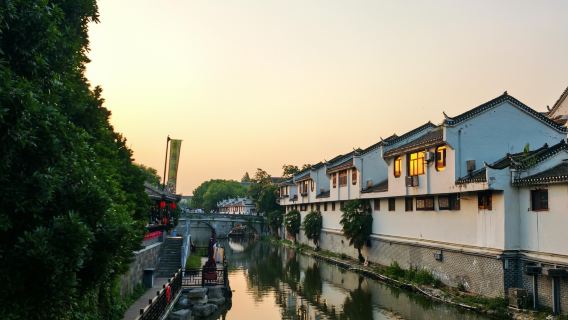
Sanhe Ancient Town is situated at the southern tip of Feixi County in Hefei, where the Fengle River, Hangbu River, and Xiaonan River converge. The town derives its name from these three waterways, with the name "Sanhe" appearing as early as the Ming Dynasty and officially becoming Sanhe Town during the Qing Dynasty. In 1858, Taiping Rebellion generals Chen Yucheng and Li Xiucheng achieved a decisive victory over the Xiang Army here, historically known as the "Great Victory of Sanhe." The triumphal arch at the town entrance, Yingwang Mansion, and ancient city walls still bear witness to this turbulent period. The old bluestone-paved streets stretch along the river, lined with contiguous Huizhou-style residences featuring gray brick walls and soaring horse-head gables, blending water-town alleys with Huizhou-style markets seamlessly. Most tours begin at Sanxian Bridge in the town center. To its northwest stands the seven-story Guocui Tower, offering panoramic views of the town and displaying Huizhou artifacts like sedan chairs, inscribed tablets, carved beds, and stone carvings. Nearby, the Dafu Mansion (Sanhe Folk Museum) recreates an official residence's hall with exquisite wood carvings, including an oversized abacus over one meter long. Northeast of the bridge, Xiangu Tower is a Huizhou-style temple funded by merchants including the owner of the time-honored pastry shop "Zhonghexiang." Heading north along the east bank of Xiaonan River leads to ancient West Street, paved with bluestones and once bustling with shops—Liutongxinglongzhuang still maintains its original commercial layout. South along the west bank brings you to Quezhu Covered Bridge, named after Sanhe's ancient moniker "Quezhu," featuring a two-tiered eaves corridor with "beauty's seat" railings perfect for resting and enjoying the waterfront. The southern area around Old South Street and Wannian Street clusters notable former residences, including those of physicist Chen-Ning Yang, general Sun Liren, and Helu. During the Anti-Japanese War, young Chen-Ning Yang sheltered here with his family. Nearby, the famous "One-Person Alley" narrows to barely accommodate a single visitor, making it a popular photo spot. Further south stand Wannian Temple, Chenghuang Temple, and the historic Wannian Stage—Sanhe being the birthplace of Lu Opera, whose authentic melodies often grace the stage during festivals. Local snacks concentrate near Sanxian Bridge: freshly fried Sanhe rice dumplings with crispy shells, shrimp paste, crispy duck, and various river delicacies represent regional cuisine, while tea-flavored dried tofu makes for perfect street-side nibbling. Rice wine and feather fans serve as portable souvenirs. In 2026, Sanhe became a key filming location for CCTV's Spring Festival Gala Hefei segment, with its night scenes of a thousand fish lanterns captivating nationwide audiences.

China · Feixi

Experiences you can't miss in Shou County

Shou County Today's weatherFoggy 10-16℃
Shou County weather for the next 2 days11/15: 9-17℃, 11/16: 10-16℃

Free things to do in Shou County

What travellers say about Shou County
user-avatar
苏槿汐9 November 2026
5.0
This is my second time visiting Hongshan. The crowds weren't too big on a rainy day, so the experience was great. I thought all the animals would be hiding indoors to avoid the rain, but I was surprised to see and take many pictures of them. The furry creatures are so cute... It's a pity I forgot to bring my stamp book again. I'll definitely bring it next time!

Nanjing Hongshan Forest Zoo

user-avatar
E04***8713 November 2026
5.0
Teacher Dong's professional skills are truly amazing! The content and teaching methods are very suitable for children. Although the number of people was indeed very large this time, the arrangements were handled very well. We would definitely work with her again.

Nanjing Museum

user-avatar
lubaizhengyang6 November 2026
4.0
The Dacheng Hall of the Confucius Temple is the core main hall of the Confucius Temple, a tranquil haven of Confucian elegance amidst the bustling Qinhuai River. With its double-eaved roofs, bracket sets, and ancient red walls, the hall houses a dignified bronze statue of Confucius, flanked by stone statues of sages. Inside, a giant portrait of Confucius hangs, flanked by four stone statues. The "Illustrations of Confucius' Sacred Traces," inlaid with jade, vividly depicts the life of the sage. There are also replicas of ancient chime bells and chime stones, and if you're lucky, you might catch a performance of traditional music. The side corridors display calligraphy and inscriptions by renowned calligraphers, showcasing the rich cultural heritage of Confucius. Outside, the Confucius Temple is bustling with crowds; stepping inside brings instant peace, perfect for quiet contemplation of Confucian culture, ideal for reading or seeking blessings. It's a perfect place to combine a visit to the Qinhuai River with a day trip.

Nanjing Confucius Temple

user-avatar
muhammadshoaibcs8 November 2026
5.0
Address: Fuzimiao Area QinhuaiTourists attraction spot, shopping, food, ancient streets. Recommend for evening time.

Confucius Temple-Qinhuai Scenic Area

user-avatar
曹小妞16 June 2026
4.0
The environment was quite nice, not crowded, and the experience was excellent. Most importantly, the kids loved it.

Yuquan Bay Hot Springs

user-avatar
黄海大智若愚12 November 2026
5.0
Each of the four exhibition halls has its own unique characteristics and is the most important highlight of the ancient town's history and culture. However, the equipment, exhibits, and services in some exhibition halls are inadequate and need to be standardized and improved.

Sanhe Ancient Town

user-avatar
Anonymous user12 November 2026
5.0
The Guishan Han Tomb isn't very large; you can see it in about an hour. Children don't need to be afraid; the crowds will give them courage. Be sure to buy a combined ticket for the Stone Garden and the Imperial Edict Museum to experience the visual impact.

Guishan Han Tomb

user-avatar
230***296 February 2025
5.0
Immerse yourself in the history of ancient imperial tombs and learn about ancient engineering technology.

gui shan jing qu

user-avatar
Anonymous user12 November 2026
5.0
A combined ticket offers a 10 yuan discount. Both Ge Garden and He Garden exceeded my expectations. I originally thought they would be small gardens, but Ge Garden is surprisingly large, unique, and beautiful—definitely worth a visit. The Slender West Lake scenic area is also quite large.

Geyuan Garden

user-avatar
美丽的小可爱呀呀12 December 2024
5.0
Leisurely walk, fresh air, not too high mountains, flat roads, small scenic spots are nice but not too big. 【Scenery】

Shungeng Mountain Scenic Area

Trip Moments in Shou County

Popular cities near Shou County

Frequently asked questions

How can I contact Trip.com customer support?

Get help anytime, anywhere within 30 secondsContact customer support

Change and cancellation policies vary by attractions and tours. Please check the product details page for more information.

Ticket prices may vary between weekdays and weekends, as well as during peak and off-peak seasons. When booking with Trip.com, you can also use Trip Coins to get extra savings. For more tips on booking discounted tickets, please visit Trip.com for the latest information.