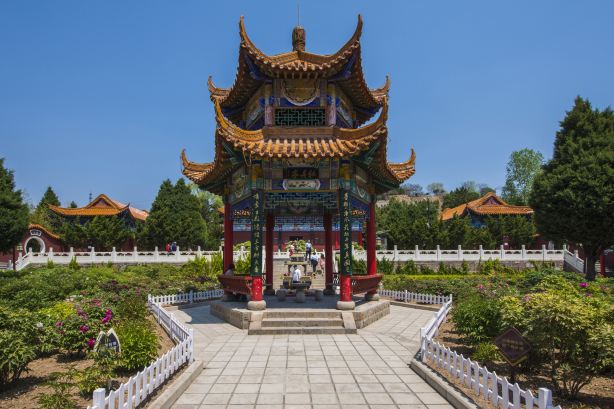
Gu County

Things to do in Gu County

Search attractions or local attractions & tours
Search

Explore top experiences

Top 10 attractions in Gu County

View all Attractions
Guangsheng Temple
No. 3 of Best Things to Do in Linfen

Guangsheng Temple

7.4
4.7/5
2.4k reviews
Guangsheng Temple is located at the southern foot of Huo Mountain in Hongtong County, Linfen, Shanxi. It is said to have been initially built during the Eastern Han Dynasty and renamed to its current name in the Tang Dynasty. Despite being repeatedly destroyed by wars, fires, and earthquakes over the centuries, the surviving halls are primarily structures from the Yuan and Ming Dynasties. The attraction consists of the upper temple on the mountain peak, the lower temple at the foot of the mountain, and the Water God Temple, forming a high-low connection that creates a natural upward visiting route. The Feihong Pagoda in the upper temple is the visual center of the entire complex. This octagonal thirteen-story brick pagoda, standing over forty meters tall, is adorned with glazed tiles in yellow, green, blue, white, and other colors from the second floor upwards. Figures of Buddhas, bodhisattvas, celestial beings, coiled dragons, and lion-like beasts protrude from the brick surfaces layer by layer. When sunlight hits it on clear days, the entire structure refracts rainbow-like brilliance, which is said to be the origin of its name "Feihong" (Flying Rainbow). The 1986 TV adaptation of *Journey to the West* filmed the episode where Tang Monk sweeps the pagoda to uncover an injustice here. In the 1930s, Liang Sicheng and Lin Huiyin also highly praised the quality and craftsmanship of the pagoda's glazed decorations during their survey. Behind the pagoda, a row of dark red sutra cabinets still stands in the Amitabha Hall, where the Buddhist canon "Zhaocheng Golden Tripitaka" was once stored. This engraved Tripitaka from the Jin Dynasty lay forgotten for centuries until its rediscovery in 1933. During the Anti-Japanese War, to prevent it from falling into Japanese hands, local soldiers and civilians risked their lives to transport it overnight. Now housed in the National Library of China, it is regarded as one of the library's most treasured collections. The sutra cabinets remain in the hall, and this legendary tale is worth pausing to hear. The Water God Temple at the foot of the mountain, the Mingying Wang Hall, is adjacent to the Huo Spring outlet. Its walls are adorned with over ten Yuan Dynasty murals centered around themes of praying for rain, rainfall, and giving thanks to deities. These murals depict water god worship and urban life rather than the typical Buddhist or Taoist subjects found in ordinary temples. The eastern section of the southern wall features "The grand performance troupe Zhongduxiu performing here," showcasing over ten actors and musicians representing various role types (sheng, dan, jing, mo, chou) on the same stage. This is a precious image for studying Yuan Dynasty zaju performances and, along with "The ball-hitting game," has been included in history textbooks. The adjacent Great Buddha Hall of the Lower Temple is a Yuan Dynasty wooden structure. Its original large-scale murals were stripped and sold overseas in the late 1920s, with the famous "Illustration of the Bhaisajyaguru Sutra" now housed at the Metropolitan Museum of Art in New York. To appreciate Yuan Dynasty murals, focus your attention on the Water God Temple. A bottom-up route is recommended: first visit the water god temple and lower monastery, then ascend via stone steps or the mountain road to see the Feihong pagoda at the summit. The glazed colors appear especially vibrant on sunny days, making it easier to capture great photos.Hongtong · 10.7km from Gu County
Hongtong Dahuaishu Ancestor Memorial Garden
No. 9 of Family-friendly Attractions in Shanxi

Hongtong Dahuaishu Ancestor Memorial Garden

6.9
4.5/5
3.5k reviews
Hongtong Dahuaishu Ancestor Memorial Garden is a national AAAAA-level tourist Attraction and a key cultural relic protection unit in Shanxi Province. The Attraction is located in Hongtong County, Shanxi Province, 2 kilometers away from Hongtong Railway Station, 3 kilometers away from Dayun Expressway Intersection, 8 kilometers away from Daxi High-speed Railway, and 22 kilometers away from Linfen Airport. The transportation is extremely convenient. The Attraction consists of four major theme sections: "Immigration Historic Site Area", "Ancestor Worship Activity Area", "Folk Customs Tour Area" and "Fenhe Ecological Area", with a total of more than 60 scenic and cultural attractions. It is the only folk worship holy place in the country with the themes of "seeking roots" and "worshiping ancestors". In recent years, Hongtong Dahuaishu Root-seeking and Ancestor-worshiping Park has achieved brilliant results with the joint efforts of all employees. It has been awarded "National Civilized Unit", "National Youth Civilized Unit", "National Primary and Secondary School Students' Research and Practice Education Base", "High-level Service Industry Standardization Demonstration Project", "China Overseas Chinese International Cultural Exchange Base", "China Couplet Cultural Garden", "National Model Workers' Home", "National Factory Affairs Open Democratic Management Demonstration Unit", "Second Shanxi Quality Award Nomination Award", "Shanxi May 1st Labor Award", "Shanxi Top Ten Quality Tourist Attraction", "Shanxi National Traditional Festival Protection Demonstration Site", "Shanxi Civilized Scenic Attraction", "Shanxi Civilized Tourism Advanced Unit", "Shanxi Cultural Industry Advanced Unit", "Shanxi Cultural System Reform Advanced Unit" and more than 100 other major brand honors. Its unique "Dahuaishu Ancestor Worship Custom" has been listed as the second batch of "Intangible Cultural Heritage". On the morning of October 29, 2018, the Ministry of Culture and Tourism held a plaque awarding ceremony for new 5A-level tourist Attraction, and Hongtong Dahuaishu Root-seeking and Ancestor-worshiping Park was officially promoted to a national 5A-level tourist Attraction. Nowadays, it has gradually formed a comprehensive tourism service area with Attraction, folk hotels and travel agencies as the main business sectors, tourism cultural and creative product development and cultural media development as the flanks, integrating food, accommodation, transportation, travel, shopping and entertainment.Hongtong · 22km from Gu County
Millennium City Park
2026 Asia 100 - Night Attractions

Millennium City Park

8.8
4.6/5
28.9k reviews
Millennium City Park is located by the Longting Lake in Kaifeng, a large-scale historical and cultural theme park that faithfully recreates the Northern Song Dynasty's capital based on the famous painting "Along the River During the Qingming Festival" by artist Zhang Zeduan, following the original layout at a 1:1 scale. The park is divided into two sections by the Shuangting Bridge: the southern area recreates the bustling urban life of Bianjing, with taverns, teahouses, pawnshops, and artisan workshops lining the streets, where peddlers with shoulder poles and shouting shop assistants move about; while the northern area features imperial gardens, with lakeside halls and quadrangular courtyards standing by the water. Staff and vendors throughout the park wear Song-style attire, accompanied by ancient music and the rhythmic sounds of bells and drums, creating the illusion of "stepping into a painting and traveling back a thousand years in a single day." The architecture here offers visually striking highlights: the Rainbow Bridge spanning the Bian River replicates the famous bridge from ancient paintings, arching like a rainbow—watching grain barges pass beneath recreates the painting's ambiance. Fuyun Pavilion towers above all other structures with its crimson facade and golden-roofed eaves, offering panoramic garden views. The reconstructed Shangshan Gate mirrors Kaifeng's Northern Song dynasty city gates, standing majestic with resplendent paintings as the garden's most imposing structure. Waterside pavilions like Shuixin Xie, Double Pavilion Bridge, and Nine Dragons Bridge dot the emerald waters in picturesque harmony. The daytime highlight is the scattered live performances throughout the park: "Judge Bao inspecting the Bian River grain transport" unfolds on the water by Rainbow Bridge, "Squire Wang's daughter seeking a husband" brings the embroidered ball tossing matchmaking to the streets, and "Yue Fei unhorsing Prince Xiao Liang" stirs up dust with galloping hooves in the drill ground. Folk performances like cockfighting, stilt walking, cuju (ancient football), and pan drumming are interspersed throughout. Families with children can visit Fun Garden and Great Song Games to try archery, dart throwing, rope climbing, and hoop diving—experiencing every Song dynasty game from a thousand years ago—or dress in period costumes at Square Courtyard to take mock imperial exams. Street-side workshops showcase folk crafts like Bian embroidery, Zhuxian Town woodblock prints, official kiln porcelain, and dough figurines, where visitors can watch artisans at work. The park takes on a different face after nightfall: red lanterns light up one after another, and the streets are ablaze with lights, making it seem like a completely different place from daytime. The large-scale water show "Northern Song Dynasty: Splendid Dreams of Dongjing" is performed on Jinglong Lake. The entire show is connected by eight classic Song Dynasty poems and a scroll of "Along the River During the Qingming Festival," transporting the audience back to Dongjing of the Northern Song Dynasty a thousand years ago. The performance lasts approx. 70 minutes, and many travelers specifically reserve their itinerary for the evening to wait for this show. After the performance, you might as well climb the Shangshan Gate tower to overlook the park scenery and the night view of Kaifeng under the lights. Dining in the park is also convenient: the snack street and night market around the Dongjing food area gather Kaifeng snacks like soup dumplings and mutton pancake, perfect for eating while strolling; for a proper sit-down meal, head to Sunyang Restaurant, a recreation of the "main shop" depicted in paintings, and try traditional Henan dishes such as soup dumplings and carp with noodles.China · Kaifeng
Jinci Temple Museum
2026 Asia 100 - Family-friendly Attractions

Jinci Temple Museum

8.7
4.8/5
20.9k reviews
Jinci Temple Museum is located at the foot of Xuanweng Mountain by the banks of the Jin River. It is an ancestral temple built to commemorate Tang Shuyu, the founding feudal lord of the State of Jin, and is also one of the earlier surviving royal sacrificial gardens in China. There is a saying that "you have not truly visited Taiyuan until you have visited Jinci." The ancient buildings in the museum are arranged in sequence along the central axis, among which the Xian Hall, the Flying Bridge over the Fish Pond, and the Hall of the Holy Mother are known as the "three treasures," while the Zhou Cypress, the Never-Aging Spring, and the Song dynasty attendant statues are known as the "three wonders"—these are the core highlights of any visit. The "Three Treasures" are located on the central axis and can be visited together. Xian Hall is the place where sacrificial offerings are placed. The hall is surrounded by railings instead of walls, making it well-ventilated and bright, and its beam structure is simple and lightweight. The Flying Bridge Across Fish Pond is on the west side of Xian Hall. It is a cross-shaped ancient bridge built over a square pond, resembling a modern overpass in form, and this type of bridge structure is extremely rare among surviving ancient buildings. The west end of the bridge connects to Shengmu Hall, the oldest surviving building in the museum. Wooden carved dragons coil around the porch columns in front of the hall, making them relatively early surviving examples of wooden coiled dragons. The hall interior was built using the reduced-column method, creating a rather spacious interior. It houses dozens of Song Dynasty colored sculptures, with the main statue of Shengmu seated in the shrine and the remaining attendants arranged on both sides with varied expressions. One attendant statue is half joyful and half sorrowful, vividly lifelike and moving. With Shengmu Hall as the center, you can also seek out the "Three Wonders." The Zhou Cypress is located on the north side of Shengmu Hall. It is said to have been planted in the Western Zhou Dynasty, and its trunk leans south like a reclining dragon, full of ancient majesty. The Never-Aging Spring is located on the south side of Shengmu Hall and is the main source of the Jin River. The museum also houses the Stele of the Inscription and Preface to Jinci, composed and handwritten by Emperor Taizong of Tang, Li Shimin, whose running-script calligraphy is vigorous and forceful. In the southern part is the Shifang Fengsheng Zen Temple, said to have originally been the villa of the Tang Dynasty general Yuchi Gong. In the Futu Courtyard, the Sarira ShengSheng Pagoda can be climbed for a distant view. The Jinci temple fair has been passed down to the present day and has been included in the national-level intangible cultural heritage list. The Water Mirror Stage, an ancient theater stage in the museum, is an important venue for activities during the temple fair.China · Taiyuan
Gu County Today's weatherOvercast 4-19℃
Gu County weather for the next 2 days11/4: 2-18℃, 11/5: 2-18℃

Free things to do in Gu County

What travellers say about Gu County

user-avatar
皮皮泡泡哦哦哦20 October 2026
5.0
The ancient pagoda was particularly impressive, and the glazed sculptures shimmered brilliantly in the sunlight. Their forms were incredibly lifelike. The only downside was the long wait for the shuttle bus; we got on the bus five minutes ago, but waited for another 40 minutes.

Guangsheng Temple

user-avatar
M37***454 October 2026
4.0
The Flying Rainbow Pagoda of Guangshang Temple was originally built in the Eastern Han Dynasty, but was later damaged by an earthquake and was not rebuilt until the Ming Dynasty. The entire 13-story pagoda is covered with colorful glazed tiles, and the carvings on it are incredibly lifelike. Each floor has its own unique meaning, and each design is exceptionally exquisite; it can only be described as absolutely magnificent.

Guangsheng Temple - Feihong Pagoda

user-avatar
M2a***w427 October 2026
5.0
The scenic area has a solemn atmosphere, and the staff provides just the right level of service. They answer all questions, are warm and polite, and don't push sales, so there's absolutely no pressure. You can worship in peace and tranquility; it's definitely worth a visit.

Hongtong Dahuaishu Ancestor Memorial Garden

user-avatar
yccui12 May 2025
5.0
Who says Chinese colored glaze is not good? When I came to Guangsheng Temple, I was really shocked by this colored glaze pagoda. When the sun shines, even the colored glaze on the eaves shines with colorful light. Combined with the Monkey King statue at the door, it is really beautiful and full of artistic conception.

Guangsheng Temple - Feihong Pagoda

user-avatar
88top11 October 2020
5.0
The Water Temple is located in Guangsheng Temple, Hongdong County, Shanxi Province. It is a customary sacrificial temple for worshiping the God of Huoquan. It includes buildings such as Shanmen (stage of the Yuan Dynasty), Yimen, and the Hall of King Mingying. There are nearly 200 square meters of murals from the Yuan Dynasty on the four walls of the Mingying Palace of the Water Temple. The dramatic mural on the east side of the south wall is especially famous in the world and is hailed as the third most unique cultural relic of Guangsheng Temple. It is currently the only large-scale Yuan Dynasty drama mural preserved in China. In 1998, this painting was included in the "Chinese History" textbook along with the ancient wall picture of playing ball.

Shuishen Temple

user-avatar
崔小跳20 August 2025
5.0
A well-preserved Ming Dynasty prison that showcases the Ming Dynasty's criminal justice system. There's also an exhibition hall dedicated to the Su San story. It's small, but rich in content. It's recommended to hire a guide to better understand history and culture.

Susan Prison

user-avatar
M22***374 May 2021
5.0
Interesting and fun, overall great, cost-effective, good scenery,

Zhangjia Grand Courtyard

user-avatar
可乐爸爸会旅行2 November 2026
5.0
The scenic area has a clear layout, starting with the West Hill Grottoes, then moving to the East Hill Grottoes and Xiangshan Temple on the opposite bank. A single visit covers most of the highlights and allows for relatively close observation of the Buddha statues, making it quite rewarding. However, it's a pity that many statues have been damaged by theft.

Longmen Grottoes

user-avatar
s旅行者1 November 2026
5.0
As night falls over the Qingming Riverside Landscape Garden, craftsmen raise their hands, sending molten iron soaring into the air. In an instant, golden light explodes, transforming into a shower of fireflies that rain down into the Bian River, reflecting a galaxy of stars on its shimmering surface. Along the riverbank, the lights of Song-style pavilions flicker, the golden blossoms vanishing in an instant, creating an atmosphere as if stepping into a radiant Song Dynasty night from the "Dongjing Menghualu" (Record of the Splendor of the Eastern Capital).

Millennium City Park

user-avatar
Anonymous user3 November 2026
5.0
Jinci Temple boasts a rich cultural heritage, truly a gem of Shanxi culture. The ancient cypress trees stand strong and vigorous, the Nanlao Spring flows gently, the Song Dynasty painted sculptures of maidens in the Holy Mother Hall are lifelike, and the Fish Pond Flying Bridge is exquisitely unique. Ancient architecture and gardens blend seamlessly, creating a tranquil environment. A guided tour is highly recommended to allow for a leisurely exploration and immersion in history. A must-see in Taiyuan, five-star recommendation!

Jinci Temple Museum

Trip Moments in Gu County

Popular cities near Gu County

Frequently asked questions

How can I contact Trip.com customer support?

Get help anytime, anywhere within 30 secondsContact customer support

Change and cancellation policies vary by attractions and tours. Please check the product details page for more information.

Ticket prices may vary between weekdays and weekends, as well as during peak and off-peak seasons. When booking with Trip.com, you can also use Trip Coins to get extra savings. For more tips on booking discounted tickets, please visit Trip.com for the latest information.