
Things to do in Qishan
Explore top experiences
Top 10 attractions in Qishan


Wuzhangyuan Zhuge Liang Temple
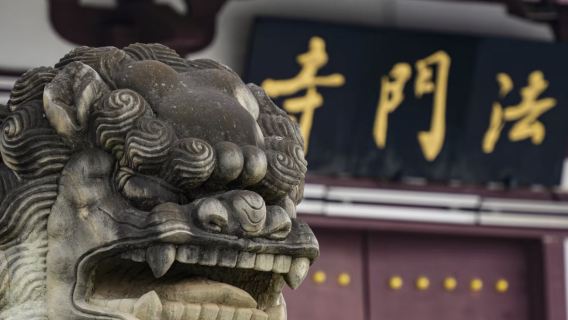
The Wuzhangyuan Zhuge Liang Temple is located on the Wuzhangyuan Terrace in the south of Qishan County, Baoji City. The temple gate is gorgeous and spectacular with a vertical wooden inscription above the gate denoting the name of the temple. According to records, Zhuge Liang Temple was built in the early Yuan Dynasty, and repeatedly renovated and improved during the Ming and Qing dynasties. Most of the existing buildings were built in the Qing Dynasty. These include the temple door, Peifang Building and both of the Xiangfang Buildings. On the east and west sides of the entrance hall, replicas of Shu generals Wei Yan and Ma Wei stand guard. Inside the temple, Zhuge Liang's "Chu Shi Biao" stone carving stands on exhibition, and there is also a stone carving of the founding emperor Zhu Yuanzhang's commentary on Zhuge Liang.Qishan · 20.1km from downtown

Zhou Gong Temple
Zhou Gong Temple lies in the south foot of Phoenix Mountain, in the northwest of Qishan County, Baoji City, and is one of the key historical relics protection organizations at the provincial level as well as a scenic spot at the provincial level. The scenic spot boasts hills surrounded on three sides, leaving only the south connecting with the plain. Qishan is the origin of Zhou royalty, and many poets and literary men once traveled here and left their famous literature works that made this place well-known.Qishan · 6km from downtown

Famen Cultural Scenic Spot
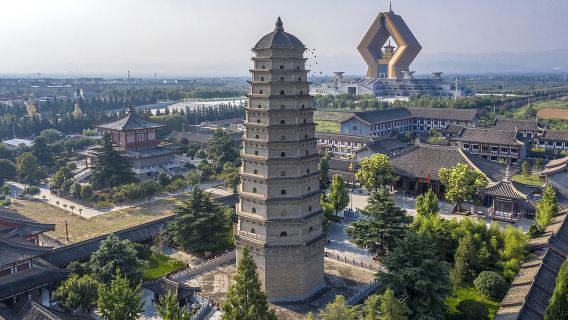
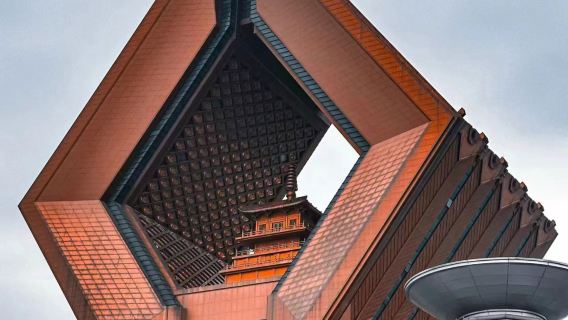
Famen Cultural Scenic Spot is located in Famen Town, Fufeng County, Baoji City, Shaanxi Province, covering an area of 1395 mu. It consists of core areas such as the Heshita Pagoda and Famen Temple Museum. The Heshita Pagoda is the iconic structure of the attraction, standing 148 m tall. Designed in the shape of hands clasped in prayer, it embodies the beautiful vision of peace, harmony, unity and reconciliation. The Famen Cultural Scenic Spot museum is a specialized museum dedicated to the collection, preservation, research, and exhibition of cultural relics unearthed from the underground palace of the Famen Cultural Scenic Spot. Its collection includes rare treasures such as gold and silver artifacts, secret-color porcelain, and glassware. The high grade, diverse types, large quantity, superior quality, and exquisite craftsmanship of these relics are exceptionally rare in the archaeological community both domestically and internationally, making them treasures of history and art.Fufeng County · 25.8km from Qishan

Water City: Three Kingdoms Town
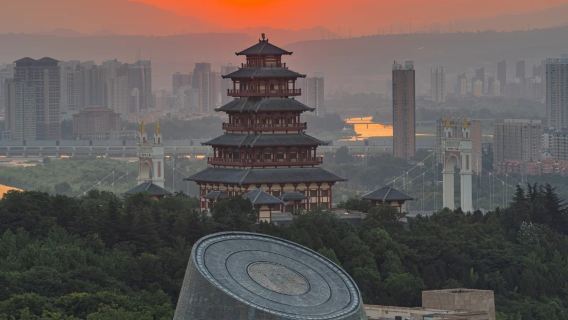
Shuicheng Three Kingdoms Town is a national AAAA-level Attraction. The area where the Attraction is located is the remains of the ancient battlefield where Zhuge Liang and Sima Yi confronted each other along the banks of the Wei River in 234 AD (234 AD). Zhuge Liang later passed away in Wuzhangyuan. The mottled war relics on this land have disappeared with the passage of time, but the stories here have never stopped. Those bravery, determination and wisdom have become a kind of culture here, and the origins have been passed down. Today, we recall history and inherit culture. Shuicheng Three Kingdoms Town combines domestic and foreign scientific and technological means to reproduce the historical features of the year and create a western tourist and cultural resort! The Water City Three Kingdoms Town Attraction relies on the authentic historical culture of the Three Kingdoms, embraces the unique charm of the Weihe Wetland, and integrates the classic historical allusions of the Three Kingdoms. With a new perspective and a combination of reality and fiction, it creates a comprehensive Three Kingdoms cultural experience site with the Three Kingdoms cultural experience as the core, deeply integrating performances, food, entertainment, leisure, and vacation. The Water City Three Kingdoms Town is committed to integrating regional historical culture and fusing modern fashion elements. It will fully and vividly display the "long-standing local cultural stories" through the functional combination of Dreaming of the Three Kingdoms, Stories of the Three Kingdoms, and Customs of the Three Kingdoms. Adhering to the southern design concept of "the city is built in the water, and people travel on the water", the Attraction will be built into a characteristic ancient town surrounded by water systems, ancient buildings and pleasant scenery, thus forming a Three Kingdoms cultural experience site with a clear theme, rich business types, and the integration of architectural landscapes and cultural arts. Visitors can "travel through time" and feel the different folk customs of the north and south during the Three Kingdoms period.Qishan · 15.6km from downtown

Emperor Qinshihuang's Mausoleum Site Museum
Emperor Qinshihuang's Mausoleum Site Museum, also known as the Terracotta Army, is located about 1.5 kilometers east of the Mausoleum of the First Qin Emperor and forms part of the extensive necropolis. There were more than a thousand terracotta soldiers unearthed here, each with a different facial expression. Standing before the massive underground army, you will feel the extraordinary might of the Qin Emperor that enabled him to unify six warring states two thousand years ago. The Qin Emperor Ying Zheng began building the mausoleum for himself at the age of 13. Nearly 720000 men and 38 years were required to complete this vast project.China · Xi'an

The Mount Taibai National Forest Park
The Mount Taibai National Forest Park is located on the northern slope of Mount Taibai, the main peak of the Qinling Mountains. Within the park, Baxian Terrace stands at an elevation of over 3,700 m, towering above all other peaks in the Qinling range. The dramatic vertical drop creates distinct layers of vegetation and climate zones as altitude increases—while the plains below swelter in midsummer heat, higher elevations bring a penetrating chill. In ancient times, the frigid summit retained snow even in June, earning "Taibai snow in June" a place among the eight scenic views of Guanzhong. Though snow in June is now rare, the alpine region still preserves Quaternary glacial relics such as cirque lakes and stone seas, offering a rare view of high-altitude landforms. Most 1-day tours turn back at "Sky circle earth square," which sits at an elevation of over 3,500 m on the main ridge of the Qinling Mountains—the watershed dividing China's north and south. Streams north of the ridge flow into the Yellow river, while those south feed the Yangtze river. On clear days, you can overlook rolling seas of clouds. The true summit ascent to Baxian Terrace begins here. A standard hiking itinerary to the peak takes approx. two days, starting from Sky circle earth square, passing Xiaowengong Temple and Dawengong Temple to reach the alpine cirque lake Daye Hai, then making the final push to the summit, with an overnight stay at Xiaowengong Temple. The Mount Taibai National Forest Park's remote areas feature complex terrain and wildlife including large predators. Whether traveling by vehicle, cable car, or on foot, always stay on developed routes and avoid venturing off main paths. The first day of the seventh lunar month is the traditional temple fair of The Mount Taibai National Forest Park, when crowds of visitors flock to the mountain, creating a lively atmosphere and offering a great opportunity to experience mountain folk customs.Mei County · 49.9km from Qishan

Shi-ku Garden in China
Shi-ku Garden in Chinais located on Shigu Mountain on the south bank of the Wei River in Baoji, to the north it overlooks the Wei River, to the east it borders the Yinxiang River, and to the south it adjoins Tiantai Mountain National Forest Park. Legend has it that the pre‑Qin stone drums unearthed in the early Tang were found in this area. The ten granite, drum‑shaped stones are inscribed with stone drum script, a writing that follows bronze script and anticipates small seal script. The Tang writer Han Yu wrote the "Song of the stone drums" to praise their value, and the original artifacts are now kept at The Palace Museum in Beijing, soShigu Mountaintook its name from this association. The park spreads along the mountain slope, integrating site conservation, bronze exhibitions, stone drum culture displays, garden sightseeing, and archaeological research into a cultural ecology park. At a high point in the park, the Shigu Pavilion is the landmark building. Modeled on Qin and Han styles, its outer‑five, inner‑nine tiering is especially striking, and from the pavilion you can look down on the urban areas on both banks of the Wei River. At the foot of the mountain, the Baoji Bronze Ware Museum houses Western Zhou bronze masterpieces such as the He zun and the Lai pan. The museum and the Shigu Pavilion, one high and one low, form the main tour route. You can also walk past the Zhou Culture Wall, the Han character gallery, the plaza for heaven worship and ancestor veneration, and the Shigu Mountain corridor bridge. At night, the Shigu Pavilion and the corridor bridge are illuminated, and the park takes on a different atmosphere.Baoji · 40.7km from Qishan

Xi'an City Wall
Xi'an City Wall is a landmark of this ancient city. The city walls that we see now were built in the early years of the Ming dynasty and they are now more than 600 years old. The walls were built on the foundations of the imperial city of the Tang Dynasty and they are formed together with a series of defensive installments such as moats and turrets. At present, Xi'an City Wall can be accessed by many city gates. Visitors can choose the nearest one to them. The South Gate is the visitor entrance of Xi'an City and is also the city gate with more tourists. Cycling on the ancient walls is a good experience. Riding on the wall overlooking the ancient capital of the thirteenth dynasty, you will have a feeling of travelling through time.China · Xi'an

Huaqing Palace
Huaqing Palace attraction is located 30 km east of Xi'an, adjacent to the Terracotta Warriors. Renowned for its timeless hot spring resources and numerous historical events, it has become an iconic cultural tourism attraction of Tang Dynasty palaces in China. Palace scenic spots Huaqing Palace boasts a long history, serving as an imperial retreat for emperors from the Zhou, Qin, Han, Sui, and Tang dynasties. The palace features cultural zones like the Tang Imperial Hot Spring Relics Museum, the Xi'an Incident site—Five-Room Hall, Nine Dragon Lake and Lotus Lake scenic areas, and the Tang Pear Garden Museum. Notable architectural complexes include Feishuang Hall, Wanshou Hall, Changsheng Hall, Huanyuan Garden, and Yuwang Hall. The stele of "hot spring ode" Mount Li hot springs, developed early and favored by emperors throughout history, enjoy the reputation of being "the imperial hot springs under heaven." As far back as the Yangshao culture period 6,000 years ago, the ancient Jiangzhai people began utilizing these springs. With their profound cultural heritage spanning millennia, Mount Li hot springs represent an indispensable part of Chinese historical culture. The stele of hot spring ode in the attraction stands 154 cm tall, 72 cm wide, and 19 cm thick, featuring a coiled dragon design and a trapezoidal base. Engraved by Yuan Chang, the governor of Yongzhou during the Northern Wei Dynasty, the inscription reads, "The hot spring is nature's prescription and the primordial healer of the universe. People from all nations and those suffering from ailments come with provisions to seek relief in its waters." This stele is the earliest surviving written artifact at Huaqing Palace. Tang Imperial Hot Spring Relics Museum This is the site of the bathing pool described in the "Song of Everlasting Sorrow" where Yang Guifei emerged from her bath. After the An Lushan Rebellion, little remained of the original structure. In 1982, while constructing the "Guifei Pavilion," the Lintong County Government accidentally discovered the ruins of a Tang Dynasty bathing pool. After excavation and restoration, the Huaqing Palace imperial hot spring ruins museum was established. This small yet exquisitely designed pool measures 3.6 meters east-west and 2.9 meters north-south, with an oval-like shape. The pool walls are entirely built with bluestone slabs, featuring a two-tiered terrace structure composed of 18 arched stone sections. Inside the pool lies a dedicated bathing stone for Yang Guifei, engraved with the character "Yang." At the center of the pool bottom is a 10 cm diameter water inlet. A white marble lotus pedestal was unearthed here, connecting to both a showerhead above and ceramic water pipes below that linked to the main water source. Due to natural pressure, hot spring water would spray outward through the lotus showerhead, creating a mist effect remarkably similar to modern showers. Adjacent to the Guifei Pool to the east lies Emperor Xuanzong's exclusive imperial hot spring. During the Tang Dynasty, the Nine Dragon Hall stood above this pool, featuring nine white jade-carved dragons spouting water outside. This pool's surface resembles a realistic lotus shape, hence its alternate name "Lotus Pool." Xi'an incident site The five-room hall at the Xi'an incident site in Huaqing Palace is where the Xi'an incident took place. To this day, the glass windows and walls of the five-room hall still bear bullet marks from the fierce battle during the military remonstrance. The desks, chairs, beds, sofas, tea sets, stoves, carpets, telephones, and other office items in each room are replicated and arranged according to their original appearance. Historical events: Beacon fire to deceive the feudal lords In 779 BC, King You of Zhou obtained the beautiful Bao Si, yet she never smiled. To solve this, the king conspired with the treacherous minister Guo Shifu and lit the beacon fires at the Huaqing Palace attraction. The feudal lords across the land saw the signals.Beacon fireHe quickly led his troops to rescue the king, but King You told the feudal lords, "I lit the beacon fires just to make my queen laugh," upon which Bao Si burst into laughter. The feudal lords arrived valiantly but left resentfully. Seeing King You's incompetence and the people's discontent, the Quanrong tribe seized the opportunity to launch an attack. As the enemy troops approached the mountain, King You urgently raised the beacon fires.Beacon fireHe mobilized troops, but none of the feudal lords came to his rescue. King You fled with Bao Si toMount LiHe was later killed by the Quanrong tribe, leaving behind historical anecdotes such as "a smile worth a thousand gold," "losing the kingdom for a smile," and "playing with beacon fires to deceive the feudal lords." And this beacon tower at Huaqing Palace attraction towers at an altitude of 913.6 m.Mount LiThe beacon tower at Huaqing Palace attraction on the first peak of Xixiu Ridge. Su Dongpo composing poetry at Mount Li During the Jiayou era of the Northern Song Dynasty, the Lishan hot springs, meticulously restored by Liu Ziyong and others, became breathtakingly beautiful, attracting crowds of visitors who composed poems and essays to express their nostalgia. Among the countless poetic works, the emerging literary giant Su Shi stood out with his masterpieces like "Lady of Guo's night outing" and "Lishan" during his visit to the hot springs. Xi'an incident The Xi'an incident, also known as the "double-twelfth incident". Zhang Xueliang and Yang Hucheng launched a mutiny at Huaqing Palace, detaining the then chairman of the Military Commission of the National Government. Performance items You can watch a large-scale dance drama at the attraction. ▲ The Song of Everlasting Sorrow is China's first large-scale live historical dance drama created by Shaanxi Tourism Group. Based on Bai Juyi's timeless poem of the same name, it fully utilizes the attraction's resources and employs high-tech stage lighting to combine historical storytelling with live performances, recreating the love story of Emperor Li Longji and Yang Guifei at Huaqing Palace over 1,300 years ago. ▲There is also the historical adaptation "12-12 Xi'an Incident," which vividly and authentically recreates the lesser-known details of the "Xi'an Incident."China · Xi'an

Mount Hua
Mount Hua, formerly known as "Xiyue", is one of the five famous mountains in China. It is located in Huayin City, Shaanxi Province. Huashan is also known as "Taihuashan". It is the birthplace of Chinese civilization. The "Hua" in "Zhonghua" and "Huaxia" comes from Huashan. The words "strange and dangerous" are the essence of Huashan's scenery. "Since ancient times, there has been only one road to Huashan" describes the steepness of Huashan. The Attraction has many thrilling attractions such as Changkong Plank Road, Kitesurfing, Qianchi Chuang, Baichi Gorge, Laojun Ligou, etc., which are carved out on the steep cliffs. Those who visit them in person will be amazed. Huashan Attraction covers a vast area, including the Main Peak Attraction, Xiyue Temple Attraction, Xianyu Attraction, etc. The Main Peak Attraction is the core Attraction of Huashan, including "Huashan One Road" and the five main peaks in the southeast, northwest, and center. Huashan in most people's minds refers to the Main Peak Attraction. Five main peaks The East Peak is about 2,100 meters above sea level and is named for its location in the east. There is a platform on the top of the peak, which is high and dangerous with a wide view. It is a good place to watch the sunrise. It is called Chaoyang Terrace, and the East Peak is also called Chaoyang Peak. The East Peak consists of four peaks, one main peak and three s-ervant peaks. The peak where Chaoyang Terrace is located is higher, the Yunv Peak is in the west, the Shilou Peak is in the east, and the Botai is in the south. There are more than dozens of landscapes on the East Peak. There is a natural stone pattern on the cliff on the side of the East Shilou Peak, which looks like a giant palm print. This is the Huayue Immortal Palm, which is listed as the first of the eight scenic spots in Guanzhong. The story of the giant spirit opening the mountain and guiding the river originated from this. The West Peak is about 2,000 meters above sea level. Because there is a huge rock on the top of the peak that looks like a lotus petal, ancient literati often called it Lotus Peak or Hibiscus Peak. Xu Xiake wrote in his "Diary of Traveling to Mount Taihua": "There is a rock rising on the peak, and there are stone pieces covering it, like a lotus flower." This stone must be referring to it. There are many landscapes on the West Peak, including Cuiyun Palace, Lotus Cave, Giant Spirit Foot, Axe-Split Stone, Sheshen Cliff, etc., and there are many beautiful myths and legends. Among them, the well-known story of Chenxiang splitting the mountain to save his mother is circulated here. The South Peak is over 2,100 meters above sea level and is the highest peak of Huashan. The ancients called it the "Head of Huashan". On one side of the South Peak is a thousand-foot cliff, standing straight like a knife, and below is a deep ravine, which is separated from Sangong Mountain and Sanfeng Mountain. The South Peak consists of one peak and two peaks. The east side is called Songhui Peak, and the west side is Luoyan Peak. The origin of the name of Luoyan Peak is said to be because the migrating wild geese often land here to rest. The North Peak is about 1,600 meters above sea level, with cliffs on all sides, covered with clouds above and connected to the earth veins below. It stands tall and unique, and is also called Yuntai Peak because it looks like a cloud platform. Li Bai of the Tang Dynasty wrote in his poem "A Song of the Cloud Platform of Mount Xiyue to Complimentary Danqiuzi": "Three peaks stand as if about to collapse, and the green cliffs and red valleys are high. The golden essence of the White Emperor mobilizes his vitality, and the stones become lotus flowers and the clouds become platforms." The famous story of "Taking Huashan by Strategy" took place here. There are many landscapes on the mountain, including the Zhenwu Hall, Jiaogong Stone Chamber, Changchun Stone Chamber, and the place where Laojun hung the plow. The Middle Peak is the only way to the other four peaks. It is located in the middle of the East, West and South Peaks. The forests on the peak are lush and green, and the environment is quiet. There is a Taoist temple named Yunu Temple on the top of the peak. It is said that it was the place where Qin Mu Gong's daughter Nong Yu cultivated herself in the Spring and Autumn Period, so it is also called Yunu Peak. Main landscape: There are more than 210 famous Attraction in Huashan. From ancient times to the present, countless literati and poets have left various classic poems here. Skywalk The Changkong Plank Road is located on the east side of the Huashan South Peak. It was built by the master of the Huashan School, Taoist He Zhizhen of the Yuan Dynasty, who wanted to get away from the world and practice Taoism. He built it by inlaying stone piles on the cliffs and paving wooden boards. At the end of the plank road, you can see the "Hezu Cave" where Master He practiced self-cultivation. The road builders chiseled stone holes on the cliffs, wedged stone piles into the holes, and laid wooden boards about 40 cm wide between the stone piles. Visitors must stick to the cliff wall, pull the iron chain with their hands, step on the wooden boards, and move forward slowly sideways. Xiyue Temple Xiyue Temple, also known as Huayue Temple, is a temple where emperors of all dynasties worshipped and offered sacrifices to Shaohao, the Great Emperor of Xiyue. It was first built during the Yuanguang period of Emperor Wu of the Han Dynasty (134-129 BC) at the entrance of Huangshengu (now Huangfuyu) at the foot of Huashan Mountain. It was moved to its current location during the reign of Emperor Huan of the Eastern Han Dynasty (147-167 AD) and renamed today. It was rebuilt many times during the Tang, Song, Ming and Qing dynasties. Canglong Ridge The steps on Canglong Ridge are only 2 feet wide, with deep ravines on both sides, as steep as a knife. The height difference between the ridge and the top is about 500 meters, and the slope is more than 45 degrees. Looking at the green pines and white clouds in the distance and hearing the sound of the wind is dizzying. Jinsuoguan Jinsuoguan is one of the five passes of Huashan Mountain. It is built on a stone archway at the entrance of the three peaks. It is the throat of the Wuyun Peak to the four peaks of East, West, South and Center. There is no way to pass after the pass, so it is also called Tongtianmen. Taoists believe that Huashan is the fairyland of gods. Only after passing Tongtianmen can you enter the fairyland. Therefore, there is a folk song that "after passing Jinsuoguan, there is another world". There has been only one road to Mount Huashan since ancient times "There has been only one road to Mount Hua since ancient times" refers to the "Huashan Valley" hiking trail, which includes various scenic spots along the Huashan hiking trail since ancient times. When connected together, it is what is commonly referred to as "There has been only one road to Mount Hua since ancient times." How to visit Huashan has two mountain gates (entrances): East Gate and West Gate (also known as Huashan Gate). Take the cable car up the mountain and go to the East Gate; if you climb the mountain on foot, enter from the West Gate. Huashan currently has two cable cars, the East and West Lines, which reach the North Peak and the West Peak respectively (please plan the climbing route in advance before purchasing the ticket and purchase the corresponding ticket type, and you cannot change it midway.). Route 1: Hiking route There has been only one road on Mount Huashan since ancient times. It is an ancient mountaineering road with a total length of 12.5 kilometers and 9,567 steps. It takes about 4 hours to hike from Yuquanyuan, through Wuli Pass, Shaluoping (night climbing), Qianchi Chuang, Baichi Gorge, etc. to the North Peak, and then start the tour from the North Peak. Route 2: "Up West and Down West", a mountaineering route suitable for the Seniors and tourists with children This route goes up the West Peak Cableway of Mount Huashan and down the West Peak Cableway, that is, going up from the west and down from the west. The whole route takes a relatively short time, about 4 hours, and is also more energy-saving, making it more friendly to the Seniors and tourists with children. Route 3: "Up West and Down North", a one-day mountaineering route chosen by 80% of tourists This route goes up by cable car from the West Peak of Mount Huashan and down by cable car from the North Peak, that is, going up from the west and down from the north. The entire route is a classic one-day tour route, which takes about 6 hours. You can visit all the attractions without backtracking. Most tourists choose this route because this road almost goes straight down, which is easier and faster than the uphill road. Route 4: "North up and north down", a time-saving, economical and panoramic mountaineering route This route goes up by cable car at the North Peak of Huashan and down by cable car at the North Peak, that is, going up from the north and down from the north. The whole route is a relatively low-cost cable car mountaineering route. If your sightseeing time is limited, you can choose this route and visit the North Peak, which has the Memorial Pavilion, Ear-Crushing Cliff, Canglong Ridge, Huashan Sword Contest Monument, panoramic Huashan and other attractions.China · Huayin
Experiences you can't miss in Qishan
Featured Cultural experiences in Qishan
View all Cultural experiences![Qinling four treasures science museum + city wall + Xi'an Muslim Quarter [premium small join-in tour 1-day tour·includes English guide]](https://ak-d.tripcdn.com/images/0350t12000tvfi30197BB_C_568_320.jpg?_fr=wc)
5.0/5
· 1 reviewFree cancellation
Instant confirmation
From€ 79.86
Free cancellation
Instant confirmation
From€ 52.97
From€ 133.09
Featured Day tours in Qishan
View all Day tours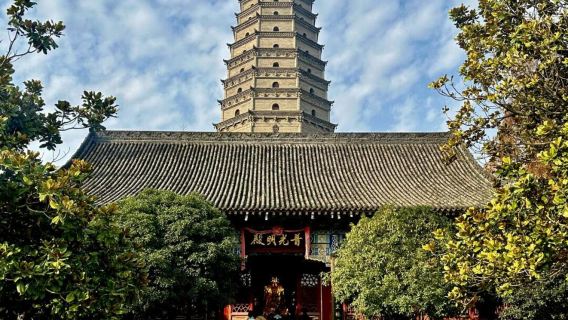


4.5/5
· 21 reviews· 231 bookedFree cancellation
Instant confirmation
From€ 28.52

5.0/5
· 3 reviews· 38 bookedFree cancellation
Instant confirmation
Book now for today
From€ 74.11
4.9/5
· 407 reviews· 423 bookedFree cancellation
Instant confirmation
Book now for tomorrow
99.3% of travelers recommend
From€ 31.68
![Xi'an Qinling Four Rare Animals Science Park Puzzle Day Tour [Qi Zai Special Line]: Immerse in Nature's Hidden Paradise](https://ak-d.tripcdn.com/images/0355812000quuw0pp8AA0_C_568_320.png?_fr=wc)
4.5/5
· 2 reviews· 24 bookedFree cancellation
Instant confirmation
From€ 28.44

5.0/5
· 1 review· 25 bookedFree cancellation
Instant confirmation
From€ 59.70
4.9/5
· 20 reviews· 65 bookedFree cancellation
Instant confirmation
Book now for tomorrow
81 travellers saved
From€ 34.79
5.0/5
· 1 reviewFree cancellation
Instant confirmation
From€ 41.00
Free things to do in Qishan
Wuzhangyuan Zhuge Liang Temple
Qishan · 20.1km from downtownImmediate access, Book now for today, Cancel anytimeZhou Gong Temple
Qishan · 6km from downtownFamen Cultural Scenic Spot
Fufeng County · 25.8km from QishanWater City: Three Kingdoms Town
Qishan · 15.6km from downtownEmperor Qinshihuang's Mausoleum Site Museum
China · Xi'anCancel anytimeThe Mount Taibai National Forest Park
Mei County · 49.9km from QishanShi-ku Garden in China
Baoji · 40.7km from QishanXi'an City Wall
China · Xi'anImmediate access, Book now for today, Cancel anytimeHuaqing Palace
China · Xi'anImmediate access, Book now for todayMount Hua
China · HuayinImmediate access, Book now for today, Cancel anytime
What travellers say about Qishan

Anonymous user6 April 2026
5.0
Wuzhangyuan in Qishan was the final resting place of Zhuge Liang's life. In the autumn of 234 AD, Zhuge Liang, the Prime Minister of Shu Han, led his army on a northern expedition, stationing his troops here to confront Sima Yi across the Wei River. Ultimately, he "died before achieving his goal," forever freezing the last moments of his life on this loess plateau. The Zhuge Liang Temple at Wuzhangyuan was first built in the Yuan Dynasty, and most of the existing buildings are from the Qing Dynasty. Its most unique layout is that the entire structure faces north, backed by the majestic Qinling Mountains and facing the surging Wei River, symbolizing Zhuge Liang's unfulfilled ambition to "pacify the Central Plains."
Wuzhangyuan Zhuge Liang Temple

_We***577 August 2026
4.0
A must-see for history and culture enthusiasts, this building dates back to the Tang Dynasty and is predominantly composed of Ming and Qing Dynasty structures. Located on the fiefdom of the Duke of Zhou, it boasts a rich cultural heritage. However, the architecture itself is not particularly stunning, and those uninterested in the cultural aspects may find it less appealing.
Zhou Gong Temple

诺飞亚norffea9 October 2026
5.0
Famen Cultural Scenic Area, a 5A-level scenic spot, boasts a grand and magnificent architectural design that will remain relevant for at least 500 years. The mountain gate square consists of four parts: the Buddha Light Gate, the Prajna Gate, the Bodhi Gate, and the Harmony Gate. The Buddha Light Avenue is the main landscape axis of the scenic area, and at the innermost part is the Relic Pagoda. The prices of food and cultural and tourism products within the scenic area are not expensive. The entire scenic area showcases the splendid history and culture of the Chinese nation.
Famen Cultural Scenic Spot

清风若溪30 April 2020
4.0
Shuicheng Three Kingdoms Town is a charming town built based on the real Three Kingdoms history and culture. It is located in the eastern section of Caijiapo Chuangye Road, Qishan County, Baoji City, Shaanxi Province, and is adjacent to the "Waterside" Weihe Wetland Park. The scenic spot integrates classic historical stories of the Three Kingdoms, leisure and entertainment, snacks and food, cultural performances, etc., allowing tourists to deeply experience the Three Kingdoms culture while tasting local food.
Water City: Three Kingdoms Town

M18***5218 October 2026
5.0
Five-star review! A huge thank you to our guide, Mr. Ren, for his excellent explanation. His professional expertise was solid, and his presentation was clear and organized. From the historical background of the Qin Dynasty and the excavation and restoration process of the Terracotta Army, to the hairstyles and armor of the terracotta warriors, the unique details of each individual face, and the exquisite craftsmanship of the bronze chariots, he narrated everything in a captivating way. The terracotta warriors, which had stood silently, seemed to come alive with stories, allowing us to truly feel the grandeur of the Qin Empire.
The guide was patient and attentive throughout the tour, planning the route and answering all the children's questions, providing a lot of historical information that was easy for children to understand.
Emperor Qinshihuang's Mausoleum Site Museum

_We***6514 October 2026
5.0
Mount Taibai boasts stunning scenery, especially breathtaking in autumn! The cable car queue is short, so you won't have to wait long. The cable car ride up the mountain offers expansive views, taking in the vibrant autumn colors of the surrounding mountains and forests. It's a great experience for children; they were excited throughout the ride and easily enjoyed the Qinling Mountains scenery. Highly recommended for families!
The Mount Taibai National Forest Park

首席监理30 May 2022
4.0
The Chinese Stone Drum Park is one of the key tourist and cultural scenic spots in Baoji City, Shaanxi Province. It is located on the Stone Drum Mountain, where the Stone Drum, which was praised by Kang Youwei as "China's No. 1 Antiquity", was unearthed. It is adjacent to Yinxiang River in the east, Jifeng Mountain, the main peak of Qinling Mountains in the south, the urban area in the west, and the Weihe River in the north. It covers an area of more than 500 acres and has a total construction area of 47,000 square meters. It is a cultural ecological park with the theme of Zhou and Qin history and culture. There are five major areas, Baoji Bronze Museum, Chencang Stone Drum Pavilion, Qin Culture Square, Stone Drum Square, and Jinshi Garden, which integrate site protection, bronze exhibition, stone drum culture display, garden sightseeing, archaeological research and leisure and entertainment, and fully display the profound history and culture of Baoji as the birthplace of Zhou and Qin culture.
Through the protection and shaping of natural landscapes, the park has become a collection of the five characteristics of Baoji, Shaanxi, namely, mountain, water, forest, plateau, and city. Through the integration and reproduction of Zhou and Qin history, the park has become a microcosm of ancestral culture and a charming place with both natural and humanistic characteristics. The two iconic buildings of the China Stone Drum Park, Chencang Stone Drum Pavilion and Baoji Bronze Museum, have become the new city coordinates of Baoji.
Shi-ku Garden in China

_TI***dc17 October 2026
5.0
It was a pleasant experience. We arrived at around 7 and spent 1-2 hours walking around. Views are mesmerizing and it's fun looking down on busy streets at night.
Xi'an City Wall

Natalia Valenzuela ubina15 October 2026
5.0
I’m really happy I visited this place! I thought I would find some gardens and a few temples, but instead, I discovered an entire mountain with a cable car and everything.I started walking around without really knowing where to go, but the area is full of maps, so it’s easy enough not to get lost.I had no idea Chiang Kai-shek’s temporary office was located here. It was truly interesting to visit!Afterwards, I wandered along the streams and lakes, surrounded by nature and temples, until I came across the cable car. I decided to take it only on the way up.From there, I continued hiking to Beacon Hill. There are quite a lot of steps, but the views make it absolutely worth it.After that, I walked all the way back down the mountain. I discovered so much more than I had expected! I even bought some souvenirs and grabbed some KFC along the way.If you’re planning to hike up to Beacon Hill without taking the cable car, be prepared for a very long walk!
Huaqing Palace
suyu17 October 2026
5.0
Mount Hua is renowned as "the most precipitous mountain under heaven," offering thrilling adventures like the Plank Road in the Sky and the Hawk's Turn, while the cable car soars through the clouds for breathtaking views. Each of its five peaks possesses its own unique character, and the sunrises and seas of clouds are magnificent. It also boasts a rich Taoist culture. With well-developed facilities and standardized management, it's a must-visit destination for adventurous travelers.
Mount Hua


