Pamukkale

Things to do in Pamukkale

Search attractions or local attractions & tours
Search

Explore top experiences

Top 10 attractions in Pamukkale

View all Attractions
Hierapolis
No. 1 of Best Things to Do in Denizli Province

Hierapolis

6.9

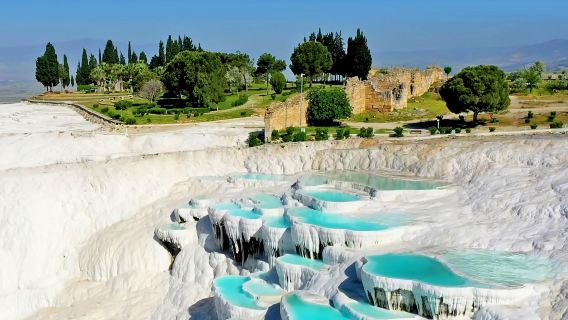
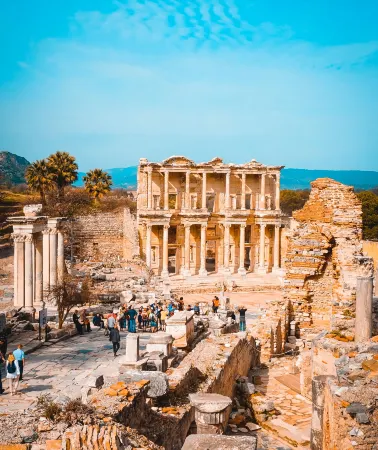
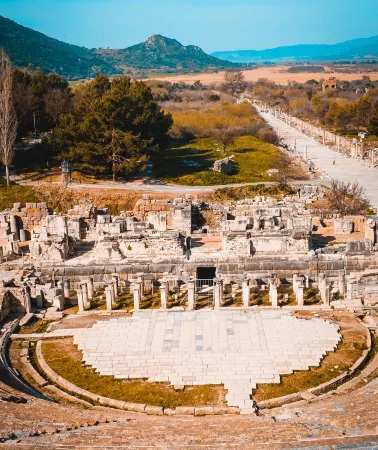
Hierapolis, located above Pamukkale, was founded in 190 BC. In ancient times, the hot springs and the limestone at the foot of the mountain were believed to possess magical properties. The site is quite large, with ancient cemeteries, bathhouses, a market, arches, an amphitheater, the remains of the Temple of Apollo, the Hierapolis Archaeological Museum, and the ancient hot springs scattered from north to south. Entering from the north gate ticket office, one first passes through an ancient necropolis with over 1,000 tombs. Continuing forward, one arrives at the North Bathhouse, featuring several interconnected stone arches, a classic example of Roman architecture. Next to the bathhouses are three continuous arches and a cylindrical stone mound. From here, heading south, a north-south avenue runs through the site. Today, this avenue is mostly broken and fenced off. The Hierapolis Archaeological Museum is located at the southern end of the avenue, at a junction where the road leading up from the travertines at the foot of the mountain leads to this point. Formerly the Southern Baths, it displays a large collection of statues and sarcophagi excavated from the site, including Classical and Roman sculptures, ancient coins, and gold and silver jewelry. Turn left at this intersection to reach the Pamukkale Ancient Thermal Pool. Roman ruins lie at the bottom of the pool, where clear, hot spring water gushes forth continuously, allowing for clear views of marble columns and fragments of statues reclining at the bottom. The well-preserved amphitheater near the ancient thermal pool is a must-see. Built in the 2nd century BC, it is said to have accommodated up to 15,000 spectators. Statues of Greek gods can be found at the main entrance, and the ruins of the Temple of Apollo can be seen in the distance in front of the amphitheater. Hierapolis-Pamukkale is a UNESCO World Heritage Site. Sunset is particularly beautiful, with the golden rays of the setting sun filtering through the arches onto the ancient stone, creating an unforgettable, time-worn beauty.

Pamukkale · 1.2km from downtown
Pamukkale
2027 Asia 100 - Night Attractions

Pamukkale

6.2

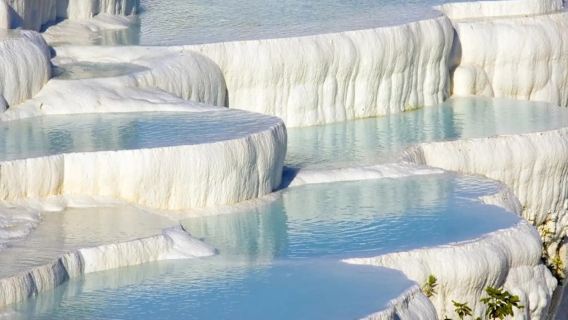
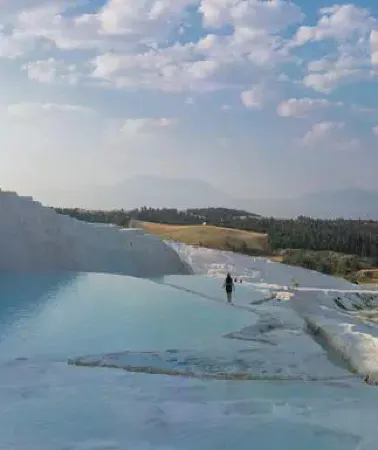
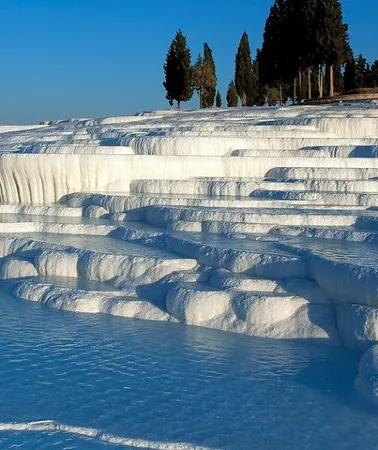
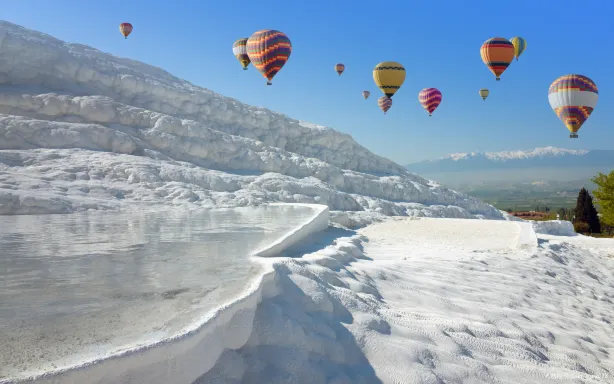
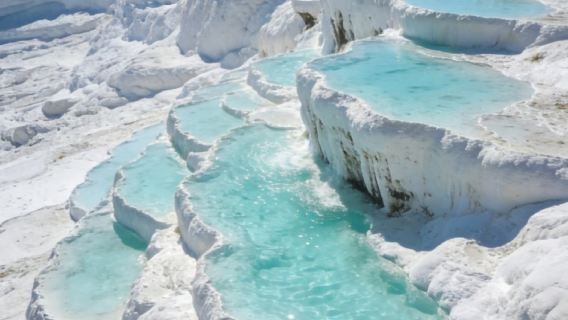
Pamukkale is located 19 km north of Denizli, Türkiye. In Turkish, Pamuk means cotton and Kale means castle, so Pamukkale is called Cotton Castle. This is a famous hot spring resort destination, home not only to natural hot springs that are thousands of years old, but also to these strange hills that look like cotton, which are actually hard limestone. In 1988, Pamukkale and the ancient city of Hierapolis on top of it were together inscribed as a World Cultural Heritage site. Unique stepped "cotton" hills The view of Pamukkale is quite unique. Hot springs gush from underground and flow down along travertine terraces, carving the hillside into a stepped form. On the platforms, the spring water collects into small pools. Looking from top to bottom, each hot spring platform resembles a mirror reflecting the blue sky and white clouds. Looking from bottom to top, it resembles a volcano that has just erupted, with white lava covering the entire hillside, creating a rather spectacular sight. This unique scenery has attracted many photography enthusiasts from around the world. The hot spring resort where Cleopatra once bathed Nestled among mountains and water, the white Pamukkale has been a hot spring retreat since the Greek era, and legend has it that Cleopatra herself once bathed here. The water here has a pH of around 6. Visitors come in an endless stream to soak in the hot springs, and European and American tourists in particular often come with their whole families. Attraction tour routes Visitors generally enter through the north gate of the attraction, where they can see the Northern Necropolis (with over 1,000 tombs), the North Baths (the core structure of the ancient city), and the Arch of Domitian. Passing through the marketplace, you can see a church and a water temple, and near the south gate stand the ruins of the Temple of Apollo and the amphitheater. You can first explore the ancient city of Hierapolis, and heading south from the ancient city down the hillside brings you to Pamukkale. In the evening, you can enjoy the beautiful sunset The more scenic areas of Pamukkale are along the path going up from the entrance. Generally, the crowds increase starting in the morning and gradually thin out toward evening, so if you arrive in the afternoon, you can simply go later to enjoy the sunset views. The white rock surfaces are tinted with soft colors by the sunlight, while the rippling water on the rock surfaces captures the ever-changing, wondrous colors of the sky.

Pamukkale · 891m from downtown
Laodicea Ancient City

Laodicea Ancient City

3.4

The ancient city of Laodicea, nestled on the banks of the Lycus River in Denizli Province, Turkey, was originally known as the "City of Zeus." It was rebuilt in the 3rd century BC by Antiochus II of the Seleucid Empire and named after his queen, Laodice. Strategically situated at the junction of Phrygia, Caria, and Lydia, and near Hierapolis, it was a crucial trading hub in Roman Anatolia and is now a UNESCO World Heritage Site. Upon entering the ruins, the remains of a double amphitheater, a stadium, temples, and a magnificent aqueduct system remain, testifying to the city's former prosperity. Archaeological excavations have unearthed the head of a statue of the goddess Hygia and a painted Scylla, highlighting the artistic achievements of the Hellenistic period 2,100 years ago. As early as the 1st century AD, Laodicea was renowned for its black wool textiles and finance, earning it the nickname "the city of wealth." After the devastating earthquake of 60 AD, the city's residents refused Roman aid and rebuilt the city with their own wealth, leaving behind a wealth of exquisite architecture in the style of Classical art. Laodicea is particularly renowned for its wool textiles. The wool from these raven-colored sheep was woven into noble yarn, crafted on wooden looms into textiles that were sold throughout the ancient world. Archaeologists have also discovered fragments of looms dating back approximately 7,000 years, testifying to the region's long-standing textile tradition. To this day, the Denizli region continues to practice these ancient techniques, producing textiles such as Buldan Bezi and Dasdar, attracting countless tourists and collectors. This ancient city, renowned for its wealth and art, was not only a center of trade and religion, but also a shining pearl witnessing the fusion of Mediterranean civilizations.

Goncali Mahallesi · 718m from downtown

Experiences you can't miss in Pamukkale

Featured Culture & history in Pamukkale

View all Culture & history
Pamukkale and Hierapolis Full Day Group Tour
󱌍
5.0/5
· 1 review
Duration: 7 hrs
English
Free cancellation
From€ 38.89
From Antalya: Pamukkale Hot Air Balloon Tour with Optional Hierapolis Visit
󱌍
4.0/5
· 2 reviews· 36 booked
Duration: 12 hrs
English
Free cancellation
From€ 40.00
Pamukkale+Hierapolis1-day Tour [From Izmir]
󱌍
27 booked
Duration: 12 hrs
English
Instant confirmation
From€ 110.00
Full-Day Pamukkale and Hierapolis Tour by Plane from Istanbul
󱌍
Duration: 9 hrs
English
Instant confirmation
From€ 376.67
Same Day Ephesus & Pamukkale Tour with Airport Transfers & Lunch
󱌍
Duration: 10.8 hrs
English
Free cancellation
Book now for tomorrow
From€ 400.00
Antalya: 1-day tour to the white wonderland of Pamukkale in Türkiye
󱌍
From€ 88.71

More things to do

Private Tours in Pamukkale

View More Private Tours in Pamukkale

Group Tours in Pamukkale

View More Group Tours in Pamukkale

Pamukkale Today's weatherCloudy 8-23℃
Pamukkale weather for the next 2 days11/22: 6-20℃, 11/23: 11-22℃

What travellers say about Pamukkale

user-avatar
D了个Y24 June 2022
4.0
The ruins of Hierapolis are located near Pamukkale. They are in the same large scenic area as the Pamukkale hot springs. You can walk between the two. It is a famous holy city in ancient Greece. It was built roughly in the 2nd century BC. At present, the ruins still have ancient Greek theaters, churches, baths and other large ruins, which reproduce the daily life scenes of the ancient Greek people. It is now a world cultural heritage. The ruins of Hierapolis were built by Eumenes II, the king of Pergamon, an ancient Greek city-state near the west coast of Turkey. It was built as a hot spring resort for the royal family and nobles. It was razed to the ground in a major earthquake in the 17th century. Now only broken walls and ruins remain.

Hierapolis

user-avatar
zixunshi993 January 2020
4.0
The archaeological museum in Pamukkale is actually a theater left over from the ancient Roman period, as well as some other living places. However, the road from the pool to the top is not very easy to walk.

Hierapolis Archaeological Museum

Trip Moments in Pamukkale

Popular cities near Pamukkale

Frequently asked questions

How can I contact Trip.com customer support?

Get help anytime, anywhere within 30 secondsContact customer support

Change and cancellation policies vary by attractions and tours. Please check the product details page for more information.

Ticket prices may vary between weekdays and weekends, as well as during peak and off-peak seasons. When booking with Trip.com, you can also use Trip Coins to get extra savings. For more tips on booking discounted tickets, please visit Trip.com for the latest information.