Mengzhou

Things to do in Mengzhou

Search attractions or local attractions & tours
Search

Explore top experiences

Top 10 attractions in Mengzhou

View all
Sui and Tang Dynasty Town Botanic Gardens
No. 9 of Family-friendly Attractions in Henan

Sui and Tang Dynasty Town Botanic Gardens

6.6
4.7/5
5.3k reviews

The Sui and Tang Dynasty Town Botanic Gardens was first established in 2005, built on the site of the Li-fang ward area of the Sui and Tang dynasty Luoyang City, integrating the zonal plants of the western Henan region with the cultural heritage of the Sui and Tang dynasty town ruins. The garden features over ten specialized areas, including the Thousand Varieties Peony Garden, the Wild Water Scenery Garden, the Magnolia and Crabapple Garden, the Hundred Herbs Garden, the Plum Garden, the Bamboo Garden, and the Osmanthus Garden, with more than two thousand plant species. Each season offers its own highlights — peonies in spring, lotus ponds in summer, red leaves in fall, and plum blossoms in winter. The Thousand Varieties Peony Garden is the centerpiece of the entire park, consisting of four sections: the Hundred Flowers Garden, the Nine Colors Garden, the Specialty Garden, and the Science and Technology Demonstration Garden. It brings together over a thousand peony varieties spanning a wide range of colors. Through rock arrangements and garden features, the garden displays peony-related poems and historical anecdotes in the form of couplets and carvings, adding a layer of cultural depth to the floral scenery. The Wild Water Scenery Garden is themed around lakes and wetlands, where aquatic plants and reed beds are occasionally visited by waterfowl, and wooden boardwalks wind through the area, making it ideal for strolling, sightseeing, and photography. The park is quite large, so taking two to three hours to stroll around at a leisurely pace is more relaxed. During the peony blooming season in spring, there are more visitors. In the Qianzi Peony Garden, the flowers are especially vivid in the morning light, making it a great time for photos. If you want to avoid the crowds, you can focus on relatively quieter areas such as the Wild Water Garden and the Herb Garden to enjoy a different kind of botanical beauty.

Luoyang · 43.5km from Mengzhou
Hanfu Costume Experiences in Luoyang
No. 4 of Activities in Henan

Hanfu Costume Experiences in Luoyang

5.9

Walk into Luoyang, the ancient capital of 13 dynasties, put on a gorgeous dress, stroll through the long river of history, and experience the charm of the thousand-year-old Han style. The profound heritage of Chinese civilization:Luoyang, as one of the birthplaces of Chinese civilization, has a profound cultural heritage that is closely linked to Hanfu. In Luoyang, Hanfu is not only a piece of clothing, but it is a bridge connecting the past and the present, allowing people to instantly travel back to that glorious and prosperous era. Luoyang's Hanfu has distinct characteristics, from the solemnity of the Qin and Han dynasties to the elegance of the Tang and Song dynasties; each style contains a unique historical charm. Perfect fusion of scenery and costumes:From the majestic magnificence of the Longmen Grottoes to the quaint tranquility of the White Horse Temple, to the quaintness of the ancient city of Luoyi, each place is an excellent background for shooting Hanfu blockbusters. Tourists dressed in Hanfu, leaving their own figures under the witness of history, become a vivid picture scroll. Professional makeup and service: Local merchants in Luoyang provide a wide variety of high-quality Hanfu clothing, and their makeup and photography services are also extremely professional. From exquisite makeup to hairstyle creation, to the use of photography techniques, tourists can show their best Hanfu style in front of the camera. Under the ancient city wall of Luoyang, Hanfu is more like a door through time and space, leading us into that magnificent and prosperous era.

China · Luoyang
Millennium City Park
2026 Asia 100 - Night Attractions

Millennium City Park

8.8
4.6/5
29.1k reviews

Millennium City Park is located by the shores of Longting Lake in Kaifeng. It is a large-scale historical and cultural theme park of the Song Dynasty, recreated one-to-one based on the famous painting Along the River During the Qingming Festival by Song Dynasty painter Zhang Zeduan. The park is divided into two sections by the Shuangting Bridge: the South Garden recreates the bustling street life of the Bianjing city, with taverns, eateries, teahouses, and pharmacies lined up along the streets; the North Garden is an imperial garden, with waterside halls, the Sifang Courtyard, and other palace buildings standing by the lake. Performers and street vendors in the park mostly wear Song Dynasty costumes, with ancient music lingering and bells and drums sounding, so that after a few steps visitors can easily fall under the illusion of "stepping into a painting in one morning, dreaming back a thousand years in one day." Architecture is the intuitive and tangible highlight here: the Rainbow Bridge spanning the Bian River is a replica of the famous bridge in the painting, shaped like a long rainbow, and standing on the bridge watching the grain boats pass by feels much like being inside the painting; the Fuyun Pavilion towers above all the other pavilions in the garden, with its tiered red towers and golden tiles on all four eaves, inviting one to climb from afar; the Shangshan Gate is rebuilt after the Northern Song dynasty Dongjing city gate, tall and majestic with brilliant painted decorations, making it the most imposing gate tower in the garden; and the Shuixin Xie, Shuangting Bridge, Jiulong Bridge, and other pavilions and waterside structures are scattered among the blue waves. The main attraction of the day is the immersive performances staged throughout the park: "Bao Zheng Inspects the Bian River Grain Transport" unfolds on the water on both sides of the Rainbow Bridge; "Squire Wang Seeks a Son-in-Law" features a decorated tower erected in front of Squire Wang's house where a silk ball is tossed to choose a groom; "Yue Fei Challenges Prince Xiao Liang" raises dust on the Song dynasty parade ground as horses gallop; and folk performances such as cockfighting, stilt walking, and pan drumming are interspersed throughout. To step into the action yourself, head to the Four Directions Courtyard to don traditional costumes and enter the examination cells for a hands-on Song dynasty imperial exam experience; families with children can enjoy carousel rides, roller coasters, and other amusement facilities wrapped in Song dynasty storytelling at the Song Dynasty·Royal Pleasure Ground; and in the entertainment quarters, face-changing, qigong fire-breathing, ancient magic, and other Song dynasty variety acts take turns on stage, with intangible cultural heritage feats ready to break out at any moment right beside you. After nightfall, the park takes on a different face: red lanterns light up one after another, the market streets are brightly illuminated, and it feels like a completely different park from the daytime. The large-scale water-based live performance "The Great Song Dynasty's Eastern Capital: A Dream of Splendor" is staged on the surface of Jinglong Lake. The entire show is woven together from eight classic Song ci poems and the painting Along the River During the Qingming Festival, drawing the audience back to the Northern Song dynasty's Eastern Capital a thousand years ago. The performance runs about 70 minutes, and many visitors deliberately plan their itinerary to stay until the evening to catch this show. Dining in the park is also convenient: the snack street at Dongjing Food Court brings together Kaifeng snacks such as fried liangfen, tongzi chicken, and almond tea, perfect for eating while strolling; if you want to sit down for a proper meal, you can visit the reconstructed Sun Yang Zheng Dian in the park, which was originally one of the seventy-two official restaurants of Bianjing in the Northern Song Dynasty, where you can taste traditional Henan dishes such as soup dumplings and carp with baked noodles.

China · Kaifeng
Mount Hua
2026 Asia 100 - Best Things to Do

Mount Hua

8.7
4.7/5
55.6k reviews

Mount Hua, known as the "Western Great Mountain" in ancient times, is one of China's Five Great Mountains. Located in Huayin, Shaanxi Province, it is also elegantly called "Taihua Mountain." The "Hua" in both "Zhonghua" and "Huaxia" originates from this mountain. "Steep and perilous" are the essence of Mount Hua's scenery, and the saying "there has always been only one path up Mount Hua" precisely describes its steepness—the Plank Road in the Sky, the Sparrowhawk Turn, the Thousand-Foot Precipice, the Hundred-Foot Gorge, the Laojun Plow Ditch, and other perilous sights leave every visitor awestruck. The Mount Hua attraction covers a vast area, including the main peak attraction, the Western Great Mountain Temple attraction, and the Xianyu attraction, among which the main peak attraction is the core, encompassing the five main peaks—east, south, west, north, and center—as well as the classic "Mount Hua Valley" climbing trail. The five main peaks each have their own distinctive features. The East Peak, at an elevation of approx. 2,100 m, has the open and expansive Chaoyang Terrace at its summit, making it an excellent spot for watching the sunrise, and is therefore also known as Chaoyang Peak; the natural stone patterns on the cliff face along the side of the peak resemble a giant palm print—this is the Huayue Immortal Palm, listed since ancient times as one of the Eight Views of Guanzhong. The West Peak, at an elevation of approx. 2,080 m, is named Lotus Peak because the giant rock at its summit resembles a lotus flower; the Cuiyun Palace, the Axe-Split Rock, and the Self-Sacrifice Cliff are scattered across it, and the myth of Chenxiang splitting the mountain to save his mother is said to have originated here. The South Peak, at an elevation of over 2,150 m, was called the "head of Mount Hua" by the ancients; it consists of two summits—Songgui Peak and Luoyan Peak—with a sheer cliff dropping straight down on one side. The North Peak, at an elevation of approx. 1,600 m, is also known as Yuntai Peak; it stands isolated and towering with precipitous drops on all four sides, and the story of "Taking Mount Hua by Strategy" took place here; the peak features views such as the Zhenwu Hall and the Jiaogong Stone Chamber. The Central Peak lies at the center of the East, West, and South Peaks, with serene and lush vegetation; on the peak is the Jade Maiden Shrine, said to be the place where Nongyu, daughter of Duke Mu of Qin during the Spring and Autumn period, cultivated herself, hence it is also known as Jade Maiden Peak. The Plank Road in the Sky is located on the mountainside east of the South Peak. It was built by the Yuan Dynasty Taoist He Zhizhen, who embedded stone stakes into the cliff face and laid wooden planks. At the end of the plank road, visitors can see Hezu Cave, where he cultivated himself. Visitors must press close to the cliff, hold the iron chains, and step on the wooden planks while moving sideways slowly—an extremely thrilling experience. The ridge of Canglong Ridge is as narrow as a blade, flanked by bottomless chasms, and walking on it makes one's heart race and vision blur. Golden Lock Pass is the vital gateway to the East, West, South, and Central peaks. Taoists believe that passing through this pass marks entry into a fairyland, and there is a folk saying: "Once past Golden Lock Pass, you enter another realm."

China · Huayin
Laojun Mountain Scenic Spot
No. 1 of Fall Viewing Attractions in Henan

Laojun Mountain Scenic Spot

8.6
4.7/5
16.6k reviews

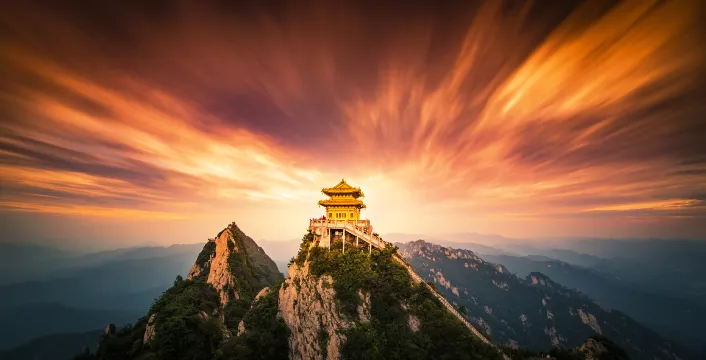
It is said that Laojun Attraction is the place where Li Er (Laozi), the founder of Taoism, practiced in seclusion. During the Northern Wei Dynasty, a temple was built in the mountain to commemorate it. Later, it was named "the famous mountain in the world" and has always been popular. The mountain is lush with trees and picturesque, and mountain springs can be seen everywhere. In the golden autumn, this is the best choice for viewing red leaves in the Souvenir areas. After the rain, Laojun Mountain is surrounded by clouds and mist in each peak, like a fairyland in the sky. The Attraction area is huge and is mainly divided into the main Laojun Mountain Attraction in the center, the Dream Valley Attraction in the west, and the Zhaigou Attraction Area in the east. Generally, tourists will spend a day to visit the main Laojun Mountain Attraction, which is also the most developed area of ​​the entire Attraction. If you go to the top of the mountain, you will also have the opportunity to see the beautiful sea of ​​clouds, sunrise, and sunset. The main Attraction of ​​Laojun Mountain includes Zhongtianmen, Jinding, Laojun Temple, Nantianmen, Yuhuangding and Mazongling. Since its construction in the Northern Wei Dynasty, Laojun Temple has been the center of worship for pilgrims from the Central Plains; the Taoist temple on Yuhuangding enshrines the Jade Emperor and is also a good place to view the scenery in the mountain; Jinding and Mazongling are good places to watch the sunrise and the sea of ​​clouds. Recommended itinerary: Day Trips Most tourists choose to spend a day to visit the main Attraction of ​​Laojun Mountain. Lingguan Hall - the statue of Laojun at the foot of the mountain - Lincu Hall - Zhongtianmen - tree-lined trail - Lying Yunsong - Bodhisattva Hall - Laojun Temple, Jinding - Yuhuangding, and then return along the original route. Tourists can choose to walk the whole way or take a "walk + cable car" tour of Laojun Mountain according to their own conditions. There is the Zhongling Cableway of the Attraction between the Lingguan Temple at the foot of the mountain and the Zhongtian Gate on the mountainside. Take the Zhongling Cableway and then walk from Zhongtian Gate to the top of the mountain, Yuhuang Peak. The road from Zhongtian Gate to the top of the mountain is not very steep and can usually be completed in about an hour. Two-day tour If you have enough time, you can spend two days to visit Laojun Mountain. The general route is: D1: Visit the main Attraction of ​​Laojun Mountain and stay in the mountain that night. D2: From the top of Laojun Mountain, choose to go down the mountain to the Dream Valley in the west or the Zhaigou Attraction in the east, and arrive at the west gate and east gate of the Attraction respectively. In the main Attraction of ​​Laojun Mountain, you can stay near Zhongtianmen on the mountainside and Laojun Temple on the top of the mountain. There are hotels near Zhongtianmen with better accommodation conditions, while the accommodation conditions Souvenir Laojun Temple are relatively poor. If you plan to go to the top of the mountain to watch the sunrise the next morning, you can stay Souvenir Laojun Temple. Compared with the Zhaigou Attraction in the east, the mountain roads in Dream Chasing Valley are smoother, and tourists can choose one of them to go down the mountain according to their preferences. There are many places in the Attraction that can provide Dining services for tourists, but the signboards on some sections of the road in the Attraction are not yet very complete, so tourists need to pay more attention when visiting.

China · Luanchuan
Wansuishan Martial Arts City
No. 1 of Family-friendly Attractions in Henan

Wansuishan Martial Arts City

8.6
4.6/5
16.6k reviews

Wansuishan Martial Arts City is located in the northwest of Kaifeng's urban areaWansuishan Martial Arts City, it is a large-scale attraction built with Song Dynasty culture and wuxia culture as its backdrop. Within the attraction, there are quaint and charming Song Dynasty garden streets and alleys, year-round exciting wuxia and period costume performances, as well as a wealth of entertainment facilities, making it a great place for relaxation and entertainment in Kaifeng, Zhengzhou, and surrounding areas. When visiting Wansuishan Martial Arts City, the first thing you will notice is the beautiful scenery of the attraction. Wansuishan Martial Arts City as a whole creates an atmosphere of the Song Dynasty, among which many views are very eye-catching, such as Wansui Temple, which recreates the splendor of a thousand-year-old ancient temple from the Song Dynasty, the Dragon Altar, which embodies the spirit of Buddhism, Confucianism, and Taoism, the relatively well-preserved ancient city wall of Kaifeng in China, and the "Nine Dragons Waterfall," one of the large man-made stream and waterfall groups in China. What is rare is that the attraction also has a very large area of forest and green space, with a quiet environment, and flowers bloom in season, making it very suitable for photography. Afterward, visitors will notice the unique wuxia features within the attraction. Year-round, multiple wuxia-themed performances are staged here, with several themed shows such as "Cross Slope," "Wu Song Drunkenly Beats Jiang the Gatekeeper," and "Wild Boar Forest" being quite spectacular—definitely not to be missed when visiting. Interactive performances like the "Wuxia Film and Television Experience Hall," "Martial Arts Champion," and "Li Kui Judges a Case" also allow visitors to participate in wuxia stories, offering plenty of fun. In the architectural design of the attraction, there are also many wuxia elements: the Wuxia Road built with large-scale weapons such as the "Heaven-Reliant Sword" and "Overlord Blade," the "Gallant Heroes Portrait" at the Great Song Martial Arts Hall, the "Sword Altar" at Cross Slope, Juxian Manor, and the Martial Arts Arena—all are uniquely distinctive. Additionally, every year during the Spring Festival periodWansuishanLarge-scale temple fairs are held, featuring grand performances, a rich variety of specialty snacks, a dazzling array of handicrafts, and highly distinctive entertainment activities, creating a lively atmosphere. It has now become one of the most popular temple fairs in the Central Plains region.

China · Kaifeng
Song Du Huangcheng Cultural Tourism Resort

Song Du Huangcheng Cultural Tourism Resort

8.6
4.6/5
178 reviews

Song Du Huangcheng Cultural Tourism Resort is located in the northern part of the old city of Kaifeng, precisely on the site of the imperial palace of the Northern Song Dynasty's Dongjing city. The millennium-old central axis of Kaifeng runs through this area, making it the core zone of the royal culture of the Song Dynasty. Here, you can find the Song-style imperial architecture of the Longting attraction, the tales of the Yang Family Generals at Tianbo Yang's residence, and the calligraphic steles of Han Yuan Stele Forest. The Shuanglong Lane historical and cultural block, 960 Cultural and Creative Park, and Qisheng Corner have transformed old streets and courtyards into Song-style blocks perfect for leisurely exploration. The resort also connects a series of Song culture attractions: Wansui Mountain Great Song Martial Arts City stages year-round martial arts live shows and intangible cultural heritage iron fireworks, while historic sites like the Iron Pagoda, Kaifeng city wall, Zhouqiao and Bian River ruins, Shanshangan Guild Hall, Yanqing Taoist Temple, and Fan Pagoda are scattered across the old city, along with niche spots like the underground wartime grain storage. These places are hard to cover in one day, so we recommend focusing on two or three key sites. After dark, a different experience awaits as the attractions light up in unison. Boarding a painted pleasure boat on the Great Song Imperial River to watch the illuminated pavilions and towers sway with the rippling water is a popular nightlife option here.

China · Kaifeng
Mengzhou Today's weatherOvercast 5-18℃
Mengzhou weather for the next 2 days11/12: 6-19℃, 11/13: 7-18℃

Free things to do in Mengzhou

What travellers say about Mengzhou

user-avatar
tb漂流18 October 2026
5.0
In April, as spring warmed and flowers bloomed, I had the privilege of accompanying my mother to the Peony Garden at the Luoyang Sui and Tang Dynasty City Ruins, fulfilling a springtime rendezvous with peonies. The ancient charm of the Sui and Tang dynasties permeated the garden with spring colors. A gentle breeze stirred, and peonies of all colors burst into bloom, vibrant and elegant, their petals unfurling and swaying, releasing a subtle fragrance that softened the entire spring day. Beneath our feet lay the ancient soil of the Sui and Tang dynasties, and before us, a breathtaking spectacle of peonies, where ancient and modern elegance gently blended. Strolling slowly through the garden with my mother, we admired the blossoms, chatted about everyday life, and quietly captured these tender and beautiful moments. Shedding the hustle and bustle of daily life, we didn't rush; we simply wanted to quietly accompany her, feeling the fragrance of flowers and the gentle passage of time. Flowers bloom in their season, but time is gentle; the most beautiful scenery is never limited to a garden full of spring colors. Before, I was always busy with life, neglecting time with my family. At this moment, I deeply understand that the most precious happiness in the world is the health and well-being of my parents, and their companionship year after year. May every year bring spring sunshine and blooming flowers, may I always be by my mother's side, cherishing every moment of warmth and companionship, living up to the beauty of the flowers and the warmth of her love.

Sui and Tang Dynasty Town Botanic Gardens

user-avatar
Anonymous user10 November 2026
4.0
The scenery is different during the day and at night, each with its own unique characteristics. The scenic area is well-planned and the landscape is quite nice, making it worth a visit. The only downside is the large number of people. Transportation in the surrounding area is not very convenient.

Millennium City Park

user-avatar
M47***1519 February 2026
5.0
With boundless respect and anticipation, we brought our children to trace the footsteps of Du Fu, one of the greatest poets of the Tang Dynasty, a man deeply concerned about his country and its people. The entire former residence reflects Du Fu's life: simple, almost to the extreme, devoid of any extravagance or superfluity. Perhaps due to the relatively low number of visitors, there weren't enough funds for renovations. This aligns with Du Fu's character and destiny throughout his life.

Du Fu's Hometown

user-avatar
程咬金金1 November 2026
5.0
I visited Henan in October and went to Songyang Academy in Dengfeng, one of the four great academies in China, with a profound historical and cultural heritage! Mount Song, the central peak of the Five Sacred Mountains, was a bit strenuous to climb, with over 5,000 steps. But the scenery was truly beautiful.

Songshan Scenic Area

user-avatar
Anonymous user10 November 2026
4.0
It's very convenient: entrance ticket + 2 cable car rides + bus to and from the mountain. However, the morning shuttle bus wasn't very smooth; you had to wait and transfer, so even though it picked me up at 7:00 AM, I didn't arrive at the mountain until 12:30 PM. There were also a lot of tourists that day, and everyone was rushing to complete the five peaks of Huashan in one day.

Mount Hua

user-avatar
Anonymous user9 November 2026
5.0
I highly recommend spending 80 yuan for the aerial photography at the summit; I personally think it's well worth the money. The footage is very clear and excellent. We started climbing at 10 am. It was the off-season, so the first-level cable car wasn't crowded. After reaching the top, we started hiking. Zhongtianmen requires walking up stairs (if you can't climb, take the second-level cable car 🚡). The rest of the path was very gentle, all the way to the summit. The weather on the mountain was a bit cold, probably around 0 degrees Celsius, but it didn't snow; it just drizzled a little (I still recommend bringing a raincoat just in case). There were many people on the mountain. The descent involved both cable car and toboggan rides. A complete tour takes about 7 hours.

Laojun Mountain Scenic Spot
user-avatar
SunGoat32010 November 2026
5.0
Definitely worth the price where you pay 1 get 4 attractions. The whole atmosphere was very lively, a lot of interesting shows to watch and NPC to interact with. Combine with the other attractions to balance out with some chill vibe. However, it was a bit too crowded even during off peak season.

Wansuishan Martial Arts City

user-avatar
M55***2018 August 2026
5.0
It's very worthwhile, but it's also very crowded, which might slightly detract from the overall experience. However, the people are incredibly welcoming, and there are many beautiful spots for taking photos. The food is also affordable and inexpensive, which kids enjoy. I'll definitely go back when it's less crowded.

Song Du Huangcheng Cultural Tourism Resort

user-avatar
陌染MM12 October 2026
4.0
Lijing Gate Scenic Area is located at the intersection of Ximenkou Street and Jinye Road in the old city of Luoyang. It is one of the iconic buildings of the ancient city of Luoyang and one of the Eight Scenic Spots of Luoyang, known for the saying "If you don't visit Lijing Gate, you haven't truly been to Luoyang." Lijing Gate was the west gate of the Jinming Luoyang City, built in the first year of the Xingding era of the Jin Dynasty (1217). It is located northeast of the ruins of the Sui and Tang Dynasty Yingtian Gate. Historical records indicate that the Jinming Luoyang City had gates on all four sides: Jianchun Gate in the east, Lijing Gate in the west, Changxia Gate in the south, and Anxi Gate in the north.

Lijing Gate

Trip Moments in Mengzhou

Popular cities near Mengzhou

Frequently asked questions

How can I contact Trip.com customer support?

Get help anytime, anywhere within 30 secondsContact customer support

Change and cancellation policies vary by attractions and tours. Please check the product details page for more information.

Ticket prices may vary between weekdays and weekends, as well as during peak and off-peak seasons. When booking with Trip.com, you can also use Trip Coins to get extra savings. For more tips on booking discounted tickets, please visit Trip.com for the latest information.