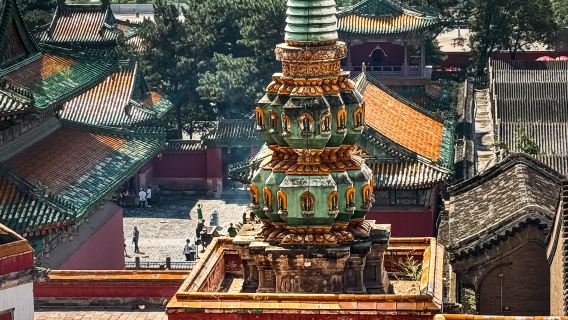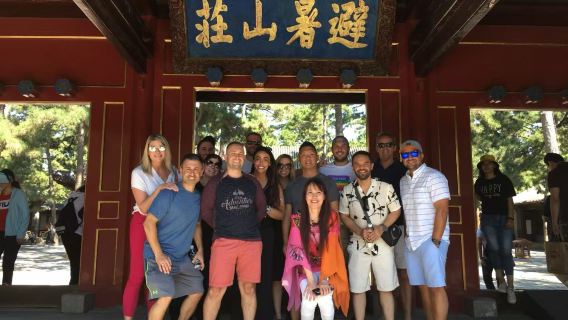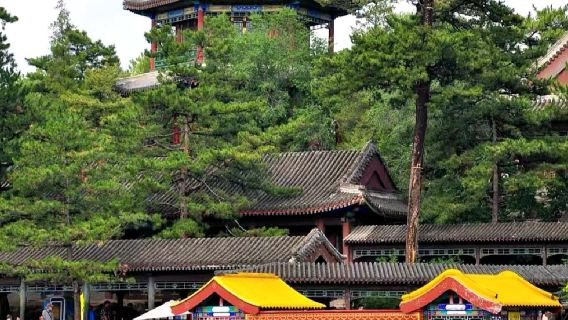

▲ Chengde's Mountain Resort Scenic Area, originally named the Rehe Imperial Palace, was constructed starting in 1703 and took 89 years to complete through the reigns of three Qing emperors: Kangxi, Yongzheng, and Qianlong. This classical imperial garden complex, integrating palace and landscape, is a national 5A-level attraction. The resort is divided into two main sections: the Palace Area and the Scenic Garden Area. The Palace Area features distinctive structures like the Golden Nanmu Hall of the Main Palace, the Four Knowledge Study, and the Misty Waves Bring Coolness Pavilion, showcasing elegant simplicity in style. It served as the Qing emperors' venue for handling state affairs, holding ceremonies, and daily living. The Scenic Garden Area consists of mountain, lake, and plain zones, blending southern delicacy with northern grandeur in its landscape. It contains over 100 architectural elements including halls, towers, pavilions, terraces, studios, temples, and more. The Qing emperors spent half of each year here receiving nobility and foreign envoys, processing official documents, and escaping summer heat, making it effectively the dynasty's second political center.

▲ Puning Temple is a significant Buddhist activity site in northern China, where monks gather and incense thrives. The temple combines Han and Xizang architectural styles, with the front section featuring traditional Han Buddhist temple characteristics, while the rear section is built in the Xizang style, modeled after the Samye Monastery in Xizang. These two distinct architectural styles blend seamlessly. Step into Puning Temple, a sacred********************site in the north with thriving incense and hundreds of resident monks. Pay homage to the gold-lacquered wooden Buddha statue—"Thousand-Armed and Thousand-Eyed Avalokiteshvara"—recorded in the Guinness World Records. Immerse yourself in the rich atmosphere of Tibetan Buddhism and appreciate the fusion of Han and Xizang Buddhist architectural styles, as well as the grandeur of this imperial temple.

▲ Putuo Zongcheng Temple is located north of The Mountain Resort Scenic Area in Chengde City, Hebei Province, on the south side of Shizigou Valley. Covering an area of 220,000 square meters, this grand-scale temple was built in 1771 (the 36th year of Emperor Qianlong's reign in the Qing Dynasty) by imperial decree to celebrate Emperor Qianlong's 60th birthday and his mother the Empress Dowager's 80th birthday. Modeled after the Potala Palace in Xizang, it is often referred to as the "Little Potala Palace." Visitors can cross the Five-Pagoda Gate and enter through the Glazed Memorial Archway to experience the imperial treatment enjoyed by Qing Dynasty emperors.

▲ The Xumi Fushou Temple was built by Emperor Qianlong within one year as a temporary palace for the Sixth Panchen Lama's visit to Chengde to celebrate the emperor's 70th birthday. It served as the Panchen Lama's residence and teaching venue, hence also called the Panchen Lama's Palace. The main hall's roof features eight exquisitely crafted gilded copper dragons, each weighing approximately one ton, appearing vividly lifelike.