Chenxi

Things to do in Chenxi

Search attractions or local attractions & tours
Search

Explore top experiences

Top 10 attractions in Chenxi

View all Attractions
Tianmen Mountain National Forest Park
2026 Global 100 - Best Things to Do

Tianmen Mountain National Forest Park

9.3
4.6/5
55.2k reviews

Tianmen Mountain National Forest Park is named after the natural wonder "Tianmen Mountain National Forest Park - Tianmen Cave." When visiting the attraction, you can enjoy a bird's-eye view of the winding Heaven-Linking Avenue and the stunning mountain scenery from the cable car. The brave can also walk along the cliff-hugging glass skywalk for an exhilarating aerial experience. Tianmen Mountain National Forest Park is located close to Zhangjiajie city. The Tianmen Cave in the park is a natural karst cave, and locals believe it leads directly to heaven. For ordinary travelers, Tianmen Cave is not open year-round. During winter each year, due to snow and icy roads, both Tianmen Cave and the Avenue toward Heaven (a winding mountain road with 99 turns) leading to it are closed. The lower station of the attraction's cableway is located in Guanliping, Yongding District, and the upper station isTianmen MountainTop. In 2020, the attraction opened the express cableway. The lower station of the express cableway is near the entrance to Tianmen Mountain, and the upper station is atTianmen CaveNear the parking lot. Tianmen Mountain National Forest Park is filled with ancient towering trees and intertwined vines. The attraction is divided into several main areas, including Tianmen Mountain National Forest Park - Tianmen Cave, central route, eastern route and western route. Travelers can choose different routes and areas to explore based on their preferences and physical condition. The core attraction along the central route is Tianmen Mountain Temple. Nearby lies the "Child-seeking cave," where folk legends claim Guanyin, the child-giving bodhisattva, manifested her divine power—devout prayers here are believed to grant offspring. The western route's highlight is a 60 m-long glass walkway clinging to sheer cliffs, with fully transparent flooring that induces both vertigo and exhilaration as visitors tread above abysses. Currently, the eastern route and Panlong Cliff each feature their own approx. 60 m glass walkways. No stay is allowed in the attraction, so it can only be visited within one day. There is a "Cherry Bay Restaurant" near Tianmen Mountain Temple, which offers snacks and fast food. Near the lower station of Tianmen Mountain cableway, there is transportation to the "Grand Canyon Theater", where you can watch the live show and magical musical "Tianmen Fox Fairy". Adapted from the mythological tale "Liu Hai cuts firewood", it tells a touching love story between a human and a fox. With live music, lighting effects, and captivating scenes like a giant moon, fox spirit transformations, snowflakes filling the sky, and high-altitude flying bridges, this legendary romance is vividly brought to life.

China · Zhangjiajie
Zhangjiajie National Forest Park
2026 Global 100 - Best Things to Do

Zhangjiajie National Forest Park

9.1
4.6/5
40.2k reviews

Zhangjiajie National Forest Park is where Zhangjiajie tourism starts. "The world knows Zhangjiajie, but who knows Wulingyuan?" Many travelers cannot distinguish the relationship between Zhangjiajie and Wulingyuan. Generally, Zhangjiajie has two concepts: Zhangjiajie City and Zhangjiajie Scenic Area. Zhangjiajie Scenic Area refers to Zhangjiajie National Forest Park, which together with Tianzi Mountain, Suoxiyu, and Yangjiajie forms the Wulingyuan attraction. Because Zhangjiajie National Forest Park was developed early and is well-known, even Zhangjiajie City was renamed after it, and people are accustomed to using Zhangjiajie National Forest Park or Zhangjiajie Scenic Area to refer to the Wulingyuan attraction. "Three thousand exotic peaks and eight hundred beautiful waters." The three thousand exotic peaks, in particular, are renowned worldwide. The mountains of Wulingyuan are entirely different from famous mountains around the world. Within its 398-square-kilometer area, more than 3,000 dense and intact sandstone peak pillars are scattered throughout, including 243 peak pillars over 1,000 meters tall. When the sea of clouds surges, these peak pillars appear to have no base, rising abruptly from the ground and piercing straight into the sky. Together with the redwood forests of North America and the glacial landscapes of Greenland, they constitute one of the world's four major natural geological wonders. Wulingyuan has a low elevation and is located in the subtropical zone. The area features lush forests and abundant water sources, and is home to a large number of endangered animal and plant species. Every peak pillar is full of vitality. Peak pillars, natural bridges, gorges, waterfalls, streams, pools, caves, and dense broad-leaved forests are often shrouded in mist and clouds on site, enhancing the beauty of the view. Together with the unique landforms, they form a distinctive view characterized by "steep mountains, elegant waters, wondrous peaks, secluded gorges, and beautiful caves," and are hailed as "an enlarged bonsai and a miniature fairyland." On December 14, 1992, the UNESCO World Heritage Committee unanimously approved the inclusion of Wulingyuan in the World Heritage List, filling the gap of China having no World Natural Heritage sites. The recognized outstanding universal value is: the quartz sandstone peak forest landform is rare in the world and has extremely high aesthetic value. UNESCO points out: "In terms of scenery, Wulingyuan can be compared with several national parks and monuments in the United States, such as the Grand Canyon, and can also be compared with the prominent sandstone peak areas of the Kimberley in Western Australia. However, because Wulingyuan has a lower elevation and is located in the subtropics, it has lush forests and abundant water sources. It also possesses a large number of peaks, displaying a more vertical profile than the heritage sites of the United States and Australia." At the end of 2009, the mesmerizing planet Pandora in the globally popular movie "Avatar" attracted countless viewers, and the prototype of its floating mountains originated from Wulingyuan. Meanwhile, Wulingyuan is also a live-action filming location for the Chinese classics "Dream of the Red Chamber" and "Journey to the West," as well as for films and TV dramas such as "Zhong Kui: Snow Girl and the Dark Crystal" and "Monster Hunt." In 2010, the unique landform of Wulingyuan was named "Zhangjiajie landform," becoming a globally recognized term and a rare landform type in the world named after a region. Attraction highlights Yuanjiajie: Landing on Pandora, the planet of Avatar Yuanjiajie is the filming location for the "Hallelujah Mountain" in the movie "Avatar," where you can explore the magical world of floating and scattered mountains from the film. If you happen to encounter a light rain in the mountains, or wait until the sky clears after the rain, you can enjoy the beautiful scenery of misty fog and layered peaks even more. The Mihun Platform is an ideal viewing spot; standing on it, you are surrounded by hundreds of towering stone peaks with magnificent momentum. Tianzi Mountain: once you've seen Tianzi, no other mountain will do When visiting Tianzi Mountain, you will see various uniquely shaped geological views and oddly formed peaks, such as Yubi Peak, Fairy Presenting Flowers, Dianjiang Terrace, Hanging Garden, and Immortal Bridge. There is no need to worry too much about whether these natural formations resemble what they are named after, because "the primitive scenery and natural beauty" are what make Tianzi Mountain so captivating. Especially in the hazy fog after a fresh rain, it feels as if you are in a fairyland. By winter, when the mountain is covered in silvery white, the scenery becomes even more enchanting. Huangshizhai: see all the other mountains as small from the summit "If you don't climb Huangshizhai, your trip to Zhangjiajie is in vain." Huangshizhai is a viewing platform in Zhangjiajie National Forest Park, surrounded by sheer cliffs and lush trees, and the top of the village is often shrouded in mist and clouds. Standing atop Huangshizhai and looking around, you can experience the lofty sentiment of "seeing all the other mountains as small." Yangjiajie: Thrills found in danger Yangjiajie is primarily known for its pristine natural beauty. With high mountains and narrow paths, it is famous for being "perilous" and is deeply favored by backpackers and adventurers. Wulong Village within the attraction is a very magical place in Zhangjiajie. It was once inhabited by bandits from western Hunan, and was later renamed after the TV series "Tales of Suppressing Bandits in Wulong Mountain." The village is built along the mountain, and there is a path up and down the mountain that requires using both hands and feet to climb to the summit. Suoxiyu: A natural ink wash landscape painting Suoxiyu is also called Suoxi, named because the stream within the attraction is shaped like a rope. Unlike other parts of the forest park, which are so steep and rugged, this place is shrouded in mist and clouds year-round, with clear streams flowing continuously through all four seasons and graceful peaks visible everywhere. Ten-Mile Gallery is the highlight attraction of Suoxiyu; within the 5 km-long gorge, wildflowers fragrance the air and fantastic peaks and unusual rocks abound. Walking through it is like stepping into a natural landscape painting. Golden Whip Stream: filming location of Journey to the West Jinbian Stream Gorge is the earliest developed area in the attraction. A clear stream runs through the valley, with towering peaks on both sides and lush greenery as far as the eye can see. This is also one of the filming locations for the classic version of Journey to the West, where fans can come and see iconic scenes such as the Water Curtain Cave and Cleaving the Mountain to Save the Mother.

China · Zhangjiajie
Orange Isle Scenic Area
No. 3 of Best Things to Do in Hunan Jiangxi Fujian Region

Orange Isle Scenic Area

9
4.6/5
13.7k reviews

Orange Isle Scenic Area is a narrow sandbar lying across the heart of the Xiang River in Changsha, stretching approx. five km. It faces Yuelu Mountain to the west and borders Changsha's old city to the east, surrounded by water on all sides. Named after the abundant orange trees planted on the isle, it was historically called Shuiluzhou. Formed by river alluvium, this sandbar has existed for over a millennium, where the "River and sky in evening snow" scenery was once among the Eight Views of Xiaoxiang. In 1925, the poem "Spring in a pleasure garden - Changsha" was composed here, with its iconic line "Alone I stand in the biting fall, watching the Xiang River flow north past Orange Isle's head," which made this riverine landmark widely renowned. The highlights of the visit are concentrated at the islet's head: A granite art sculpture over 30 m tall, modeled after the 1925 youth image, stands facing the river as Changsha's highly recognizable landmark. Nearby, the Questioning Heaven Platform extends toward the river center, where leaning on the railing reveals the mighty Xiang River flowing northward, with Yuelu Mountain and the city skylines on both banks facing each other across the water. The Songju Pavilion, white marble poetry stele, and the 200-year-old ancient phoenix tree at the islet head are all in this area. Heading north from the islet head, a hundred-acre orange orchard bears golden fruits in fall, while bamboo groves, peach orchards, plum gardens, and osmanthus groves take turns showcasing seasonal flora. The historic Zhuzhang Ferry (where Zhu Xi and Zhang Shi once crossed the Xiang River for lectures) and the Huxiang Culture Exhibition Hall are scattered along the way. At the islet's tail, the reconstructed Jiangshen Temple and Gongji Tower area was precisely where ancients admired the "River and sky in evening snow" scenery. The island is long and narrow, making round-trip walks quite tiring. A sightseeing train is available for transportation, with multiple stops along the way for hopping on and off. Travelers with limited time are advised to head straight to the island's tip to see the sculpture and river views, then stroll leisurely along the riverside path. At dusk, watching the sunset over the Xiang River and seeing the lights gradually illuminate both shores from the island's tip is especially worth setting aside time for.

China · Changsha
Fanjing Mountain
2026 Asia 100 - Best Things to Do

Fanjing Mountain

9
4.6/5
23k reviews

Fanjing Mountain is located in Tongren City in the northeastern part of Guizhou Province. It is the main peak of the Wuling Mountains, spanning the junction of three counties: Jiangkou, Yinjiang, and Songtao. Its highest peak, Fenghuang Mountain, rises over 2,500 meters above sea level; the Old Golden Summit is over 2,400 meters, and the New Golden Summit, also known as the Red Cloud Golden Summit, is over 2,300 meters. The three peaks stand side by side in majestic grandeur. Fanjing Mountain was originally named "Three Valleys Mountain," derived from "Fanjing Pure Land." Buddhism was introduced to this area during the Song Dynasty and flourished in the Ming Dynasty, when temples and monasteries dotted the mountain. Because its towering height rivaled the Five Great Mountains, the ancients honored it as "the patriarch of famous mountains." The Red Cloud Golden Summit is the iconic view of the entire mountain—a solitary peak rising straight from the ground and piercing the sky. The Golden Knife Gorge splits the summit from top to bottom into two halves, with only a narrow canyon where one can climb up along iron chains, and the gorge tops are connected by a flying bridge, making it extremely precipitous. At the summit, the Shakyamuni Hall and the Maitreya Hall face each other, serving as the core symbol of the Maitreya sacred site. The three main peaks connect to form a reclining Maitreya statue stretching over 10,000 m, which locals call "Fanjing Mountain." The Mushroom Stone is another representative view—a sandy slate pillar that is large at the top and small at the bottom, shaped like a mushroom, approx. 10 m tall, appearing on the verge of toppling yet having stood for many years. The surrounding stone forest peak clusters, such as the Ten Thousand Scrolls of Scriptures and Eagle Rock, are geological relics formed over a billion years ago and sculpted by wind and rain erosion. The mountain also preserves a well-intact subtropical primary ecosystem, where the Guizhou golden snout monkey is distributed, and ancient rare plants such as the dove tree also thrive and reproduce here. In fall, the layered forests are dyed in brilliant colors, and the red leaves in the mountains set off the ancient temple; you can take a cable car to overlook the autumn colors across the mountain, or follow the mountain trails to experience them up close.

China · Jiangkou
Hunan Museum
2026 Asia 100 - Best Things to Do

Hunan Museum

8.8
4.8/5
16.3k reviews

Hunan Museum is a relatively large history and culture museum in Hunan Province, and among its collections, the artifacts unearthed from the Mawangdui Han Tombs are particularly representative. "The Changsha Mawangdui Han Tombs Exhibition" is the museum's permanent exhibition, presenting in a concentrated way the precious artifacts unearthed from three Western Han tombs. One of the most striking exhibits in the exhibition is the plain silk unlined robe with straight-cut front, as thin as cicada wings and weighing less than 50 grams, whose weaving technique is astonishing. In addition, visitors can see well-preserved printed silk padded robes, fine and elegant embroidery, brightly glossy painted lacquerware, and an exquisite T-shaped painted silk painting. More than 100,000 characters of silk manuscripts were unearthed from Tomb No. 3, among which are many lost texts long since gone from circulation, covering fields such as philosophy, history, astronomy, and medicine. The "Topographic Map of the Southern Part of the Changsha Kingdom," also from Tomb No. 3, was drawn using techniques broadly similar to those of modern maps and holds important value in the study of ancient maps. The well-preserved body of Lady Xin Zhui unearthed from Tomb No. 1 has survived intact for more than two thousand years and is another major highlight of the exhibition. The museum also features permanent exhibitions such as "Hunan People: A Historical and Cultural Exhibition of the Three Xiang Regions," displaying collections including Shang and Zhou bronzes, ceramics from famous Hunan kilns, and Ming and Qing calligraphy and paintings, presenting the historical and cultural threads of Hunan from different dimensions. The Mawangdui Han Tomb Exhibition and the Three Xiang Historical and Cultural Exhibition together form the museum's two core exhibitions, and are well worth setting aside ample time to view in detail.

China · Changsha
Xijiang Qianhu Miao Village
2026 Global 100 - Night Attractions

Xijiang Qianhu Miao Village

8.6
4.3/5
26.6k reviews

Xijiang Qianhu Miao Village is a collection of over ten natural villages built along the mountainside, inhabited by the "Xi" clan of the Miao people. The village features layers of wooden stilt houses on the slopes, with coffee-colored old houses nestled against lush green mountains. The Baishui River divides the village in two. The side of the river (to the left after entering the Xiaobei Gate for travelers) is mainly a commercial pedestrian street, while the opposite side (to the right after entering the Xiaobei Gate for travelers) is primarily the viewing platform overlooking the village. Upon arriving at Xijiang Qianhu Miao Village, you'll see a gate with the plaque "Xijiang Qianhu Miao Village" after getting off at the parking lot. From this gate to the village is a 1.5 km walk, which you can cover either by electric bikes or on foot. After this 1.5 km stretch, you'll encounter another gate similar to the one at the parking lot, also bearing the "Xijiang Qianhu Miao Village" plaque—this marks the true entrance to the village. First drink the welcoming wine, then enter the village. The first thing you see is the commercial pedestrian street, selling a dazzling array of Miao ethnic specialty products. The most eye-catching are the Miao silver ornaments. Kongbai in Xijiang town of Leishan near the Miao village is a well-known silversmith village, where almost all the men master the silver ornament making techniques, and the craftsmanship of Miao silver is exquisite. The performance venue in the pedestrian street area offers Miao ethnic song and dance shows. You can also visit the Xijiang Miao Ethnic Museum and the Drum Head's House (the Miao king's residence, where a bronze drum is enshrined). Alternatively, take a stroll along the Baishui River to see the wind-and-rain bridges with roofed eaves sheltering from the elements, or the low, narrow wooden plank bridges. At the end of the village lies a pastoral landscape, where even during peak season few visitors come. Across the river is a station for electric bikes to the viewing platform, but walking there isn't far, and several spots along the way offer excellent views. Upon reaching the viewing platform, wait for nightfall—the grand spectacle of Xijiang is just beginning. Thousands of lights illuminate from beneath the eaves of wooden stilt houses, dotted like stars to outline the entire Miao village in the shape of an ox head. It's hard to imagine such a brilliantly lit scene in a mountain village. Returning to the viewing platform at dawn, the Miao village is shrouded in mist as the first sunlight gilds the wooden houses golden. Smoke curls up from chimneys, marking the start of a new day. In Miao villages, you can often see Miao women with their hair buns coiled on top of their heads and adorned with large flowers. Just looking isn't enough—you can also rent a few sets of Miao costumes to dress up as a Miao woman yourself. It's especially beautiful and very popular among young women. Xijiang Qianhu Miao Village has mature tourism development, with no worries about food and accommodation. For dining, the famous option is the long-table banquet. Restaurants in the village will often ask if you'd like to try it—simply joining tables to make them longer counts as a long-table banquet, serving as a fun experience. The authentic long-table banquet is held outdoors, with dozens of tables connected end-to-end, sometimes so long that you can't see from one end to the other. These are set up during important festivals or when significant group tours visit, so don't miss the chance if you encounter one. The cuisine of southeastern Guizhou tends to be sour, and the village's specialty dishes include sour fish soup, pickled vegetables, and cured meat.

China · Leishan
Wulong Karst Tourism Area

Wulong Karst Tourism Area

8.3
4.6/5
5.3k reviews

Wulong Karst Tourism Area is located in Wulong District, Chongqing, downstream of the Wu River, a tributary of the Yangtze River. It features a typical karst landscape, with magnificent natural bridges, vast sinkholes, and steep, deep gorges. You can descend into a 100 m deep sinkhole and look up at the towering cliffs surrounding you like clouds. Alternatively, you can explore the valley floor within the gorges, following the underground river along the rock walls, and experience the wonders of nature. Tiankeng attractionIt features natural bridge clusters and sinkhole clusters. The area gained widespread recognition after serving as a filming location for the movie Curse of the Golden Flower. It was also used as a filming location for Transformers: Age of Extinction. Longshuixia ground fissure offers a distinct experience: first take the sightseeing elevator down to the mountainside, then hike deep into the valley bottom, following the underground river along cliffside walkways with waterfalls and streams accompanying the journey, their sounds echoing between steep walls. Xiannü mountain presents a rare alpine grassland in southern China, averaging nearly 2 km in elevation where forests meet meadows, with summer temperatures around 20°C and winter ski opportunities; Furong cave is renowned for its cave deposition views, featuring stalactite marvels like Coral jade pool and Giant curtain waterfall, each displaying unique formations.

China · Chongqing
Three Natural Bridges
No. 2 of Global Traveller-Picked Attractions in Chongqing

Three Natural Bridges

8.3
4.6/5
17.4k reviews

Three Natural Bridges is located in Xiannüshan Town, Wulong, Chongqing, and is a typical karst landscape attraction. The three natural stone arch bridges—Tianlong Bridge, Qinglong Bridge, and Heilong Bridge—are arranged longitudinally and span the Yangshui River gorge in parallel, with each bridge standing more than 200 m tall, connecting the mountain masses on both banks into one whole and forming the unique view known as "three bridges flanking two pits." The huge depressions enclosed between the bridges are what people commonly call "heavenly pits." It is quite rare to find three giant natural bridges appearing in succession within such a short stretch of gorge—such a bridge cluster view is truly uncommon. The three bridges each have a distinct form: Tianlong Bridge is tall and massive, with a through-cave developed beneath it; after rain, waterfalls often cascade down from the deck of Qinglong Bridge, and the mist catches the sunlight to form a rainbow—hence the bridge's name; Heilong Bridge takes its name from its deep, dark arch cave, with several mountain springs hanging along its walls. At the bottom of the pits, streams murmur and trees are lush and green; looking up, you see nearly vertical cliff faces, with mountain springs plunging down from the cliff tops—walking through feels like passing through a gorge at the center of the earth. Tours usually begin by taking the sightseeing elevator down to the bottom of the sinkhole, then following the valley-floor trail through three bridge arches in succession, looking up at the bridge arches and cliff faces. Tianfu Post Station at the bottom of Tianlong Bridge sinkhole is a faux-antique quadrangle courtyard with gray-tiled roofs, gray walls, and upturned eaves. A post station once stood here during the Tang Dynasty, and the courtyard has been restored to its original appearance. Director Zhang Yimou's film "Curse of the Golden Flower" was shot on location here, and it is also a filming location for "Transformers: Age of Extinction" and the film adaptation of "Ten Miles of Peach Blossoms." After the tour, visitors can walk up the trail to exit the attraction and transfer to a shuttle bus back to Xiannüshan Town Visitor Center, or make a side trip to the adjacent Longshuixia Ground Fissure to see both karst landscapes—the "sinkhole" and the "ground fissure"—in one visit.

China · Chongqing

Experiences you can't miss in Chenxi

Featured Culture & history in Chenxi

View all Culture & history
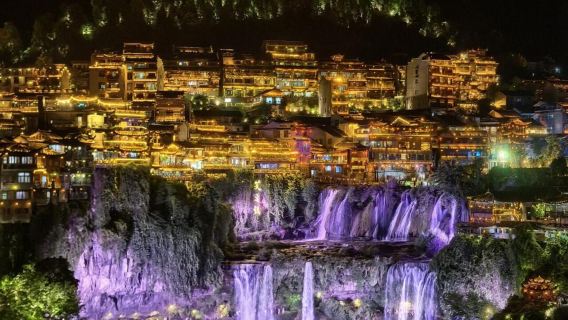
Furong Town night view half-day tour | 12-person small group + zero-distance waterfall trekking experience
Trip.Select
󱌍
4.9/5
· 34 reviews· 133 booked
Duration: 3.5 hrs
English
Free cancellation
Instant confirmation
Book now for tomorrow
25 consecutive positive reviews
From€ 62.21
[Depart From Zhangjiajie] Fenghuang Ancient Town + Furong Old Town Day Tour
󱌍
34 booked
Duration: 11.1 hrs
English
Free cancellation
Instant confirmation
Book now for tomorrow
From€ 65.58
Private Transfer from Zhangjiajie to Furong Town  and stops at Fenghuang old town
󱌍
5.0/5
· 1 review
Duration: 11.1 hrs
English
Free cancellation
Instant confirmation
From€ 62.55
[DIY Private Tour] Furong Town + Fenghuang Ancient Town Zhangjiajie Round-Trip All-Inclusive Pure Play
󱌍
5.0/5
· 12 reviews· 34 booked
Duration: 9.3 hrs
English
Free cancellation
Instant confirmation
Book now for tomorrow
5% off
Limited-time sale
From€ 140.40€ 147.79
Furong Town self-guided tour from Zhangjiajie + multiple transfer options (optional round-trip to Zhangjiajie)
󱌍
Duration: 4 hrs
English
Free cancellation
Instant confirmation
Book now for tomorrow
From€ 40.75
[Zhangjiajie Departure] Furong Town & Fenghuang Ancient Town Day Tour: Private Car+Ticket
󱌍
Duration: 4 hrs
English
Free cancellation
Instant confirmation
Book now for tomorrow
From€ 130.10
Chenxi Today's weatherClear 12-19℃
Chenxi weather for the next 2 days11/15: 13-19℃, 11/16: 12-17℃

Free things to do in Chenxi

What travellers say about Chenxi

user-avatar
gz伊妹儿15 August 2020
5.0
The scenery of Pu City Ancient Town is nice and it is a very good choice. The architectural style is unique and charming. It is a good place to take pictures. It is interesting and refreshing to learn about the local folk customs and local conditions.

Pushi Town

user-avatar
没有糖的喵丶13 November 2026
5.0
As night falls, Fenghuang Ancient Town dons its finest attire. Lights illuminate both banks of the Tuojiang River, stilted houses stand overlooking the water, their warm glow reflected on the surface, swaying gently with the ripples. The Rainbow Bridge spans the river, bustling with tourists, while Miao silver shops and snack stalls sway gently in the breeze. Strolling along the Tuojiang River in the evening breeze, listening to the murmuring water and the occasional song from a boat, the lights, ancient buildings, and green mountains blend seamlessly, creating a captivating atmosphere. There's no need to rush to see the sights; simply gaze at the river lights and experience the unique romance of this border town. The night view is stunning, but be prepared for crowds. Find a quiet corner to enjoy the gentle beauty of the night all to yourself.

Fenghuang Ancient Town

user-avatar
牛畅畅13 November 2026
5.0
Zhangjiajie is simply a treasure trove of tourist destinations; I regret not coming sooner. Tianmen Mountain is very well-planned, and perhaps because I visited during the off-season, everything seemed very convenient, haha.

Tianmen Mountain National Forest Park

user-avatar
_TI***x313 November 2026
5.0
beautiful park with the most insane views. obviously can be very crowded at the best peaks so be prepared. tons of food/merch on every corner but don’t feed the monkeys! and don’t carry any food or a plastic bag near them because they will rip it out of your hands. best advice is to go to the quiet west gate and do the park backwards for no queues and a calmer experience. golden whip trail is also stunning and very calm - but again don’t bring food around the monkeys!

Zhangjiajie National Forest Park

user-avatar
YazonDinAlt23 October 2026
4.0
Orange Island is a bit of a mixed experience, and I'm honestly not entirely sure whether I'd consider it a must-visit in Changsha.It's a large, green, and pleasant park, with beautiful riverside views and plenty of space for walking. If you enjoy places with historical significance or simply want to experience a different side of the city, it's definitely worth considering.Most visitors seem to take the sightseeing train to the southern end of the island, where the famous Mao Zedong statue is located. That's also where you'll find plenty of people taking photos, so don't expect a particularly quiet experience.The main downside is that visiting the island takes quite a bit of time, especially if you want to explore it properly. And while it's certainly a nice place, I'm not sure the experience justifies spending several hours here if you have a limited amount of time in Changsha and other places you'd like to see.On the other hand, if you're simply looking for a relaxing walk through a green park, with opportunities to stop by the river and enjoy the scenery, it's a lovely option.Overall, I'd say it's worth visiting if you have some extra time or are particularly interested in Chinese history. Otherwise, I wouldn't necessarily put it at the very top of your Changsha itinerary.

Orange Isle Scenic Area

user-avatar
ajohn111211 November 2026
4.0
The unique geological structure creates the special landscape of Fanjingshan. The three major scenic spots, Old Golden Summit, Red Cloud Golden Summit, and Mushroom Rock, each have their own unique style and charm. The scenic area management, including the entrance, cable car, and shuttle bus, is very mature, and the staff at each point are also very enthusiastic.

Fanjing Mountain

user-avatar
M2x***o213 November 2026
5.0
Our guide, Ms. Xiao Xiao, gave a truly unique experience at the Mawangdui Museum in Changsha, my first visit to the city. She explained everything in great detail, even using a tablet with pictures to help us see and understand things we couldn't clearly see or see otherwise. It was a wonderfully surprising experience, and I highly recommend it to everyone visiting museums!

Hunan Museum

user-avatar
_TI***4711 November 2026
5.0
We really enjoyed visiting Xijiang Miao Village! During the day, the village is relatively quiet and peaceful, but as evening approaches, it truly comes to life and takes on a special charm, with its beautiful atmosphere and illuminated traditional houses.While the main streets are lovely to explore, we highly recommend wandering off the beaten path and walking further up into the village. This is where you get a better glimpse of the traditional houses and everyday local life, beyond the more touristy areas.We were also lucky enough to catch a traditional performance in the village square, which was a lovely and interesting experience.Overall, a wonderful place to visit, especially if you take the time to explore beyond the main streets and discover the quieter, more authentic corners of the village. We would definitely recommend it!

Xijiang Qianhu Miao Village

user-avatar
_TI***mm12 November 2026
5.0
Very unique experience at wulong krast, great scenery, great weather, excellent and worth the journey out of chongqing by hsr!!

Wulong Karst Tourism Area

user-avatar
fionatky14 November 2026
4.0
A wonderful destination with a great atmosphere—thoroughly enjoyed my visit and would definitely come back!

Three Natural Bridges

Trip Moments in Chenxi

Popular cities near Chenxi

Frequently asked questions

How can I contact Trip.com customer support?

Get help anytime, anywhere within 30 secondsContact customer support

Change and cancellation policies vary by attractions and tours. Please check the product details page for more information.

Ticket prices may vary between weekdays and weekends, as well as during peak and off-peak seasons. When booking with Trip.com, you can also use Trip Coins to get extra savings. For more tips on booking discounted tickets, please visit Trip.com for the latest information.